YOUR AP STUDY COMPANION
AP Biology Online Center
Prepare for AP Biology with independent practice, flashcards, and quick review. Study biological concepts and data reasoning, learn the official exam format, and compare a general biology guide with your course needs.
AP Biology Practice Tests
Work through the existing practice form and review the explanations. Its scope and timing are described in the study view.
AP Biology Flashcards
Search, shuffle, and flip the existing deck to practice active recall.
AP Biology Study Guides
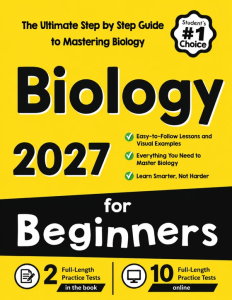
Biology for Beginners
General biology review. Compare its contents with your AP Biology course and exam requirements before choosing.
View book & purchase options →AP Biology Quick Review
Open the existing quick review and work on one concept at a time.
MEET THE ASSESSMENT · CHOOSE YOUR NEXT SKILL
Know AP Biology before you start.
College Board lists a three-hour hybrid digital exam: 60 multiple-choice questions in 90 minutes and six free-response questions in 90 minutes. Both sections count equally. The independent practice form here focuses on multiple-choice study; it does not replace free-response preparation or reproduce an official AP score.
Official assessment information ↗Multiple-choice practice
Use the independent practice form to explain concepts, analyze diagrams, and check your reasoning.
Explore this study route →Free-response preparation
Practice explaining evidence and experiments as well as selecting an answer. Use the official free-response resources.
Explore this study route →Biology concept review
Choose one concept from the existing study blueprint, then return to its review or flashcards.
Explore this study route →Build a study routine
Review an explanation, recall it without notes, and try another practice question.
Explore this study route →Practice Test 1
Complete the timed practice form, then review every answer explanation.
- 60 independent practice questions
- 90-minute countdown after Begin Test
- Explanations shown after submission
Quick Review
Review one concept before practice, then revisit ideas behind your missed answers.
- 48 concept review boxes
- One popup study view
- Return to the Online Center after review
Flashcards
Use active recall to review the terms and ideas in this subject.
- 319 concept flashcards
- Search, filter, shuffle, and flip
- Mark known cards as you study
Study Topics
Find your current unit and choose a linked lesson before your next study block.
- 8 course units
- 74 topics linked below
- Open a lesson for guided practice
Practice Resources at a Glance
This study Online Center centers the timed practice form, then gives you the quick-review boxes and flashcards you need to repair missed concepts.
AP Biology Lessons
Choose a topic from your current unit. Each linked lesson includes explanations, a teaching video, and practice with answers. Some closely related topics share a lesson.
Unit 1: Chemistry of Life
- 1.1Water, Hydrogen Bonding, and the Properties Life Runs On
- 1.2Carbon Skeletons, Functional Groups, and the pH Scale
- 1.3From Monomers to Polymers: How the Four Families Are Built
- 1.4Carbohydrates: One Monomer, Many Jobs
- 1.5Lipids: The Family Defined by What Water Rejects
- 1.6Proteins: Sequence, Folding, and Structure-to-Function Argument
- 1.7Nucleic Acids, Directionality, and the Link to Unit 6
Unit 2: Cell Structure and Function
- 2.1Cell Theory, Two Kinds of Cells, and the Organelle Inventory
- 2.2Compartmentalization and the Endosymbiotic Origin of Organelles
- 2.3Surface Area, Volume, and the Limits on Cell Size
- 2.4The Fluid Mosaic Membrane
- 2.5Membrane Permeability: What Gets Through and What Does Not
- 2.6Transport Across Membranes: Gradients, Diffusion, and Osmosis
- 2.7Facilitated Diffusion: Channels, Carriers, and Saturation
- 2.8Active Transport, Pumps, and Bulk Transport
- 2.9Tonicity, Cell Volume, and Osmoregulation
- 2.10Water Potential: Predicting Water Movement with Numbers
Unit 3: Cellular Energetics
- 3.1Free Energy, Coupling, and Why ATP Is the Cell's Currency
- 3.2Redox, Electron Carriers, and the Shape of a Metabolic Pathway
- 3.3Enzymes: Active Sites, Kinetics, and Inhibition
- 3.4Temperature, pH, and the Limits of Enzyme Function
- 3.5Cellular Respiration and the ATP Ledger
- 3.6Inside the Matrix: Pyruvate Oxidation and the Krebs Cycle
- 3.7Electron Transport, the Proton Gradient, and Chemiosmosis
- 3.8Fermentation and the NAD⁺ Problem
- 3.9Photosynthesis: Pigments, Light, and the Thylakoid Reactions
- 3.10The Calvin Cycle: Turning Gas into Sugar
- 3.11Photorespiration and the C4 and CAM Adaptations
- 3.12Putting the Two Pathways Side by Side
Unit 4: Cell Communication and Cell Cycle
- 4.1Signal Types: Contact, Local, and Long Distance
- 4.2Reception, Transduction, and Response
- 4.3Inside the Pathway: Cascades, Branching, and Shutting Off
- 4.4Feedback: Loops That Hold Steady and Loops That Finish
- 4.5The Cell Cycle and Its Checkpoints
- 4.6Cyclins, Cdks, and the Machinery Behind the Checkpoints
- 4.7Mitosis, Cytokinesis, and Reading Cell-Cycle Data
- 4.8Reading Cell-Cycle Experiments
- 4.9When Cell-Cycle Control Fails
Unit 5: Heredity
- 5.1Meiosis Stage by Stage, and the Accounting That Goes With It
- 5.2Mitosis Versus Meiosis, Separated Once and For All
- 5.3Where the Variation Comes From
- 5.4Mendel's Laws, Crosses, and the Probability Rules
- 5.5Chi-Square: Testing a Genetic Hypothesis Against Real Counts
- 5.6Inheritance Patterns Mendel Did Not See
- 5.7Chromosomal Inheritance: Linkage, Nondisjunction, and Pedigrees
- 5.8The Environment Writes on the Phenotype
Unit 6: Gene Expression and Regulation
- 6.1DNA and RNA: The Molecules That Hold the Message
- 6.2DNA Replication, Enzyme by Enzyme
- 6.3Transcription and RNA Processing
- 6.4Translation and the Genetic Code
- 6.5Mutation: What Changes, and When It Matters
- 6.6Regulation of Gene Expression: Operons and Transcription Factors
- 6.7Gene Expression and Cell Specialization
- 6.8Viruses: Information That Borrows a Cell's Machinery
- 6.9Biotechnology: PCR, Gels, Plasmids, and CRISPR
Unit 7: Natural Selection
- 7.1Variation, Differential Reproductive Success, and Fitness
- 7.2Modes of Selection and the Cost of Attracting a Mate
- 7.3Artificial Selection: The Same Mechanism With a Chooser
- 7.4Drift, Gene Flow, and Mutation: The Other Three Mechanisms
- 7.5Hardy--Weinberg Equilibrium and How to Calculate With It
- 7.6Speciation and Reproductive Isolation
- 7.7Evidence, Phylogeny, and Reading a Tree
- 7.8Phylogeny: Reading Trees and Building a Cladogram
- 7.9Evolution Is Still Running: Variation, Extinction, and Change We Can Watch
- 7.10Variation in Populations: The Reserve a Species Draws On
- 7.11Origins of Life on Earth
Unit 8: Ecology
- 8.1Levels of Organization, Body Size, and the Cost of Being Alive
- 8.2Behavior as a Product of Natural Selection
- 8.3Energy Flow and the Cycling of Matter
- 8.4Population Growth, Carrying Capacity, and Limiting Factors
- 8.5What Applies the Brake: Density-Dependent and Density-Independent Regulation
- 8.6Community Interactions, Niches, and Succession
- 8.7Biodiversity: Richness, Evenness, and the Value of Redundancy
- 8.8Disruptions in Ecosystems
Study Topics
Follow the eight-unit sequence, or use a missed question to choose the lesson you need.
Chemistry of Life
7 topics with linked lessons above.
Cell Structure and Function
10 topics with linked lessons above.
Cellular Energetics
12 topics with linked lessons above.
Cell Communication and Cell Cycle
9 topics with linked lessons above.
Heredity
8 topics with linked lessons above.
Gene Expression and Regulation
9 topics with linked lessons above.
Natural Selection
11 topics with linked lessons above.
Ecology
8 topics with linked lessons above.
AP Biology spans 38 topics across four big ideas, from water chemistry and enzymes through genetics, evolution and ecosystem disruption. This Online Center follows the College Board unit order, pairs every topic with flashcards, and ends with a 60-question practice test whose explanations walk through the reasoning rather than just naming the answer.
Study path
- Map the main domains in the Study Topics.
- Take the practice test and read every explanation.
- Use Quick Review and Flashcards to repair weak spots, then retest.
The practice tools open in a focused study window so you can keep your place on this Online Center.
60 questions · 90 minutes
No timer is running on this screen. The countdown starts only after you select Begin Test.
Answer every question, then use the explanations to choose what to review next.
A USEFUL NEXT STEP
AP Biology: study questions
What is the official AP Biology exam format?
College Board lists a three-hour hybrid digital exam: 60 multiple-choice questions in 90 minutes and six free-response questions in 90 minutes. Both sections count equally. The independent practice form here focuses on multiple-choice study; it does not replace free-response preparation or reproduce an official AP score.
Official source ↗How should I use these independent AP Biology study tools?
Start with a practice activity, review explanations for missed questions, and use quick review or flashcards for one weak topic. The practice results are study feedback, not official exam scores. Compare a book’s contents with your course or test requirements before buying.
Resources from Effortless Math · Editorial standards