Calculating Water Potential: Formula and Worked Examples
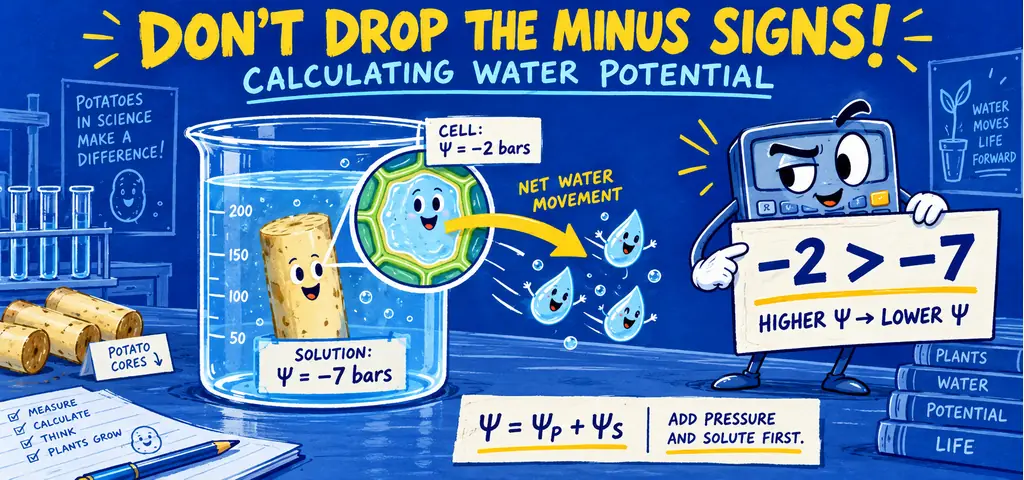
To calculate water potential, add pressure potential to solute potential: Ψ = Ψp + Ψs. For the ideal dilute-solution model, Ψs = −iCRT. Calculate the total on each side of a water-permeable membrane, keep the signs and units, then predict net passive movement from the higher total to the lower total.
A Calculation Method You Can Check
- Identify the solute and the stated dissociation assumption for i.
- Use mol/L for C and kelvin for T. These worked examples use the rounded conversion T = °C + 273; the exact offset is 273.15.
- Calculate −iCRT, then add the stated pressure potential.
- Repeat for the other side and compare signed totals in the same unit.
With R = 0.0831 L·bar/(mol·K), the result is in bars. One bar equals 0.1 MPa, so −3.68 bars equals −0.368 MPa. These cell-scale examples omit gravity and matric effects; broader plant and soil models may need them.
An overly concentrated fertilizer solution can make a plant lose water despite watering. Dissolved solutes lower the water potential outside its cells. To predict the direction of water movement, you must also account for pressure inside the cells.
Watch the process
Water Potential
Water potential combines the effects of dissolved solutes and pressure in one quantity. Comparing the values inside and outside a cell lets you predict net passive water movement, including when a cell wall exerts pressure on the contents.
Water potential, written \(\Psi\) and measured in bars, is the free energy of water per unit volume relative to pure water at atmospheric pressure. Pure free water at the same temperature and reference pressure has \(\Psi = 0\). In the AP cell-scale model, two contributions add: \[\Psi = \Psi_p + \Psi_s\] where \(\Psi_p\) is pressure potential and \(\Psi_s\) is solute potential. Net passive water movement is from higher water potential toward lower water potential. Calculate the total potential on each side before comparing them.
Adding solute always lowers water potential, so \(\Psi_s\) is always zero or negative. It is calculated as \[\Psi_s =-iCRT\] with \(i\) the ionization constant, the idealized number of dissolved particles per formula unit of solute; \(C\) the molar concentration in mol/L; \(R\) the pressure constant, \(0.0831\ \text{L}\cdot\text{bar}/(\text{mol}\cdot\text{K})\); and \(T\) the temperature in kelvin, which is degrees Celsius plus 273. Sucrose does not dissociate, so \(i = 1\). Sodium chloride dissociates into two ions, so \(i = 2\). Calcium chloride gives three, so \(i = 3\). Use these ideal values when the question assumes complete dissociation; real concentrated solutions can deviate.
Pressure potential is the physical pressure on the solution. In an open beaker it is zero. Inside a turgid walled plant cell it is positive, because the wall pushes back on the swelling protoplast, and that positive turgor pressure raises the cell’s water potential toward zero. In the xylem of a transpiring plant it is negative, because the column is under tension.
Two Worked Problems
Solute Potential of a Sucrose Solution
Calculate the solute potential of a \(0.15\ \text{M}\) sucrose solution at \(22^\circ\text{C}\). Then state the solution’s water potential in an open beaker.
Collect the four quantities. Sucrose is a nonelectrolyte, so \(i = 1\). The concentration is \(C = 0.15\ \text{M}\). The constant is \(R = 0.0831\ \text{L}\cdot\text{bar}/(\text{mol}\cdot\text{K})\). Convert the temperature: \(T = 22 + 273 = 295\ \text{K}\).
Substitute into \(\Psi_s =-iCRT\): \[\Psi_s =-(1)(0.15)(0.0831)(295).\] Work the product in stages. \((0.0831)(295) = 24.51\). Then \((0.15)(24.51) = 3.68\). Carry the negative sign through: \(\Psi_s =-3.68\ \text{bars}\).
For the water potential, the beaker is open to the atmosphere, so \(\Psi_p = 0\) and \(\Psi = 0 + (-3.68) =-3.68\ \text{bars}\). The negative sign is a first check: dissolved solute lowers solute potential in this model. Check units, temperature, sign, and magnitude separately. With the supplied gas constant, the result should be in bars. Verify that temperature was converted to kelvin; using Celsius can still leave the same written pressure units while giving the wrong value. Then check that a positive solute concentration gives a negative solute potential of a plausible magnitude.
Answer
\(\Psi_s =-3.68\ \text{bars}\), and \(\Psi =-3.68\ \text{bars}\) for the open solution.
Which Way Does Water Move? A Potato Core
A cylinder of potato tissue is placed in an open beaker of \(0.3\ \text{M}\) sucrose at \(25^\circ\text{C}\). The potato cells have an internal concentration equivalent to \(0.2\ \text{M}\) of a nonpenetrating, nondissociating solute and a turgor pressure of \(2\) bars. Predict whether the core gains or loses mass.
Compute the solution first. \(T = 25 + 273 = 298\ \text{K}\), and sucrose gives \(i = 1\): \[\Psi_s =-(1)(0.3)(0.0831)(298) =-7.43\ \text{bars}.\] The beaker is open, so \(\Psi_p = 0\) and the solution’s water potential is \(\Psi_{\text{solution}} =-7.43\ \text{bars}\).
Now the cell. Using the stated nondissociating-solute equivalent, its internal solutes give \[\Psi_s =-(1)(0.2)(0.0831)(298) =-4.95\ \text{bars},\] and its wall supplies \(\Psi_p = +2\) bars, so \(\Psi_{\text{cell}} = 2 + (-4.95) =-2.95\ \text{bars}\).
Compare. The cell sits at \(-2.95\) bars and the solution at \(-7.43\) bars. Water moves from higher to lower water potential, and \(-2.95\) is higher than \(-7.43\), so water leaves the cell for the beaker. The core loses mass, the protoplast shrinks, turgor pressure falls toward zero, and if enough water leaves the membrane pulls away from the wall in plasmolysis.
The trap here is the negative numbers. Students who ignore the signs read \(7.43\) as larger than \(2.95\) and send water into the cell, which is backward. On an ordinary number line, −2.95 lies to the right of −7.43. For these initial values, net passive water movement is toward the lower value, from the cells into the solution.
Answer
For the stated initial values, water moves out of the cells into the sucrose solution, so the model predicts an initial mass loss. The final mass change requires information about equilibration and other experimental effects.
The potato-core experiment is a standard AP laboratory, and it is usually run to find the unknown. Weigh identical cores, soak each in a different sucrose concentration, and plot percent change in mass against molarity. The concentration at which mass does not change is the concentration whose water potential matches the tissue’s, so the \(x\)-intercept estimates the external concentration whose water potential matches the tissue under the assay conditions. It does not directly give intracellular solute concentration, because cell pressure also contributes. Compute the external solution’s potential with \(\Psi_s=-iCRT\) and \(\Psi_p=0\); at water equilibrium, this estimates tissue water potential. Allow time for equilibration and control other causes of mass change.
Compare the Potato-Core Example Before Water Moves
| Side | Ψs | Ψp | Total Ψ |
|---|---|---|---|
| Open solution | −7.43 | 0 | −7.43 |
| Potato cell | −4.95 | +2 | −2.95 |
The cell begins at the higher total, so the initial net water movement is outward. As water moves, cell volume, solute concentration and turgor can change; do not treat these starting values as fixed throughout the assay.
The Confusion to Clear Up Here
Compare the signed value of water potential, not just its magnitude. Many cell and tissue examples use negative water potentials, and negative numbers compare backward from what beginners expect. A cell at \(-2\) bars has a higher water potential than a solution at \(-7\) bars, so water leaves the cell. Draw the number line every time until it is automatic. Comparing \(2\) against \(7\) would reverse the predicted direction by discarding the negative signs.
Solute potential is one contribution to water potential. They are the same only when the pressure potential is zero, which is true for the open beaker used here; a turgid plant cell also has a positive pressure contribution. If a question hands you a turgor pressure, it has told you \(\Psi_p \ne 0\) and it expects you to add it. Comparing solute potentials alone would omit the supplied pressure contribution.
Review: Water Potential: Predicting Water Movement with Numbers
Water potential is one signed number combining the relevant contributions to water’s free energy, and water always runs from the higher value to the lower one.
Add solute and \(\Psi\) falls; add pressure and \(\Psi\) rises. Change either on one side and you can reverse the direction of flow.
Do not compare magnitudes. Compare signed values on a number line, where \(-2\) sits to the right of \(-7\).
Memory Hook: Down the Potential Hill
Water runs downhill in \(\Psi\), and adding solute digs the hill deeper while adding pressure fills it in. Solute makes \(\Psi\) more negative; pressure makes it less negative. Compute both sides and compare the signed totals. Net passive water movement is toward the lower value, even when one or both potentials are positive. Never ask which side has more water.
Water potential calculations
Practice question 1
What is the solute potential of a \(0.1\ \text{M}\) sodium chloride solution at \(27^\circ\text{C}\)? (\(R = 0.0831\ \text{L}\cdot\text{bar}/(\text{mol}\cdot\text{K})\))
-
\(-2.49\) bars
-
\(-4.99\) bars
-
\(+4.99\) bars
-
\(-0.45\) bars
Practice question 2
A plant cell has \(\Psi_s =-5.0\) bars and \(\Psi_p = 3.0\) bars. It is placed in an open beaker of solution whose \(\Psi_s\) is \(-1.0\) bar. Net water movement will be
-
into the cell, because the cell’s water potential of \(-2.0\) bars is lower than the solution’s \(-1.0\) bar
-
out of the cell, because the cell’s solute potential is more negative than the solution’s
-
out of the cell, because the cell’s positive pressure potential pushes water outward on its own
-
nowhere, because the pressure potential exactly cancels the difference in solute potential
Practice question 3
Increasing the turgor pressure inside a plant cell while its solute concentration and temperature stay constant will
-
raise the cell’s water potential and oppose further water entry
-
lower the cell’s water potential and draw more water in
-
have no effect, since only solutes determine water potential
-
make the cell’s solute potential less negative
Practice answer key
1. B; 2. A; 3. A.
Practice answer explanations
-
Water potential calculations, Question 1. Choice B is correct. Sodium chloride dissociates into two particles, so \(i = 2\), and \(T = 27 + 273 = 300\) K, giving \(\Psi_s =-(2)(0.1)(0.0831)(300) =-4.99\) bars. Choice A drops the ionization constant and treats the salt as a nonelectrolyte. Choice C loses the negative sign, but solute can only lower water potential. Choice D leaves the temperature in Celsius.
-
Water potential calculations, Question 2. Choice A is correct. The cell’s water potential is \(3.0 + (-5.0) =-2.0\) bars and the open solution’s is \(0 + (-1.0) =-1.0\) bar, so water moves from the higher value to the lower one and enters the cell. Choice B compares solute potentials alone and ignores the turgor pressure that the question supplies. Choice C treats the pressure term as a force acting by itself, but \(\Psi_p\) is only one addend; here it raises the cell’s \(\Psi\) to \(-2.0\) bars and still leaves it below the solution’s. Choice D asserts a cancellation the arithmetic does not give.
-
Water potential calculations, Question 3. Choice A is correct. Pressure potential is positive inside a walled cell, so raising it raises \(\Psi\) and reduces the difference driving water inward. Choice B reverses the sign of the pressure term. Choice C denies the pressure term entirely, which contradicts \(\Psi = \Psi_p + \Psi_s\). Choice D confuses a change in pressure with a change in solute concentration, which the question holds constant.
Continue your review at the AP Biology study hub.
Connect Water Movement to Free Energy
For the distinction between a favorable direction and the rate of a process, review free energy and ATP coupling.
Source for further study
OpenStax explains water potential and its components in plant transport, including pressure, solutes, gravity and matric effects.

Related to This Article
More math articles
- Classifying Quadrilaterals for 4th Grade
- How to Multiply Radical Expressions? (+FREE Worksheet!)
- How to Divide Rational Expressions? (+FREE Worksheet!)
- Party leader
- The Best Grade 3 ELA Practice Tests for Tennessee Students
- The Best Grade 4 ELA Practice Tests for Utah Students
- 4th Grade OSTP Math Worksheets: FREE & Printable
- Math Café: How to Learn the Art of Writing and Solving Two-variable Equations
- Acceleration and Free Fall
- Top 10 Tips You MUST Know to Retake the SSAT Math









What people say about "Calculating Water Potential: Formula and Worked Examples"?
No one replied yet.