ASVAB · Arithmetic Reasoning & Mathematics Knowledge
ASVAB Practice Test: Free Math Practice, Worksheets & Subtest Review
Review ASVAB subtests with topic lessons, practice, and study paths. Explore Math, Verbal, Science and Technical, and Spatial preparation resources.
What is on the ASVAB math test?
The ASVAB is the military's enlistment test. Its two math subtests are Arithmetic Reasoning, which uses word problems, and Mathematics Knowledge, which covers high school math concepts. On the paper version, AR has 30 questions in 36 minutes and MK has 25 questions in 24 minutes. The computer-adaptive CAT-ASVAB has 15 scored questions in each. AR and MK count toward the AFQT score, which decides enlistment eligibility. Calculators are not allowed.
- Arithmetic Reasoning
- P&P: 30 questions, 36 min; CAT-ASVAB: 15 scored questions, 55 min (113 min with tryout items)
- Mathematics Knowledge
- P&P: 25 questions, 24 min; CAT-ASVAB: 15 scored questions, 31 min (65 min with tryout items)
- Calculator
- Not allowed
- AFQT
- Built from AR, MK, Word Knowledge and Paragraph Comprehension; reported as a percentile from 1 to 99
- Retests
- Wait 1 calendar month, then 1 more month, then 6 months between later retests
Source: official ASVAB official information. Rules and dates can change, so confirm with the official site or your test center.
On this page
ASVAB Test Outline
Use this outline to find a subtest and move directly to its Online Center.
These ten study areas follow the computer-based ASVAB subtests. The paper test combines Auto and Shop Information. Timing and question counts depend on the format and any unscored tryout questions. Calculators are not allowed. Confirm your format with your recruiter. Official ASVAB format and rules ↗
General Science (GS)
The General Science subtest samples foundational biology, earth science, chemistry, and physics knowledge. Review the core idea in each topic, then practice explaining what the evidence supports.
Topics covered
- Life science
- Earth and space science
- Physical science
- Scientific reasoning
Arithmetic Reasoning (AR)
Solve everyday math word problems by choosing the right operation, setting up the relationship, and checking whether the answer makes sense.
Topics covered
- Translate words into operations
- Fractions, ratios, and proportions
- Rates, time, and distance
- Percent and money problems
Word Knowledge (WK)
The Word Knowledge subtest asks you to identify precise word meanings and close synonyms. Review word parts, context, tone, and shades of meaning, then practice with focused vocabulary flashcards.
Topics covered
- Prefixes, roots, and suffixes
- Context clues
- Synonyms and precision
- Multiple meanings
Paragraph Comprehension (PC)
Read short passages carefully, identify what the writer states, and separate direct evidence from a tempting guess.
Topics covered
- Find the main idea
- Use only passage evidence
- Read references in context
- Notice contrast and cause
Mathematics Knowledge (MK)
Review the math principles and formulas used to solve direct questions in algebra, geometry, number operations, and measurement.
Topics covered
- Work with signed numbers and order of operations
- Solve equations
- Use geometry formulas
- Read graphs and coordinate pairs
Electronics Information (EI)
Build a clear foundation in current, voltage, resistance, circuits, and common electronic components.
Topics covered
- Voltage, current, and resistance
- Ohm’s law
- Series and parallel circuits
- Recognize components
Auto Information (AI)
Review the purpose of major vehicle systems and how their common parts work together.
Topics covered
- Engine and fuel system
- Cooling and lubrication
- Electrical and starting systems
- Brakes, tires, and safety
Shop Information (SI)
Recognize common hand tools, measuring tools, workshop practices, and the jobs each tool is designed to do.
Topics covered
- Match the tool to the task
- Measure carefully
- Fasteners and materials
- Safe work habits
Mechanical Comprehension (MC)
Use basic physical principles to reason about motion, force, work, simple machines, pressure, and mechanical advantage.
Topics covered
- Force and motion
- Levers and mechanical advantage
- Gears, pulleys, and wheels
- Pressure, fluids, and work
Assembling Objects (AO)
The Assembling Objects subtest asks you to visualize how pieces fit together. Track distinctive features, preserve the relationships between edges, and check the full outline before choosing.
Topics covered
- Track the edges
- Rotate without reflecting
- Match unique features
- Check the whole silhouette
Choose Your ASVAB Route: AFQT Skills and Job Aptitudes
Your first study choice should match the skill you need to build. Arithmetic Reasoning, Mathematics Knowledge, Word Knowledge, and Paragraph Comprehension contribute to the AFQT. The remaining subtests also matter for job-related aptitude scores. A strong math review alone does not cover the entire ASVAB.
Build the four AFQT skill areas
Alternate calculation with verbal work. Use Arithmetic Reasoning to translate situations, Mathematics Knowledge to apply rules, Word Knowledge to sharpen meaning, and Paragraph Comprehension to justify answers from a passage.
Prepare for technical and spatial demands
Keep electronics, vehicle systems, tools, mechanics, science, and spatial relationships distinct. Start with the subtest you find least familiar, then connect it to a neighboring topic: circuits to electrical vehicle systems, or forces to simple machines.
Make practice tell you what to study
For every missed item, record whether the problem was unfamiliar knowledge, a misread clue, a wrong setup, or an arithmetic error. Repair that cause before repeating the quiz. Recognizing an answer from memory is less useful than explaining the relationship that makes it correct.
Practice without a calculator. Confirm your delivery format with your recruiter: computer testing separates Auto and Shop, while paper testing combines them. Question counts and time limits can vary with the administration and tryout items.
ASVAB Practice Tests
Choose a practice activity. Independent practice results are study feedback, not official test scores.
ASVAB Flashcards
Open a vocabulary or formula resource. Availability and scope are described below.
ASVAB Study Guides
Compare the actual book titles and check their product pages before choosing. These are independent preparation resources.
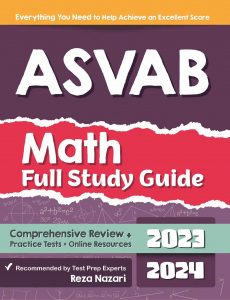
ASVAB Math Full Study Guide: Comprehensive Review + Practice Tests + Online Resources
Open the product page to check the contents, edition, format, and purchase options.
View book & purchase options → $16.99 · PDF

ASVAB Math Practice Workbook 2026: The Most Comprehensive Review for the Math Section of the ASVAB Test
Open the product page to check the contents, edition, format, and purchase options.
View book & purchase options → $19.99 · PDF
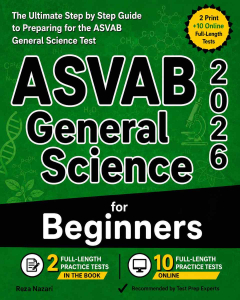
ASVAB General Science for Beginners: The Ultimate Step by Step Guide to Preparing for the ASVAB General Science Test
Open the product page to check the contents, edition, format, and purchase options.
View book & purchase options → $18.99 · PDF
ASVAB Quick Review
Review one skill, try its practice, and use the result to choose your next step.
Jump into ASVAB
See it. Understand it. Try it.
ASVAB Quick Review organizes important ideas by subtest. Choose one area, refresh the key idea, and try an original example in its study Online Center.
Six ways into ASVAB study
Each Online Center pairs topic review with a chance to try the idea.
Choose a focused ASVAB study path
This ASVAB study center connects ten focused subtest Online Centers, topic reviews, original practice checks, and math resources so students can choose a clear next step.
This is an unofficial ASVAB preparation resource from the Effortless Math team. The official ASVAB program provides authoritative information about formats and testing.
Start With A Practice Test
Start with official sample questions or a focused practice check. Use what feels unfamiliar to choose an ASVAB subtest Online Center, then review the topics that need more work.
Try a sample first
Use official examples to notice which question formats feel familiar.
Know what is tested
Check the subtests and format used by your testing program.
Choose one study Online Center
Select a subtest that supports your goals or needs more practice.
Review and practice
Use Quick Review and original practice checks, then revisit missed ideas.
ASVAB Snapshot
aptitude domains
listed subtests
math subtests used in AFQT
updated study path
ASVAB Quick Review Topics
Open a focused Quick Review for one of the ten ASVAB subtests, then try original practice checks in its Online Center.
ASVAB Skill Practice Checks
Choose a subtest to try original practice examples, check your understanding, and review the reasoning.
General Science (GS)
The General Science subtest samples foundational biology, earth science, chemistry, and physics knowledge. Review the core idea in each topic, then practice explaining what the evidence supports.
Start practice →
Arithmetic Reasoning (AR)
Solve everyday math word problems by choosing the right operation, setting up the relationship, and checking whether the answer makes sense.
Start practice →
Word Knowledge (WK)
The Word Knowledge subtest asks you to identify precise word meanings and close synonyms. Review word parts, context, tone, and shades of meaning, then practice with focused vocabulary flashcards.
Start practice →
Paragraph Comprehension (PC)
Read short passages carefully, identify what the writer states, and separate direct evidence from a tempting guess.
Start practice →
Mathematics Knowledge (MK)
Review the math principles and formulas used to solve direct questions in algebra, geometry, number operations, and measurement.
Start practice →
Electronics Information (EI)
Build a clear foundation in current, voltage, resistance, circuits, and common electronic components.
Start practice →
Auto Information (AI)
Review the purpose of major vehicle systems and how their common parts work together.
Start practice →
Shop Information (SI)
Recognize common hand tools, measuring tools, workshop practices, and the jobs each tool is designed to do.
Start practice →
Mechanical Comprehension (MC)
Use basic physical principles to reason about motion, force, work, simple machines, pressure, and mechanical advantage.
Start practice →
Assembling Objects (AO)
The Assembling Objects subtest asks you to visualize how pieces fit together. Track distinctive features, preserve the relationships between edges, and check the full outline before choosing.
Start practice →
ASVAB Topics: Learn, Study Worksheets, and Quiz
Open a topic lesson, use its printable study worksheet, then try the subtest’s mixed quiz. Each mixed quiz combines several topics; these are study checks, not official score predictions.
10 ASVAB subtests
General Science (GS)
Arithmetic Reasoning (AR)
Word Knowledge (WK)
Paragraph Comprehension (PC)
Mathematics Knowledge (MK)
Electronics Information (EI)
Auto Information (AI)
Shop Information (SI)
Mechanical Comprehension (MC)
ASVAB Mistakes to Watch For
Use a missed or guessed question to choose your next review. Open a worked check, then follow the link to the matching topic. These examples explain the method and are not official test questions.
Units in a multi-step problem
Keep the units beside each number. Convert them before calculating, then check whether the result answers the original question.
See a worked check
At 48 miles per hour, a trip lasting 2.5 hours covers 48 × 2.5 = 120 miles. Multiplying hours by miles per hour leaves miles.
Choosing the closest word meaning
Compare the meaning of each choice rather than choosing a word that only sounds familiar. Word parts can help, but confirm the meaning in context.
See a worked check
The root port means carry in words such as portable and transport. Portable describes something that can be carried or moved.
Staying with passage evidence
An answer can sound reasonable and still go beyond the passage. Locate the sentence that supports your choice before committing to it.
See a worked check
If a passage says a machine was repaired on Tuesday, that supports the repair date. It does not establish who caused the damage or how long the repair lasted.
Forces and turning effects
Mark the pivot and the direction of each force. A force farther from the pivot has a greater turning effect when the force and angle stay the same.
See a worked check
A perpendicular force of 10 N applied 0.2 m from a pivot produces a turning moment of 2 N·m. At 0.4 m, the same force produces 4 N·m.
Rotation versus reflection
Track one distinctive corner or connection while rotating the whole shape. A mirror image reverses the arrangement of its parts.
See a worked check
Trace an L shape around its corners in order. A rotation preserves that corner order; reflecting the shape reverses it.
Choose Your ASVAB Prep Tool
Choose a focused study Online Center, Quick Review, practice check, or official sample question to match your next step.
Subtest Online Centers
Open topic explanations and examples for one ASVAB area.
Practice checks
Try original questions and review the reasoning.
ASVAB Math Practice
Build arithmetic and mathematics knowledge in the dedicated center.
Official samples
See the sample formats published by the official ASVAB program.
Choose Your ASVAB Study Route
Start with the route that fits your last practice result. Follow the steps in order, then use a fresh example or practice set to decide what comes next.
Build verbal skills
Use this route when unfamiliar words or unsupported reading inferences cause mistakes.
Explain the word meaning or point to the passage evidence before choosing an answer.
Strengthen math reasoning
Choose this route when you can calculate but need help setting up word problems.
Use paper to track units and intermediate steps during practice.
Review technical and spatial ideas
Pick the subtest you need rather than treating technical review as one long course.
Use your recruiter’s guidance to confirm the test format and your preparation needs.
ASVAB Math Full Study Guide: Comprehensive Review + Practice Tests + Online Resources
A focused resource for Arithmetic Reasoning and Mathematics Knowledge, with explanations and practice for ASVAB math preparation.
- Supports the two ASVAB math subtests
- Pairs with the Arithmetic Reasoning and Mathematics Knowledge Online Centers
- Use topic review before mixed practice
- A focused math resource within the broader ASVAB study plan
Arithmetic Reasoning
Work through quantitative relationships and multi-step word problems.
Mathematics Knowledge
Review algebra, geometry, formulas, and mathematical principles.
Targeted practice
Build confidence with explanations and ASVAB math practice.
Test-day bridge
Connect math lessons to both ASVAB math subtest Online Centers.
How to use it
- Read one lesson and note the worked example.
- Practice the same skill in an ASVAB Math Online Center.
- Review a related ASVAB math flashcard.
- Try mixed ASVAB math questions and revisit each miss.
Choose The Right ASVAB Study Guide
Use a study guide when you need explanations; choose a workbook when you need more practice with individual topics. The two options below make those starting points easy to compare.
ASVAB Math Full Study Guide: Comprehensive Review + Practice Tests + Online Resources
Need a broad math review?
Use the study guide to review the method before adding more practice.
View book details → $16.99 · PDF

ASVAB Math Practice Workbook 2026: The Most Comprehensive Review for the Math Section of the ASVAB Test
Need extra topic practice?
Work on the topics you miss, then return to a mixed practice set.
View book details → $19.99 · PDF

ASVAB General Science for Beginners
Science foundations
Build core science knowledge with lessons and guided practice.
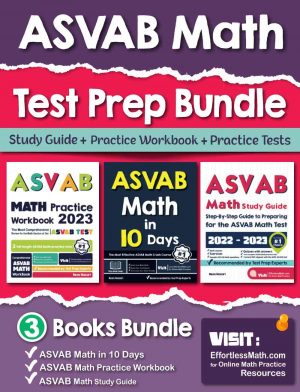
ASVAB Math Test Prep Bundle: Study Guide + Practice Workbook + Practice Tests
Complete math library
Combine a study guide, workbook, and practice tests for the two math subtests.
Prepare for the ASVAB Math Test in 7 Days: A Quick Study Guide with Two Full-Length ASVAB Math Practice Tests
Focused quick review
Use a short review plan to prepare for ASVAB math practice.
4-Week ASVAB Study Roadmap
Use a steady month-long plan to sample the test, strengthen priority topics, and revisit missed questions.
Diagnose and choose a focus
Try official samples, then select two priority subtests.
Build foundations
Review key ideas in your priority verbal and math Online Centers.
Connect related skills
Add science, technical, or spatial review to your study mix.
Practice and confirm
Revisit missed skills and confirm the testing program and format.
ASVAB FAQ
How many math questions are on the ASVAB?
It depends on the version. The paper ASVAB has 30 Arithmetic Reasoning questions and 25 Mathematics Knowledge questions. The computer-adaptive CAT-ASVAB has 15 scored questions in each math subtest, and it may add unscored tryout questions. Because the CAT-ASVAB adapts to your answers, harder questions follow correct answers.
What is the difference between arithmetic reasoning and math knowledge on the ASVAB?
Arithmetic Reasoning tests whether you can solve word problems, such as rates, percents, ratios and simple interest. Mathematics Knowledge tests math concepts directly, including algebra, geometry, exponents and number properties. Both subtests count toward your AFQT score, so they matter for enlistment eligibility and not only for job qualification.
Can you use a calculator on the ASVAB math test?
No. The official ASVAB site says you cannot use a calculator on any part of the test. The goal is to measure basic math you can do yourself. Practice arithmetic by hand, including fractions, decimals, percents and square roots, so you can work quickly within the time limits.
How soon can you retake the ASVAB?
After your first test, you must wait one calendar month to retest. After that retest, you wait one more calendar month. After the second retest, you must wait six calendar months before testing again. Scores can be used for enlistment for up to two years from the test date.
What subjects are on the ASVAB?
The ASVAB includes subtests across verbal, math, science and technical, and spatial areas. The combination depends on your testing program.
Which ASVAB subtests count toward the AFQT?
Arithmetic Reasoning, Mathematics Knowledge, Word Knowledge, and Paragraph Comprehension contribute to the AFQT score.
Are these official ASVAB questions?
No. The study Online Centers provide original practice examples. Use the official ASVAB site for authoritative sample questions and testing information.
Do all ASVAB programs use the same subtests?
No. Subtests can vary by testing program. Check official information for the format you will take.
How should I study for the ASVAB?
Start with sample questions, identify unfamiliar areas, and use one focused Online Center at a time. Return to missed ideas after practice.
Where can I review ASVAB math?
Use the Arithmetic Reasoning and Mathematics Knowledge Online Centers for focused explanations and practice.
Related Online Centers
Make This Your ASVAB Starting Point
Choose one subtest, work through its Quick Review, and follow the next step that fits your study plan.
Keep the two ASVAB math paths distinct
Arithmetic Reasoning focuses on math in word problems. Mathematics Knowledge reviews mathematical concepts. Use the official ASVAB subtest descriptions to choose your next study area. Our materials are independent preparation, not official ASVAB questions.
A USEFUL NEXT STEP
ASVAB: study questions
What subjects are on the ASVAB?
ASVAB subtests cover Verbal, Math, Science and Technical, and Spatial skills. Auto Information and Shop Information are separate computer subtests but combined in the paper-and-pencil administration.
Official source ↗Which ASVAB subtests count toward the AFQT?
The AFQT uses Arithmetic Reasoning, Mathematics Knowledge, Word Knowledge, and Paragraph Comprehension. The other ASVAB subtests help measure additional aptitudes and inform military job qualification.
Official source ↗Are these official ASVAB preparation materials?
Effortless Math is an independent publisher. Its original materials are preparation resources, and practice results are study feedback rather than official scores. Use the test provider’s website for registration, policies, and official practice.
Official source ↗Resources from Effortless Math · Editorial standards · Test details checked October 5, 2026