YOUR ASVAB Mathematics Knowledge STUDY COMPANION
ASVAB Mathematics Knowledge Online Center
Mathematics Knowledge asks you to use high-school mathematical principles. Work with numbers, algebraic expressions, equations and geometry without a calculator.
ASVAB Mathematics Knowledge Practice Tests
Use the existing original practice check to find a weak skill. Results are learning feedback, not official ASVAB or AFQT scores.
ASVAB Mathematics Knowledge Flashcards
Recall a concept and connect it with a subject example.
ASVAB Mathematics Knowledge Study Guides
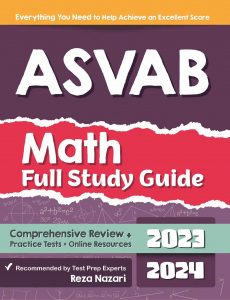
ASVAB Math Full Study Guide: Comprehensive Review + Practice Tests + Online Resources
Math-focused preparation for Arithmetic Reasoning and Mathematics Knowledge. Prepare other ASVAB subtests separately.
View book & purchase options →ASVAB Mathematics Knowledge Quick Review
Refresh one concept before trying another practice check.
Open this resource →MEET THE ASSESSMENT · CHOOSE YOUR NEXT SKILL
Know ASVAB Mathematics Knowledge before you start.
The official ASVAB describes this subtest as assessing high school mathematics principles. Administration and subtest timing depend on the test format. Calculators are not permitted. The independent fixed study checks here do not reproduce CAT-ASVAB adaptive routing or official ASVAB or AFQT scores.
Official assessment information ↗Number operations
Keep signs and order of operations visible as you work.
Explore this study route →Algebra and equations
Apply the same operation to both sides and check the result in the original equation.
Explore this study route →Geometry and graphs
Label dimensions and distinguish a length, an area, and a volume.
Explore this study route →Official test format
Confirm your administration format. Fixed study checks do not reproduce CAT-ASVAB adaptive routing.
Explore this study route →ASVAB Mathematics Knowledge Practice Center
Use the two original practice checks to try the reasoning, then study the explanations and return to any topic that needs another look.
ASVAB Mathematics Knowledge Study Blueprint
Open each area to review the key idea and an example. The map organizes the study areas on this page; it does not represent official ASVAB question percentages.
01 Work with signed numbers and order of operationsEvaluate parentheses and exponents first, then multiply or divide, and finally add or subtract. 1study areas
- For 8 − 2 × 3, multiply first: 8 − 6 = 2.
- Use the example to explain the clue that makes the answer fit.
02 Solve equationsUndo operations in reverse order and do the same operation to both sides. 1study areas
- For 3x + 4 = 19, subtract 4, then divide by 3: x = 5.
- Use the example to explain the clue that makes the answer fit.
03 Use geometry formulasIdentify the shape and the requested measure before selecting a formula. Keep square and cubic units distinct. 1study areas
- A rectangle 7 units by 4 units has area 7 × 4 = 28 square units.
- Use the example to explain the clue that makes the answer fit.
04 Read graphs and coordinate pairsIn an ordered pair (x, y), move horizontally by x and vertically by y. 1study areas
- The point (−2, 3) is 2 units left and 3 units up from the origin.
- Use the example to explain the clue that makes the answer fit.
Study-map shares describe the learning resources on this page. They are not presented as official test percentages.
Mathematics Knowledge asks you to use high-school mathematical principles. Work with numbers, algebraic expressions, equations and geometry without a calculator.
Know the task
A short expression may require several linked steps. Identify the mathematical operation, simplify carefully, and check whether a proposed answer satisfies the original relationship. Mathematics Knowledge is one of the four subtests used in AFQT scoring.
Test Outline
The published proctored CAT-ASVAB Mathematics Knowledge subtest has 15 scored questions and a 31-minute limit when no tryout questions are included. Extra tryout items can increase both the item count and time allowance. The two fixed practice forms here each use 15 questions and 31 minutes. They do not adapt to your answers or estimate an official score.
Mathematics Knowledge
15 questions · 31 minutes
- Signed numbers and order of operations
- fractions, decimals and exponents
- equations and inequalities
- factoring and polynomials
- lines and slope
- angles, area and volume
- right triangles and similarity
Skills to review
Signed numbers and order of operations; fractions, decimals and exponents; equations and inequalities; factoring and polynomials; lines and slope; angles, area and volume; right triangles and similarity.
Two full-length subject forms
Practice Test 1 and Practice Test 2 each contain 15 original four-option questions, with a worked explanation for every answer. Take Form 1 before reviewing. Record guessed answers as well as errors, and save Form 2 until you have practiced the methods you missed.
Work through a question
Write each algebra step on a separate line. When you divide an inequality by a negative number, reverse its direction. In geometry, identify the height perpendicular to the base before substituting dimensions.
Quick Review
The Quick Review contains 10 focused sections. Choose a topic from an actual missed or guessed question, read the explanation, then explain the idea in your own words. A negative exponent gives a reciprocal; it does not make a number negative. Area uses square units and volume uses cubic units. A diagram may illustrate a relationship without being drawn to scale.
Flashcards
The 20-card deck lets you reveal an answer and move in either direction. Try recalling the idea before revealing it. Explain the rule before revealing the answer. Revisit any card you could only guess.
A practical study route
Start with the number and algebra topics you missed, then work through geometry. After a short flashcard session, explain why a method applies before calculating. Pair this Online Center with Arithmetic Reasoning to practice choosing a relationship from a word problem.
Try ten additional sample questions
The ten questions on this page are a separate untimed sample set. Choose an answer to see feedback and an explanation. Use them to practice the reasoning, then open a full subject form when you are ready for a timed session.
Choose an answer and press Submit for feedback. These ten untimed examples are separate from the full practice forms.
Correct answer: A.
Evaluate the parentheses first: \(3+4=7\). Then \(18-2(7)=18-14=4\).Correct answer: C.
Add 9 to both sides to obtain \(7x=35\). Divide both sides by 7, giving \(x=5\).Correct answer: B.
Rewrite the fraction as \(\frac{3}{8}=\frac{375}{1000}=0.375\).Correct answer: D.
Divide powers of the same nonzero base by subtracting exponents: \(y^{9-4}=y^5\).Correct answer: B.
The two numbers must multiply to \(-15\) and add to \(2\). They are \(5\) and \(-3\), giving \((x+5)(x-3)\). Expanding confirms \(x^2+2x-15\).Correct answer: D.
Triangle area is one-half times base times perpendicular height: \(\frac{1}{2}(14)(5)=35\) square centimeters.Correct answer: B.
In slope-intercept form \(y=mx+b\), the coefficient \(m\) is the slope. Here \(m=-3\).Correct answer: D.
The principal square roots are \(12\) and \(5\), so their sum is \(17\). Adding radicands first would change the expression.Correct answer: C.
Subtract 3 to obtain \(4x\leq16\). Divide by positive 4, keeping the inequality direction: \(x\leq4\).Correct answer: A.
Each of the four sides is \(52/4=13\) units long. The area is \(13^2=169\) square units.Choose an answer and press Submit for feedback. These ten untimed examples are separate from the full practice forms.
Frequently asked questions
Can I use a calculator?
Calculators are not permitted on the official ASVAB. Use scratch paper and practice the calculations by hand.
Is this the official test?
No. These are original independent study materials. They do not reproduce the secure ASVAB item bank, adaptive selection or official score conversion.
Can I change answers here?
This study interface permits backward navigation. On official CAT-ASVAB, you cannot change an answer after proceeding to the next question.
Does a practice percentage predict my score?
No. The displayed raw result helps you identify skills to review. It cannot be converted directly into an ASVAB or AFQT score.
What if I am taking a different version?
Confirm your testing version with your recruiter. Paper-and-pencil ASVAB has different section counts and times; CAT-ASVAB can include additional tryout items.
Official sources
Format and tools: https://www.officialasvab.com/applicants/what-to-expect/ . Subtest scope: https://www.officialasvab.com/applicants/subtests/ . Scoring: https://www.officialasvab.com/applicants/scores/ . Navigation: https://www.officialasvab.com/recruiters/cat-asvab/ . Checked November 4, 2026. Independent preparation; not endorsed by the ASVAB program or Department of Defense.
More lessons and study resources
These existing lessons and resource links remain available alongside the new timed forms and study tools. Short skill checks are supplemental practice, with their own formats.
ASVAB Mathematics Knowledge: Learn, Practice, and Review
Choose a lesson, use its printable study worksheet, then check your understanding with the subtest’s mixed quiz. Open the worksheet associated with each lesson for additional study.
The mixed quiz reviews several areas of Mathematics Knowledge; it is not a separate quiz for each row. These four groups are a study map, not an official question distribution.
Work with signed numbers and order of operations
Read the lesson and worked example
Work from the structure of the expression. Complete parentheses and exponents before multiplication or division; do multiplication and division from left to right, followed by addition and subtraction from left to right. Track negative signs carefully. Subtracting a negative is equivalent to adding its opposite. Estimate the sign and size of the result before finishing the arithmetic.
Method: Rewrite one step per line and keep the operation order visible.
For −3 + 2 × 5, multiply first to get −3 + 10 = 7. For (−3 + 2) × 5, the parentheses give −5.
Common mistake: Parentheses change which operations belong together.
Solve equations
Read the lesson and worked example
An equation states that two expressions are equal. Preserve equality by applying the same operation to both sides. Combine like terms before isolating the unknown, and use the distributive property when parentheses occur. Substitute the solution into the original equation to catch arithmetic or sign errors. An inequality follows similar steps, but multiplying or dividing by a negative reverses its direction.
Method: Simplify, undo addition or subtraction, undo multiplication or division, then substitute.
For 2(x + 3) = 18, divide by 2 to obtain x + 3 = 9, then subtract 3: x = 6. Substitution gives 2(9) = 18.
Common mistake: Do not distribute to only one term inside parentheses.
Use geometry formulas
Read the lesson and worked example
Decide whether the question asks for a length, an area, or a volume before selecting a formula. Perimeter measures the boundary; area measures a surface; volume measures space. A triangle’s height is perpendicular to its chosen base. In a right triangle, the Pythagorean theorem relates the two legs to the hypotenuse. Keep units consistent before calculating.
Method: Sketch the figure, mark known measures, select a formula, and label the result with appropriate units.
A circle with diameter 10 has radius 5. Its area is π × 5² = 25π square units, while its circumference is 10π units.
Common mistake: Using the diameter as the radius makes an area calculation four times too large.
Read graphs and coordinate pairs
Read the lesson and worked example
An ordered pair lists horizontal position before vertical position. Slope compares vertical change with horizontal change in a consistent direction. A line’s intercept identifies where it crosses an axis. Read graph scales before interpreting a point; one grid square need not equal one unit. For a mean, divide the sum by the number of values; a median depends on ordering the data.
Method: Label x and y, read the scale, and write the relationship before calculating.
Between (1, 2) and (3, 8), slope is (8 − 2)/(3 − 1) = 6/2 = 3. Reversing both differences also gives 3.
Common mistake: Reversing only one difference changes the sign incorrectly.
Explore the subject Online Centers
A USEFUL NEXT STEP
ASVAB Mathematics Knowledge: study questions
What does ASVAB Mathematics Knowledge cover?
The official ASVAB describes this subtest as assessing high school mathematics principles. Administration and subtest timing depend on the test format. Calculators are not permitted. The independent fixed study checks here do not reproduce CAT-ASVAB adaptive routing or official ASVAB or AFQT scores.
Official source ↗How should I use these independent ASVAB Mathematics Knowledge study tools?
Start with a practice activity, review explanations for missed questions, and use quick review or flashcards for one weak topic. The practice results are study feedback, not official exam scores. Compare a book’s contents with your course or test requirements before buying.
Resources from Effortless Math · Editorial standards