YOUR ASVAB Arithmetic Reasoning STUDY COMPANION
ASVAB Arithmetic Reasoning Online Center
Build the habit that matters most in a word problem: turn the situation into the right mathematical relationship. Use the two timed forms to find weak skills, review the worked examples, and practice recalling the methods with flashcards.
ASVAB Arithmetic Reasoning Practice Tests
Use the existing original practice check to find a weak skill. Results are learning feedback, not official ASVAB or AFQT scores.
ASVAB Arithmetic Reasoning Flashcards
Recall a concept and connect it with a subject example.
ASVAB Arithmetic Reasoning Study Guides
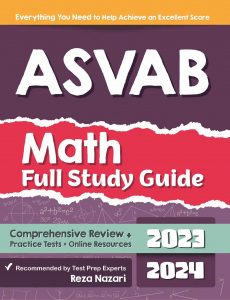
ASVAB Math Full Study Guide: Comprehensive Review + Practice Tests + Online Resources
Math-focused preparation for Arithmetic Reasoning and Mathematics Knowledge. Prepare other ASVAB subtests separately.
View book & purchase options →ASVAB Arithmetic Reasoning Quick Review
Refresh one concept before trying another practice check.
Open this resource →MEET THE ASSESSMENT · CHOOSE YOUR NEXT SKILL
Know ASVAB Arithmetic Reasoning before you start.
The official ASVAB describes this subtest as assessing arithmetic word problems. Administration and subtest timing depend on the test format. Calculators are not permitted. The independent fixed study checks here do not reproduce CAT-ASVAB adaptive routing or official ASVAB or AFQT scores.
Official assessment information ↗Translate the relationship
Write what the quantities mean before choosing an operation.
Explore this study route →Ratios and proportions
Keep units aligned on both sides of a proportion.
Explore this study route →Rates, money, and percents
Check whether the requested result is the whole, the part, or a change.
Explore this study route →Official test format
Confirm your administration format. Fixed study checks do not reproduce CAT-ASVAB adaptive routing.
Explore this study route →ASVAB Arithmetic Reasoning Practice Center
Use the two original practice checks to try the reasoning, then study the explanations and return to any topic that needs another look.
ASVAB Arithmetic Reasoning Study Blueprint
Open each area to review the key idea and an example. The map organizes the study areas on this page; it does not represent official ASVAB question percentages.
01 Translate words into operationsLook for what the situation asks you to compare or find. Write a short equation before calculating. 1study areas
- A $48 item is discounted by $8. The sale price is 48 − 8 = $40.
- Use the example to explain the clue that makes the answer fit.
02 Fractions, ratios, and proportionsKeep units attached to quantities. For a proportion, compare matching units on both sides. 1study areas
- If 3 notebooks cost $6, one notebook costs 6 ÷ 3 = $2.
- Use the example to explain the clue that makes the answer fit.
03 Rates, time, and distanceUse distance = rate × time, and convert units before substituting. 1study areas
- At 50 miles per hour for 3 hours, a car travels 50 × 3 = 150 miles.
- Use the example to explain the clue that makes the answer fit.
04 Percent and money problemsChange a percent to a decimal, then multiply by the whole amount. 1study areas
- Twenty percent of $60 is 0.20 × 60 = $12.
- Use the example to explain the clue that makes the answer fit.
Study-map shares describe the learning resources on this page. They are not presented as official test percentages.
Build the habit that matters most in a word problem: turn the situation into the right mathematical relationship. Use the two timed forms to find weak skills, review the worked examples, and practice recalling the methods with flashcards.
Meet Arithmetic Reasoning
Arithmetic Reasoning measures the ability to solve arithmetic word problems. The published proctored CAT-ASVAB format has 15 scored questions with a 55-minute limit when no tryout questions are included. A subtest with tryout items can have 15 additional questions and a 113-minute limit. Calculators are not allowed. The official computer test adapts to each examinee and does not let you return to a submitted answer.
Test Outline
The main task is reading a situation and choosing the correct calculation. Review fractions and decimals, ratios and proportions, percents, rates and units, distance and time, averages, work, money, and measurement in context. These study groups organize preparation. The ASVAB program does not publish a guaranteed question percentage for each group on the cited applicant pages. The two practice forms use 15 questions and 55 minutes each. They are fixed study simulations with raw feedback and explanations. They do not reproduce CAT item selection, tryout items, score conversion, or the secure item bank.
Arithmetic Reasoning
15 questions · 55 minutes
- fractions and decimals
- ratios and proportions
- percents
- rates and units
- distance and time
- averages
- work
- money
- measurement in context
Choose a practice form
Practice Test 1 and Practice Test 2 each contain 15 original questions with four answer choices and worked explanations. Take the first form before reviewing, record any guessed or missed item, and choose a review topic from that record. Take the second form after you have repaired the underlying method. The study interface permits backward navigation so you can practice deliberately. The official CAT interface has different navigation rules.
Review the skill behind the error
The Quick Review has 12 topic sections. Each explains a method, gives a concrete relationship or example, and identifies mistakes worth checking. If your calculation is correct but your answer is wrong, look first at the base quantity, units, and meaning of the unknown. A percent question can change completely when the base changes.
Use the flashcards
The 24-card deck covers methods and distinctions rather than answers to the practice tests. Read the front and explain the idea aloud before revealing the back. Give yourself an example with different numbers. If you can state a rule but cannot decide when to use it, return to its Quick Review section.
A study plan you can adjust
In your first session, take Form 1 and record the reason for each error: reading, setup, calculation, or missing knowledge. In the next sessions, choose one or two related review topics and solve a fresh example without a calculator. Use a brief flashcard session the following day. When you can explain the corrected steps without help, take Form 2. Compare the kinds of errors, as the two raw scores alone do not measure official score growth.
How Arithmetic Reasoning fits the ASVAB
Arithmetic Reasoning is one of four subtests used to calculate AFQT scores, together with Mathematics Knowledge, Word Knowledge, and Paragraph Comprehension. Arithmetic Reasoning emphasizes quantitative situations. Mathematics Knowledge emphasizes high-school mathematical principles. Use both math Online Centers, and include verbal study in an AFQT preparation plan.
Frequently asked questions
Can I use a calculator?
The official ASVAB does not permit calculators. Use scratch paper and practice arithmetic by hand.
Are these questions official?
These are original independent practice questions. Secure ASVAB questions are controlled testing materials and are not reproduced here.
Does 80 percent correct predict my AFQT score?
No. A raw practice percentage cannot be converted directly to an AFQT percentile. Official scoring uses the ASVAB program's procedures and norms.
Why are there only 15 questions?
The practice form uses the official CAT scored-question count without tryout items. Paper-and-pencil Arithmetic Reasoning instead has 30 questions and 36 minutes. Confirm the version you will take with your recruiter.
Should I memorize formulas or do word problems?
Know the useful relationships, then practice deciding which one matches a situation. Labeling units and checking the requested quantity can prevent a correct calculation from answering the wrong question.
Ten additional sample questions
The ten untimed questions on this page are separate from the two timed forms. Choose an answer and read the worked explanation. The Math and ASVAB overview pages also use selected examples from this sample bank; those presentations are study routes rather than additional unseen questions.
Choose an answer and press Submit for feedback. These ten untimed examples are separate from the full practice forms.
Correct answer: B.
The departure times must be multiples of both intervals. The garage shuttle leaves 24, 48, and 72 minutes after noon. Of these, 72 is the first multiple of 18, since \(4 \times 18 = 72\).Correct answer: D.
After the down payment, she owes \(710 - 170 = 540\) dollars. The four installments total \(4 \times 85 = 340\) dollars, leaving \(540 - 340 = 200\) dollars.Correct answer: A.
The difference between the two shares is \(7 - 4 = 3\) parts. Three parts represent 27 saplings, so each part represents \(27 ÷ 3 = 9\). The maples make up four parts, or \(4 \times 9 = 36\) saplings.Correct answer: C.
The first cyclist has a \(9 \times \frac{1}{2} = 4.5\) mile lead. The gap closes at \(15 - 9 = 6\) miles per hour. Closing the gap takes \(4.5 ÷ 6 = 0.75\) hour, or 45 minutes.Correct answer: B.
There are 16 ounces in a pound, so the full carton weighs \(8 \times 16 + 4 = 132\) ounces. The six brackets weigh \(132 - 12 = 120\) ounces together. Each weighs \(120 ÷ 6 = 20\) ounces.Correct answer: A.
After dropping 11, 13, 38, and 46, the remaining times are 16, 18, and 26 seconds. Their mean is \((16+18+26)÷3=20\) seconds.Correct answer: D.
Two-thirds of 45 is 30. Passing requires at least 31 yes votes, so the proposal needs \(31-27=4\) of the seven ballots still to be counted.Correct answer: C.
Six packs from X cost \(6 \times 18 = 108\) dollars. Four packs from Y cost \(4 \times 24 = 96\) dollars. Both orders supply exactly 48 cartridges, and Y saves the lab \(108 - 96 = 12\) dollars.Correct answer: A.
The number of kits must divide both 42 and 70. Since \(42 = 14 \times 3\) and \(70 = 14 \times 5\), and 3 and 5 share no factor greater than 1, the greatest common factor is 14. Each kit gets 3 pencils and 5 stickers.Correct answer: D.
Only three 6-inch widths fit across 22 inches, leaving 4 inches unused. Four rows fit in the 16-inch depth. The drawer holds \(3\times4=12\) cases.Choose an answer and press Submit for feedback. These ten untimed examples are separate from the full practice forms.
Official sources
Format, tools, and delivery: https://www.officialasvab.com/applicants/what-to-expect/ .
Scope: https://www.officialasvab.com/applicants/subtests/ .
Scoring: https://www.officialasvab.com/applicants/scores/ .
CAT navigation: https://www.officialasvab.com/recruiters/cat-asvab/ .
Checked November 4, 2026. This independent study center is not endorsed by the ASVAB program or the Department of Defense.
More lessons and study resources
These existing lessons and resource links remain available alongside the new timed forms and study tools. Short skill checks are supplemental practice, with their own formats.
ASVAB Arithmetic Reasoning: Learn, Practice, and Review
Choose a lesson, use its printable study worksheet, then check your understanding with the subtest’s mixed quiz. Open the worksheet associated with each lesson for additional study.
The mixed quiz reviews several areas of Arithmetic Reasoning; it is not a separate quiz for each row. These four groups are a study map, not an official question distribution.
Translate words into operations
Read the lesson and worked example
Identify the unknown before choosing an operation. A fixed charge is added once, while a per-item or per-hour charge is multiplied by a quantity. Mark words that describe the relationship, but let the situation decide the operation: more does not always mean add. Write units beside the numbers, estimate a sensible range, and solve in a short sequence.
Method: Write the unknown, a relationship in words, an equation, and the unit of the answer.
A rental costs $18 plus $7 per hour. For 4 hours, the cost is 18 + 7 × 4 = $46. The fixed fee is not multiplied by 4.
Common mistake: Do not add every number simply because it appears in the problem.
Fractions, ratios, and proportions
Read the lesson and worked example
A fraction represents part of a whole or a quotient. A ratio compares quantities in a stated order. A unit rate reduces a comparison to one unit, making prices or production rates easier to compare. In a proportion, put corresponding quantities in matching positions and keep units consistent. Reduce common factors before multiplying when that makes the arithmetic easier.
Method: Label both sides of a ratio. Find a one-unit value before scaling to the requested amount.
Six parts cost $15. One part costs $2.50, so ten parts cost $25 if the unit price stays the same.
Common mistake: The ratio 2:3 means 2 of one quantity to 3 of another; it is not automatically 2 out of 3 total.
Rates, time, and distance
Read the lesson and worked example
Distance equals rate multiplied by time when the rate is constant. Rearrange the relationship instead of memorizing three unrelated rules. Convert minutes to hours when the rate is per hour. For an average rate over a whole trip, divide total distance by total time; do not average speeds unless the time spent at each speed is equal.
Method: Write d = rt and convert the time first. Check whether the result is a distance, a rate, or a time.
At 48 miles per hour for 45 minutes, time is 3/4 hour. Distance is 48 × 3/4 = 36 miles.
Common mistake: Forty-five minutes is 0.75 hour, not 0.45 hour.
Percent and money problems
Read the lesson and worked example
A percent is a rate per hundred. Identify the base amount before multiplying by the decimal rate. A discount subtracts from the original price; tax is added to the applicable taxable price. For percent change, divide the change by the original amount. Successive percentage changes are applied to changing amounts rather than simply added together.
Method: Underline the base amount and name the requested quantity: percent amount, final price, or percent change.
An $80 item at 25% off has a $20 discount and costs $60 before tax. If tax is 5% of the sale price, tax is $3 and the total is $63.
Common mistake: The discount amount and the amount paid are different answers.
Explore the subject Online Centers
A USEFUL NEXT STEP
ASVAB Arithmetic Reasoning: study questions
What does ASVAB Arithmetic Reasoning cover?
The official ASVAB describes this subtest as assessing arithmetic word problems. Administration and subtest timing depend on the test format. Calculators are not permitted. The independent fixed study checks here do not reproduce CAT-ASVAB adaptive routing or official ASVAB or AFQT scores.
Official source ↗How should I use these independent ASVAB Arithmetic Reasoning study tools?
Start with a practice activity, review explanations for missed questions, and use quick review or flashcards for one weak topic. The practice results are study feedback, not official exam scores. Compare a book’s contents with your course or test requirements before buying.
Resources from Effortless Math · Editorial standards