YOUR ASVAB GENERAL SCIENCE PREP STARTS HERE
ASVAB General Science Online Center
Study physical and biological science foundations with independent practice checks, flashcards, and focused review. Connect a structure or process with its function. Choose one topic and strengthen it before another activity.
Free study tools · Focused review · Books to compare
ASVAB General Science Practice Tests
Use the existing original practice check to find a weak skill. Results are learning feedback, not official ASVAB or AFQT scores.
ASVAB General Science Flashcards
Recall a concept and connect it with a subject example.
ASVAB General Science Study Guides
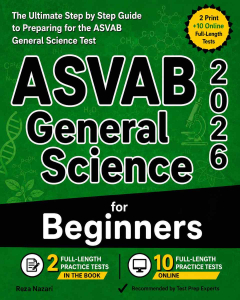
ASVAB General Science for Beginners: The Ultimate Step by Step Guide to Preparing for the ASVAB General Science Test
General Science study. Compare the preview and contents with your needs.
View book & purchase options →ASVAB General Science Quick Review
Refresh one concept before trying another practice check.
Open this resource →MEET THE ASSESSMENT · CHOOSE YOUR NEXT SKILL
Know ASVAB General Science before you start.
The official ASVAB describes this subtest as assessing physical and biological science foundations. Administration and subtest timing depend on the test format. Calculators are not permitted. The independent fixed study checks here do not reproduce CAT-ASVAB adaptive routing or official ASVAB or AFQT scores.
Official assessment information ↗Life science
Connect a structure or process with its function.
Explore this study route →Earth and space science
Distinguish a short-term observation from a larger process.
Explore this study route →Physical science
Identify the relationship and units before using a formula.
Explore this study route →Official test format
Confirm your administration format. Fixed study checks do not reproduce CAT-ASVAB adaptive routing.
Explore this study route →ASVAB General Science Practice Center
Use the two original practice checks to try the reasoning, then study the explanations and return to any topic that needs another look.
ASVAB General Science Study Blueprint
Open each area to review the key idea and an example. The map organizes the study areas on this page; it does not represent official ASVAB question percentages.
01 Life scienceReview cells, body systems, heredity, ecosystems, and how organisms use energy. 1study areas
- Plants use light energy to make sugars through photosynthesis.
- Use the example to explain the clue that makes the answer fit.
02 Earth and space scienceConnect weather, rocks, water, Earth structure, and the motions of Earth and other objects in space. 1study areas
- The water cycle moves water through evaporation, condensation, and precipitation.
- Use the example to explain the clue that makes the answer fit.
03 Physical scienceUnderstand matter, energy, forces, motion, and basic chemical changes. 1study areas
- A physical change alters form or state without creating a different substance.
- Use the example to explain the clue that makes the answer fit.
04 Scientific reasoningRead a question for variables, observations, and evidence before selecting a conclusion. 1study areas
- A controlled experiment changes one factor while keeping other conditions alike.
- Use the example to explain the clue that makes the answer fit.
Study-map shares describe the learning resources on this page. They are not presented as official test percentages.
Read the clue.
Build the answer.
Review the General Science ideas that matter. Refresh a key point, follow a clear example, and check your understanding.
Start Here: What the ASVAB General Science Test Really Measures
The General Science subtest samples foundational biology, earth science, chemistry, and physics knowledge. Review the core idea in each topic, then practice explaining what the evidence supports. Use this page to review related knowledge and practice applying it. The exact test version and subtests depend on your testing program.
ASVAB study content on this page is unofficial. Confirm your test version and current format with your testing program.
How to Use This Online Center
Start with one topic group below. Read its short explanation, work through the example, and say why the answer fits. Keep a short repair list for ideas that were wrong, guessed, or slow; return to those areas before your next practice session.
ASVAB General Science: Learn, Practice, and Review
Choose a lesson, use its printable study worksheet, then check your understanding with the subtest’s mixed quiz. Each worksheet provides a worked example and space to organize your reasoning.
The mixed quiz reviews several areas of General Science; it is not a separate quiz for each row. These four groups are a study map, not an official question distribution.
Life science
Read the lesson and worked example
Cells carry out life processes. The nucleus contains genetic information in eukaryotic cells, the cell membrane controls exchange, and mitochondria help release usable energy from food. Plants also have chloroplasts that capture light for photosynthesis. Follow energy from producers to consumers; decomposers recycle matter. Energy flows through a food web, while matter cycles.
Method: Compare photosynthesis with cellular respiration, then connect one organism to its role in a food web.
A plant stores light energy in sugar; an animal obtains chemical energy by eating. Both plants and animals use cellular respiration.
Common mistake: Do not assume only animals respire or that decomposers create energy.
Earth and space science
Read the lesson and worked example
Evaporation turns liquid water into vapor; condensation forms liquid droplets; precipitation returns water to the surface. Weather describes short-term conditions, while climate describes long-term patterns. Weathering breaks rock down, erosion moves the material, and deposition leaves it elsewhere. Earth rotates to produce day and night; its tilted axis and orbit explain seasonal changes.
Method: Draw the water cycle with arrows and label one change of state. Separate a process from the material it moves.
A river carrying sediment is erosion; sediment settling in a slower stretch is deposition.
Common mistake: Seasons are not mainly caused by Earth being closer to the Sun.
Physical science
Read the lesson and worked example
An element contains one type of atom; a compound contains elements chemically combined. A mixture can often be separated physically. Melting changes state without changing chemical identity, whereas burning forms different substances. An unbalanced force changes motion. Heat transfers energy from warmer to cooler objects, and electrical or chemical energy can become motion, light, or heat.
Method: Classify a change before naming it: did the substance change, or only its form? For motion, identify the net force.
Ice melting remains water. Iron rusting produces new compounds. These are physical and chemical changes respectively.
Common mistake: A change of appearance alone does not prove that a chemical reaction occurred.
Scientific reasoning
Read the lesson and worked example
An independent variable is the factor intentionally changed; a dependent variable is the measured response. Keep other relevant conditions alike so they do not explain the difference. Repeated observations help distinguish a consistent pattern from an unusual result. Read graph labels and units before comparing values. A conclusion should match the evidence collected, rather than claim more than the experiment tested.
Method: Name the changed factor, measured response, and two controlled conditions. Then state a conclusion that the data could support.
To compare plant growth under two light levels, use similar plants, soil, watering, and duration. Measure growth in the same units.
Common mistake: A correlation can suggest a relationship without establishing its cause.
Active recall · ASVAB General Science
67 ASVAB General Science Flashcards
Numbered science concepts with original examples, unique hints, search, and shuffle.
Organized for review across life science, Earth and space, chemistry, and physics. The official ASVAB describes this subtest broadly as physical and biological science and publishes sample questions, not a fixed vocabulary list or topic weights.
A Four-Week General Science Study Plan
Use one study area each week, or shorten the plan if your practice shows that an area is already secure. Revisit earlier topics briefly so the final week includes mixed review.
Week 1: Cells, energy, and ecosystems
Compare photosynthesis with cellular respiration, then connect one organism to its role in a food web.
Use the lesson and worksheet first. At the end of the week, revisit the worked example without looking at the explanation, then record any step you could not explain.
Week 2: Water, weather, and Earth
Draw the water cycle with arrows and label one change of state. Separate a process from the material it moves.
Use the lesson and worksheet first. At the end of the week, revisit the worked example without looking at the explanation, then record any step you could not explain.
Week 3: Matter, forces, and energy
Classify a change before naming it: did the substance change, or only its form? For motion, identify the net force.
Use the lesson and worksheet first. At the end of the week, revisit the worked example without looking at the explanation, then record any step you could not explain.
Week 4: Variables and evidence
Name the changed factor, measured response, and two controlled conditions. Then state a conclusion that the data could support.
Use the lesson and worksheet first. At the end of the week, revisit the worked example without looking at the explanation, then record any step you could not explain.
Recommended ASVAB Study Resources
Pair this focused topic review with official test information and the broader ASVAB study Online Centers.
Official ASVAB information
Check current subtest descriptions and sample question formats.
ASVAB Math Practice Center
Review Arithmetic Reasoning and Mathematics Knowledge practice resources.
ASVAB Online Center
Choose another subtest Online Center when you are ready to work on a different area.
ASVAB General Science Study Questions
What should I learn first for ASVAB General Science?
Compare photosynthesis with cellular respiration, then connect one organism to its role in a food web.
Which General Science mistakes should I watch for?
Do not assume only animals respire or that decomposers create energy. Seasons are not mainly caused by Earth being closer to the Sun.
What is included in the printable worksheets?
Each worksheet follows one lesson and includes its core explanation, a worked example, space to trace the method, and an error-review record. They are guided study organizers, not full-length practice tests.
Does each topic have a separate quiz?
The Mixed quiz button opens the existing short practice check for this subtest. It combines several topics. Use its explanations to decide which lesson to revisit; its result is not an official ASVAB score.
Where can I confirm the official test format?
Use the official ASVAB subtest descriptions and applicant guidance linked below. Test delivery affects the number of questions and time limits. These lessons and study examples are independently written preparation material.
Make This Your ASVAB General Science Starting Point
Choose a topic, practice until you can explain why the answer fits, and return to another study area when you are ready.
Every lesson in one place
Open a lesson in a new tab and keep this Online Center nearby as your study home.
Browse the complete lesson directory
A USEFUL NEXT STEP
ASVAB General Science: study questions
What does ASVAB General Science cover?
The official ASVAB describes this subtest as assessing physical and biological science foundations. Administration and subtest timing depend on the test format. Calculators are not permitted. The independent fixed study checks here do not reproduce CAT-ASVAB adaptive routing or official ASVAB or AFQT scores.
Official source ↗How should I use these independent ASVAB General Science study tools?
Start with a practice activity, review explanations for missed questions, and use quick review or flashcards for one weak topic. The practice results are study feedback, not official exam scores. Compare a book’s contents with your course or test requirements before buying.
Resources from Effortless Math · Editorial standards