Acids, Bases, and the pH Scale
Some liquids are acids, some are bases, and the pH scale is how we measure where a substance falls between them. It runs from 0 to 14, and it turns up in biology, chemistry, and everyday life — from stomach acid to soap. This lesson covers acids, bases, and how to read the pH scale.
Acids and Bases
An acid is a substance that tastes sour and can be corrosive — lemon juice and vinegar are common acids. A base (also called an alkali when dissolved in water) feels slippery and includes things like soap and baking soda. When an acid and a base combine, they can cancel each other out in a reaction called neutralization, often producing water and a salt.
Reading the pH Scale
The pH scale measures how acidic or basic a substance is on a scale from \(0\) to \(14\). A pH below \(7\) is acidic, a pH of exactly \(7\) is neutral (pure water), and a pH above \(7\) is basic. The further from 7, the stronger the acid or base.
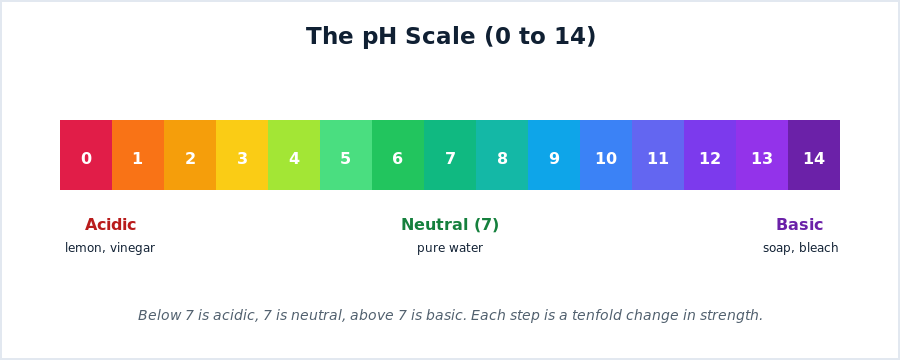
One detail worth knowing: each step on the scale is a tenfold change in strength. A pH of \(4\) is ten times more acidic than a pH of \(5\), and a hundred times more acidic than a pH of \(6\). Formally, pH is defined as \[ \text{pH} = -\log[\text{H}^+], \] but for the test you mainly need to read the scale and know which end is which.
Measuring pH
You can estimate pH with an indicator — a substance that changes color depending on acidity. Litmus paper turns red in acid and blue in base; universal indicator shows a range of colors matched to pH values. When a question shows an indicator color or a pH number, place it on the scale: under 7 acidic, 7 neutral, over 7 basic.
Watch: A Short Video Lesson
FuseSchool walks through this skill clearly in a few minutes. It is a helpful companion to the reading above:
A Routine for pH Questions
- pH below \(7\) = acidic; pH \(7\) = neutral; pH above \(7\) = basic.
- The further from 7, the stronger the acid or base.
- Each step is a tenfold change in strength.
- Indicators (litmus, universal) reveal pH by color.
Practice
- What pH value is neutral?
- Is a substance with pH \(3\) an acid or a base?
- Is a substance with pH \(11\) an acid or a base?
- How much more acidic is pH \(4\) than pH \(6\)?
- What does litmus paper do in an acid?
- What is it called when an acid and base cancel out?
Answers
- \(7\).
- An acid.
- A base.
- \(100\) times more acidic (two steps of ten).
- Turns red.
- Neutralization.
Where This Fits in Your Science Prep
Acids and bases build on chemical reactions (neutralization is a reaction) and connect to solutions and solubility. See all topics on the Science Topics Hub.

Related to This Article
More math articles
- Reaction Types and Redox: Oxidation, Reduction and Agents
- Free Grade 8 English Worksheets for Utah Students
- The Best Grade 3 ELA Practice Tests for Iowa Students
- Citing Text Evidence in Grade 6: How to Move from Vague Answers to Strong Analysis
- How to Apply Limit Properties
- The Best Grade 7 Math Book for Kentucky Students
- The Ultimate 6th Grade SOL Math Course (+FREE Worksheets)
- The Best Grade 6 ELA Practice Tests for Pennsylvania Students
- The Best AFOQT Math Worksheets: FREE & Printable
- How to Mastering the Art of Function Transformations





















What people say about "Acids, Bases, and the pH Scale"?
No one replied yet.