No-Commission Baccarat and the Dragon-7 Trade-off
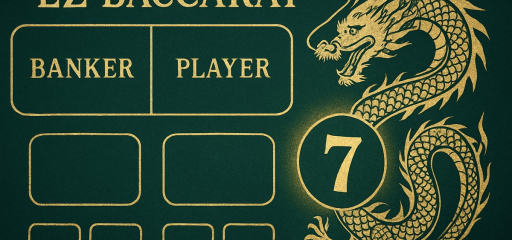
Walk into any modern Asian-style pit and you’ll spot the sign: no commission baccarat, no 5% bite on Banker wins, just clean even-money payouts. It sounds like a gift from the casino. It isn’t, of course, somewhere in the rule sheet there’s a clause that claws the money back, and in the most popular version (EZ Baccarat) that clause is the Dragon 7 rule. I’ve watched players cheer when they dodge the commission and groan twenty hands later when a Banker three-card 7 pushes their bet. Same math, different packaging. Let’s unpack what’s really being traded.
The 5% Commission Recap
Traditional baccarat charges a 5% fee on every winning Banker bet. The reason is structural, Banker wins slightly more than Player thanks to the drawing rules, so the house has to siphon some of that edge back. Without the fee, Banker would be a positive-EV bet, and casinos don’t run charities. With the fee, Banker’s expected value lands at roughly -0.0106 per unit wagered, or a 1.06% house edge. Player sits at about 1.24%, and the Tie at a brutal 14% or so depending on payout. Banker’s the best line bet at the table, even after the haircut.
That commission is annoying for two reasons. It slows the game down, dealers track little markers, settle at shoe’s end, and players hate doing mental math on a 95% payout. And it looks bad. A $100 win that pays $95 feels like a penalty, even when the underlying odds are favorable. Casinos noticed.
What EZ Baccarat Actually Changes
EZ Baccarat, and a handful of similar no-commission variants, pay Banker wins at a flat 1:1. No fee, no markers, no end-of-shoe reconciliation. To compensate, the game introduces a single rule tweak: when Banker wins with a three-card total of 7, the hand is a push. Bets aren’t lost, they’re just returned. Player bets on that hand also push, but since players weren’t winning anyway, it doesn’t matter to them.

That single carve-out is doing a lot of work. Banker wins on a three-card 7 happen on roughly 5.7% of all hands, not a tiny slice. By converting those wins into pushes, the casino reclaims most of the ground it gave up by dropping the commission. The remaining 95-ish percent of Banker wins now pay full freight instead of 0.95, which is genuinely better for the player. The net? Banker’s house edge drops from about 1.06% to roughly 1.02%. A real improvement, just not the dramatic one the signage implies.
Doing the Trade-off Math
Here’s the back-of-envelope. In standard baccarat, Banker wins about 45.86% of hands, loses 44.62%, and ties 9.52%. Apply the 5% commission to wins and you get an EV around -0.0106. Now in EZ Baccarat, peel off the 5.7% of hands that were Banker three-card 7 wins. Those become pushes. So your Banker win probability drops from 0.4586 to about 0.4016. But every remaining win pays 1.00 instead of 0.95. Crunch it out and the EV lands near -0.0102. You’re saving four ten-thousandths of a unit per bet, call it forty cents per $1,000 wagered. Not nothing, but not life-changing either.
The Side-Bet Menu
Here’s where the casino makes its real money on no-commission baccarat. Dropping the commission costs the house some theoretical hold, so EZ and its cousins push side bets hard. The marquee proposition is the Dragon 7, a wager that specifically picks the three-card Banker 7 outcome (the same hand that creates the push on your main bet). It pays 40 to 1.
Sounds juicy. Let’s check the math. The probability of a Banker three-card 7 is about 0.0226 per hand. Expected value:
EV = 0.0226 × 40 + 0.9774 × (-1) = 0.904 - 0.9774 ≈ -0.0734
That’s a house edge of roughly 7.6%, about seven times worse than betting Banker straight. The casino isn’t subtle about it. They’ve engineered a rule that punishes your main bet and then sold you the antidote at a 7%+ markup. I’ll admit it’s elegant casino design. As a player, though, the side bet’s a gift to the house.
There’s also the Panda 8 on EZ Baccarat, Player winning with a three-card 8, paying 25 to 1, with a house edge around 10.2%. And depending on the shop you’ll see Dragon Bonus, Lucky 6 (especially in Macau-style no-commission games where Banker winning with 6 pays half), and other ornaments. None of them are good bets. They’re entertainment surcharges.
Side-by-Side: Commission vs. No-Commission
| Bet / Rule | Traditional Baccarat | EZ / No-Commission |
|---|---|---|
| Banker payout | 1:1 minus 5% commission | 1:1, Banker 3-card 7 pushes |
| Banker house edge | ~1.06% | ~1.02% |
| Player house edge | ~1.24% | ~1.24% (unchanged) |
| Tie (8:1) | ~14.4% | ~14.4% |
| Dragon 7 side bet (40:1) | n/a | ~7.6% |
| Panda 8 side bet (25:1) | n/a | ~10.2% |
| Pace of play | Slower, commission tracking | Faster, clean settlement |
That last row matters more than people think. Faster pace means more hands per hour. More hands per hour means more total exposure to the house edge. If you play 80 hands an hour at 1.06% versus 100 hands at 1.02%, your expected loss per hour is actually higher in the no-commission game. The per-bet edge dropped, but the per-hour edge rose. That’s not an accident.
A Closer Look at the Dragon 7 Side Bet
It’s worth spending another minute on the Dragon 7 because it’s the engine of the whole format. The bet wins only on the very specific outcome the main-game rule punishes, Banker winning with a three-card 7. So players who notice the rule tend to think, reasonably, that they should hedge. The casino is counting on exactly that reasoning. Here’s the trap in numbers: you’d need to win the side bet about once every 41 hands just to break even on it, but it actually hits roughly once every 44 hands. That gap of about three hands per cycle is where the 7.6% edge lives.

Some advantage-play crews have shown that Dragon 7 becomes beatable when a depleted shoe is rich in eights, nines, and low cards in a particular configuration. Eric Curry’s published count gives modest positive EV at high counts late in the shoe. That’s real, but it’s also why most modern installations use auto-shuffle baccarat shoes or aggressive cut-card placement that strips out the playable conditions. For a recreational player, treat the count as a curiosity, not a strategy.
Why the 5.7% Slice Matters
Players who haven’t done the arithmetic tend to underestimate how often the Dragon 7 rule bites. Roughly one Banker win in eight is a three-card 7, frequent enough that you’ll see it multiple times per shoe. Each time, a winning hand turns into a push. Psychologically that’s worse than losing a fair fight; you watched your hand win and got nothing for it. The dealer’s already sliding cards into the discard rack while you process what happened.
- About 5.7% of all hands are Banker wins with a three-card total of 7
- That’s roughly 1 in every 17-18 hands overall
- Among Banker wins specifically, it’s about 1 in 8
- Over a 70-hand shoe, expect 3-5 of these push outcomes
- Your Banker bet doesn’t lose money on those. It just doesn’t earn the 1.00 it would’ve earned in a 5%-commission game’s net (0.95) payout
One observation from years of watching these tables: the players who chase the Dragon 7 side bet to “hedge” their main bet end up losing far more than they’d have given to the commission. The hedge costs 7.6% to insure against giving up roughly 0.04%. I’ve never seen the math support it, and I’ve looked.
The Optics of “No Fee”
So why does no-commission baccarat dominate new installations? Marketing. Casinos figured out a long time ago that perceived fairness drives action more than actual fairness. A flat 1:1 payout reads as honest. A 95% payout reads as a tax. Players will swap a 1.06% edge for a 1.02% edge plus a 7.6% side-bet trap, and they’ll play more hands per hour while doing it, because the table feels less like the house is nibbling.
There’s also the side-bet flywheel. Once Dragon 7 is on the layout, dealers prompt it, the displays light up when it hits, and players who’ve never played a prop bet in their lives start tossing a red chip on it “just to see.” The whole apparatus is engineered to monetize the rule change the casino just made. It’s clever. It’s also a worse deal for the disciplined player who’d happily eat a 5% commission to avoid the temptation.
If you want to dig into the rule variants and payout tables in granular detail, the Wizard of Odds breakdown of EZ Baccarat is the canonical reference. For more grounded number-crunching on probability and expected value, my main hub at EffortlessMath has the foundations you’ll need to evaluate any game on its merits.
FAQ
Q: Is no-commission baccarat actually better for the player?
A: Per hand wagered, yes, barely. The house edge on Banker drops from about 1.06% to 1.02%. But faster game pace and the temptation of side bets often cancel that gain. Your hourly expected loss can be higher even though your per-bet edge is lower.
Q: Should I ever take the Dragon 7 side bet?
A: Not on math. The house edge is roughly 7.6%, which is among the worst bets on the floor outside of specialty props. Card counters using specific systems can flip it positive in late-shoe situations, but that’s a niche pursuit and most casinos shuffle aggressively to kill it.
Q: Why does the casino push Banker as the “smart” bet if they only earn 1% on it?
A: Volume. Baccarat shoes run fast, 70-90 hands an hour with high average bets. A 1% edge on a $200 average bet, played 80 times an hour, is $160 expected hold per player per hour. That’s plenty when twenty seats are full.
Q: What about the Player bet, does no-commission change it?
A: No. Player still wins at 1:1 and the house edge stays around 1.24%. The Dragon 7 rule affects only Banker wins, since Banker is the side that benefits from the drawing rules in the first place.
Q: If I’m only going to play occasionally, does any of this matter?
A: Honestly, not much. Over a hundred hands at $25, you’re talking about a difference of maybe a dollar in expected loss between the two formats. What matters more is whether you can resist the side bets and whether you can keep the pace from inflating your total exposure. The disciplined player who flat-bets Banker, skips every prop, and quits when the shoe ends is getting roughly the same deal in either format, within a rounding error.
The takeaway I’d hand a friend before their first EZ Baccarat session: bet Banker, ignore the Dragon 7 sign no matter how often it lights up, and don’t let the faster pace pull you into more hands than you planned. The rule change saves you four-hundredths of a percent per bet. The side bets and the speed can cost you far more than that if you let them. It’s a perfectly fine version of baccarat, just don’t mistake the marketing for the math.
Gambling outcomes are uncertain; no strategy guarantees profit.

Related to This Article
More math articles
- Death penalty
- Free Grade 8 English Worksheets for Wisconsin Students
- Oscar’s Grind: Why a ‘Smart’ Progression Still Loses
- Free Grade 4 English Worksheets for Tennessee Students
- Unity and Relevance: Every Sentence Earns Its Place
- Merton’s Strain Theory and Adaptations
- 4th Grade Wisconsin Forward Math Worksheets: FREE & Printable
- Sound bites
- Free ParaPro Math Practice Test: 20 Questions and Answers
- Efficient Study Techniques for Tackling Advanced Math Topics







What people say about "No-Commission Baccarat and the Dragon-7 Trade-off - Effortless Math"?
No one replied yet.