Roulette Inside vs. Outside Bets: A Risk-Adjusted Comparison
Stand at a European roulette table and you face a choice that looks like style but is actually math: do you scatter chips on single numbers chasing the 35:1 thrill, or park them on red, black, or a dozen and grind out 1:1 paydays? The casino does not care which you pick. On a single-zero wheel the house edge is 2.70% on every single bet on the layout, from a straight-up number to the column. What changes between roulette inside vs outside bets is not the long-run cost, it is the shape of the ride: how often you win, how big each win is, and how long your bankroll survives. This piece compares the two families on a risk-adjusted basis, with payouts, win probabilities, variance, and what those numbers actually mean across a real session.
What counts as an inside bet
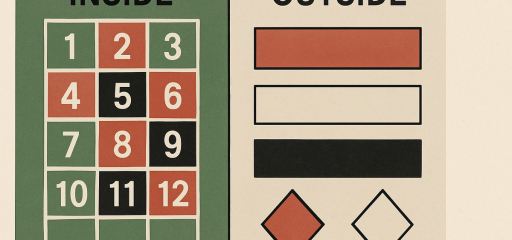
Inside bets sit on the numbered grid itself. They cover one number or a small cluster of adjacent numbers, and they pay the most per unit risked. The cluster sizes are fixed by the layout, which is why the payouts are fixed too: each inside bet is priced so that, on a fair wheel without the zero, it would break even. The single zero is what tilts the math toward the house, and it tilts every inside bet by the same percentage.
- Straight up, one number, pays 35:1.
- Split, two adjacent numbers, pays 17:1.
- Street, three numbers in a row, pays 11:1.
- Corner (square), four numbers meeting at a corner, pays 8:1.
- Six-line (double street), six numbers across two rows, pays 5:1.
- Top line, 0, 1, 2, 3 (American layout includes 00); on European wheels this is a four-number bet paying 8:1.
The pattern is clean: as the cluster grows, the payout shrinks in lockstep so that payout × probability stays the same. Which is why no inside bet beats any other on expected value.
What counts as an outside bet
Outside bets live in the boxes around the grid. They cover large groups of numbers and pay much less per unit, but they hit far more often. They are the bets people imagine when they picture a casual roulette player: red or black, odd or even, a quiet $5 on the third dozen.
- Red / Black, 18 numbers, pays 1:1.
- Even / Odd, 18 numbers, pays 1:1.
- High (19 to 36) / Low (1 to 18), 18 numbers, pays 1:1.
- Columns, 12 numbers down a vertical column, pays 2:1.
- Dozens (1 to 12, 13 to 24, 25 to 36), 12 numbers, pays 2:1.
None of these cover the zero. That is the whole story of the house edge in one sentence.
The house edge is identical at 2.70%
On a single-zero wheel there are 37 pockets. Every bet on the layout, inside or outside, is paid as if there were only 36. The casino keeps that one pocket of mismatch, which works out to 1/37 ≈ 2.70% of every unit wagered, regardless of which bet you place.
Quick check on a straight-up number: probability of winning is 1/37, payout is 35:1. Expected return per $1 staked is (1/37)(36) − 1 = −1/37 ≈ −2.70%. On red: probability 18/37, payout 1:1. Expected return is (18/37)(2) − 1 = −1/37 ≈ −2.70%. Same on dozens: (12/37)(3) − 1 = −1/37. The arithmetic doesn’t budge.
So if anyone tells you a particular outside bet is “safer in the long run” than a straight-up because of the house edge, they are wrong about the math. The long-run cost is the same. What differs is how that cost is delivered.
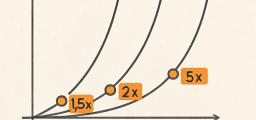
The variance gap: 35:1 vs 1:1
Variance is the technical name for how violently your bankroll swings around its average. For a single-unit bet that wins with probability p and pays b:1, the variance per unit staked is
Var = p(b − q)² + q(−1 − q)², where q = (−p·b + (1−p)) is the mean return per unit. Easier in practice to compute directly.
For a straight-up: p = 1/37, payout +35 with prob 1/37, −1 with prob 36/37. Mean ≈ −0.027. Variance ≈ (1/37)(35.027)² + (36/37)(−0.973)² ≈ 33.21 per unit bet.
For red (or any even-money bet): p = 18/37, payout +1 with prob 18/37, −1 with prob 19/37. Mean ≈ −0.027. Variance ≈ (18/37)(1.027)² + (19/37)(−0.973)² ≈ 0.999 per unit bet.
Ratio: about 33:1. A straight-up bet is roughly 33 times more volatile per unit wagered than a red/black bet. That is the entire personality difference between inside and outside roulette.
Bet-by-bet table
| Bet | Numbers covered | Payout | P(win) | House edge | Variance / unit |
|---|---|---|---|---|---|
| Straight up | 1 | 35:1 | 1/37 ≈ 2.70% | 2.70% | ≈ 33.21 |
| Split | 2 | 17:1 | 2/37 ≈ 5.41% | 2.70% | ≈ 16.10 |
| Street | 3 | 11:1 | 3/37 ≈ 8.11% | 2.70% | ≈ 10.40 |
| Corner | 4 | 8:1 | 4/37 ≈ 10.81% | 2.70% | ≈ 7.55 |
| Six-line | 6 | 5:1 | 6/37 ≈ 16.22% | 2.70% | ≈ 4.69 |
| Column / Dozen | 12 | 2:1 | 12/37 ≈ 32.43% | 2.70% | ≈ 1.97 |
| Red / Black / Odd / Even / High / Low | 18 | 1:1 | 18/37 ≈ 48.65% | 2.70% | ≈ 0.999 |
Read the right two columns together. House edge is a flat line. Variance climbs by a factor of about 33 as you move from even-money outside bets to a straight-up inside number. That column is what you are really shopping for at the table.
Why payouts are structured this way
Roulette’s payout schedule is older than most modern casino games and it was built around a simple rule: on a 36-pocket wheel, every bet would be a fair coin flip in expectation. A straight number would pay 35:1 because the odds against winning would be exactly 35:1. A corner of four numbers would pay 8:1 because the odds against would be 32:4 = 8:1. The single zero (and on American wheels, the double zero) was added later as the house’s cut, and the payouts were left unchanged. Which is why every bet on the European layout costs the same 2.70%, the entire edge is concentrated in that one extra pocket, and it taxes every bet proportionally.
Knowing this changes how you should read the table. The payouts are not the casino’s generosity for high-risk bets; they are the leftover scaffolding from a fair game. The only thing the house is actually selling, across the whole layout, is access to a wheel that pays out as if there were 36 pockets when there are really 37.
Session length on the same bankroll
Take a player with a $200 bankroll betting $5 a spin at a wheel turning roughly 40 spins per hour. Expected loss per hour is 40 × $5 × 2.70% = $5.40, regardless of bet choice. But how long the $200 lasts varies wildly with the bet.
On even-money bets, with variance near 1 per unit, the standard deviation of a single $5 spin is about $5. Over a one-hour session of 40 spins, the standard deviation of total result is roughly $5 × √40 ≈ $31.6. The bankroll mostly drifts down at $5, $6 an hour, with everyday swings of $30. People sit there for hours.
On straight-up bets at $5 each, the per-spin standard deviation is about $5 × √33.21 ≈ $28.8. Over 40 spins, total result has standard deviation around $182. A $200 stack can vanish, or double, in twenty minutes. Most sessions end with no hits and the bankroll gone before the hour is up; a minority of sessions end up well in profit because one or two straight-ups landed.
Same house edge, same expected loss, completely different experience. That is the bargain inside bets offer: you trade certainty of slow bleed for a real (if small) chance of walking away ahead in any given short session.
Combining inside and outside: does covering both sides help?
A popular table move is to bet, say, $10 on red and $1 on a straight-up black number. The reasoning sounds clever: if the wheel hits red, the $1 is lost but the $10 wins; if it hits your unlikely black number, the $1 pays $35 and you “win on the loss.” Layered bets like this look like hedges. They are not.
Each chip on the layout is its own independent bet, priced at the same 2.70% house edge. Adding a straight-up to a red bet does not lower the casino’s edge on either chip. It just averages two losing-by-2.70% wagers into a combined wager that loses 2.70% on the total amount staked. What it does change is variance, in a predictable direction: adding a high-variance chip to a low-variance chip raises the overall swing per spin.
If you want a higher hit rate, bet more on the outside. If you want bigger spikes, bet more on the inside. If you want both, stack chips on both, just don’t tell yourself the math is doing anything magical. It is not. It is averaging.
What “covering the layout” math actually says
Some players cover most of the wheel with a mix of inside bets, say, all dozens, plus a handful of corners, plus a couple of straights, hoping that the few uncovered numbers (and the zero) “rarely” hit. The math is unforgiving here.
Whatever fraction of the 37 pockets you cover, your expected loss is exactly 2.70% of total chips on the table per spin. If you have $100 spread across the layout, you expect to lose $2.70 per spin. The fact that 30 of 37 pockets pay you something does not change that, because the pockets that don’t pay you cost you everything. The math is a balance scale, not a coverage map.
What heavy coverage does buy is a high hit rate with mostly small wins and occasional brutal misses. The variance can actually drop below a pure straight-up strategy, but only because most spins return something. Long sessions still drift downward at 2.70%.
Risk-adjusted bet selection
Since every bet has the same expected return, the only honest way to compare them is by what fits your goals for the session:
- Want maximum time at the table? Outside even-money bets. Lowest variance, longest expected survival on a fixed bankroll.
- Want a real shot at a memorable win in an hour? A modest stake on straight-ups or splits. High variance is your friend here, because it gives the upside room to exist.
- Want a middle path? Columns and dozens. Pay 2:1, hit about a third of the time, variance close to 2. Decent compromise between session length and payout size.
- Avoid American wheels if you can. The double zero doubles the house edge to 5.26% on almost every bet, and there is no compensating change in payouts or variance. The European single-zero wheel is strictly the better deal.
- Bet sizing matters more than bet choice. A $1 straight-up costs you the same expected pennies as a $1 even-money. A $25 chip on either bet costs 25× more in expected loss. Variance scales with the square of bet size; bankroll lasts proportionally less.
Treat the choice between inside and outside as a thermostat for variance, not a hunt for an edge. There is no edge to find on a European wheel; the layout is priced to take 2.70% from every chip, full stop. For a deeper dive into the bet-by-bet math, the encyclopedia entry at Britannica’s roulette page covers the history and rules, and the analysis tables at Wizard of Odds: Roulette spell out the variance numbers for every bet type. For more on how probability gets taught in plain English, see Effortless Math.
FAQ
Q: Is red/black “safer” than a straight-up bet?
A: In the everyday sense, yes, your bankroll bleeds slowly instead of crashing. In the house-edge sense, no, both cost 2.70% of every dollar wagered on a single-zero wheel.
Q: Do columns and dozens have a better house edge than straight-ups?
A: No. Identical 2.70% on European roulette. They just hit more often (about 32% vs. About 2.7%) and pay less (2:1 vs. 35:1).
Q: Can I lower the house edge by mixing inside and outside bets?
A: You can’t. Each chip is taxed at 2.70%. Mixing changes variance and hit rate, never the long-run cost.
Q: Why is American roulette worse?
A: It adds a second zero (38 pockets) without raising any payout. House edge jumps from 1/37 ≈ 2.70% to 2/38 ≈ 5.26% on essentially every bet. Same variance shape, twice the expected loss.
Q: If variance is roughly 33× higher on a straight-up, do I lose 33× faster?
A: No, expected loss is the same. But the range of likely outcomes around that expected loss is much wider, so you are far more likely to bust your bankroll quickly (and far more likely to leave a big winner) than on even-money bets.
Gambling outcomes are uncertain; no strategy guarantees profit.

Related to This Article
More math articles
- The Best Grade 7 ELA Practice Tests for Pennsylvania Students
- Begin a Captivating Journey with “ATI TEAS 7 Math for Beginners”: The Ultimate Guide and Solutions Handbook
- Unions, Unemployment, and Work-Family Boundaries
- Reconstruction Amendments
- The Ultimate 8th Grade STAAR Math Course (+FREE Worksheets)
- Million-Dollar Wins on Negative-EV Bets: How Both Can Be True
- How to Define Elapsed Time
- Due Process and the Rights of the Accused
- A Comprehensive Collection of Free AFOQT Math Practice Tests
- Urbanization, Urban Growth, Suburbanization, and Metropolitan Regions







What people say about "Roulette Inside vs. Outside Bets: A Risk-Adjusted Comparison - Effortless Math"?
No one replied yet.