How to Calculate Compound Interest (Formula & Examples)
Compound interest is the single most important math concept for your wallet. Albert Einstein supposedly called it “the eighth wonder of the world.” Whether or not he actually said that, the math holds: small amounts of money, growing for long periods, become large amounts of money. Or, small debts grow into large debts.
This guide shows you the formula, walks through real examples, and gives you the Rule of 72 so you can estimate compound interest in your head.
What Compound Interest Means
Compound interest is interest earned on both your original money and previously earned interest.
Compare:
Simple interest on $1,000 at 10% per year:
– Year 1: $100 interest → balance $1,100.
– Year 2: $100 interest → balance $1,200.
– Year 3: $100 interest → balance $1,300.
Compound interest on $1,000 at 10% per year:
– Year 1: $100 interest → balance $1,100.
– Year 2: $110 interest → balance $1,210.
– Year 3: $121 interest → balance $1,331.
In just 3 years, compound interest earns $31 more. Over 30 years, the gap is enormous.
The Compound Interest Formula
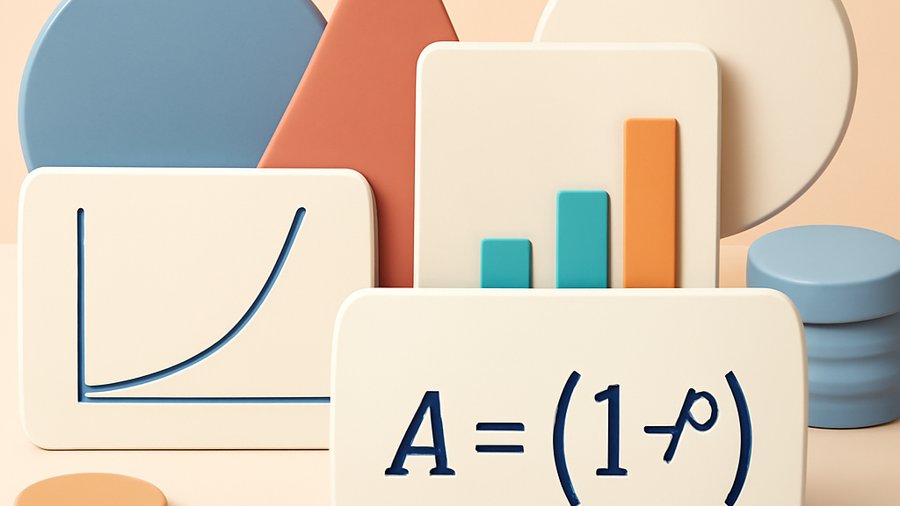
\[A = P\left(1 + \frac{r}{n}\right)^{nt}\]
Where:
– \(A\) = final amount.
– \(P\) = principal (starting amount).
– \(r\) = annual interest rate (as a decimal, 5% = 0.05).
– \(n\) = times interest is compounded per year.
– \(t\) = number of years.
Plain English
“Take your starting money. Add a small percent each compounding period. Repeat for the number of periods.”
Worked Example #1, Annual Compounding
You invest $5,000 at 7% annual interest, compounded annually, for 10 years.
\[A = 5000 \left(1 + \frac{0.07}{1}\right)^{1 \times 10} = 5000(1.07)^{10}\]
\[A = 5000 \times 1.9672 = \$9,836\]
You almost doubled your money in 10 years.
Worked Example #2, Monthly Compounding
You invest $5,000 at 7% annual interest, compounded monthly, for 10 years.
\[A = 5000 \left(1 + \frac{0.07}{12}\right)^{12 \times 10} = 5000(1.00583)^{120}\]
\[A \approx 5000 \times 2.0097 = \$10,049\]
Monthly compounding earns about $213 more than annual over 10 years. More frequent compounding = more interest, but the difference shrinks the more often you compound.
Worked Example #3, Credit Card Debt
This one’s painful. You carry a $3,000 credit card balance at 22% APR, compounded daily, for 2 years (and pay nothing).
\[A = 3000 \left(1 + \frac{0.22}{365}\right)^{365 \times 2}\]
\[A \approx 3000 \times 1.552 = \$4,655\]
In 2 years, $3,000 of debt becomes $4,655, a $1,655 cost for borrowing.
This is why minimum payments on credit cards are a trap.
Worked Example #4, Retirement Savings
You’re 25. You save $300/month into a retirement account at 8% annual return, compounded monthly, until age 65 (40 years).
This involves a slightly different formula (annuity), but the result:
\[A \approx \$1,055,000\]
A million dollars from $300/month, because of time and compounding.
If you wait until 35 to start, the same $300/month gives you only ~$450,000 at 65. Starting 10 years earlier doubles the outcome.
The Rule of 72, Mental Math for Compound Growth
The Rule of 72 estimates how long it takes for an investment to double:
\[\text{Years to double} \approx \frac{72}{\text{interest rate}}\]
Examples
- 3% interest: doubles in 72 ÷ 3 = 24 years.
- 6% interest: doubles in 72 ÷ 6 = 12 years.
- 8% interest: doubles in 72 ÷ 8 = 9 years.
- 12% interest: doubles in 72 ÷ 12 = 6 years.
- 15% interest: doubles in 72 ÷ 15 ≈ 5 years.
Why it’s useful
You can estimate any compound growth in your head:
– “I have $10,000 at 6%. How long to $40,000?” 6% doubles in 12 years → $20K in 12 → $40K in 24.
– “Credit card at 24%. How long until my debt doubles?” 72 ÷ 24 = 3 years.
How Compounding Frequency Matters
Same 6% interest on $1,000 for 10 years:
| Compounding | Final amount |
|---|---|
| Annually | $1,791 |
| Quarterly | $1,814 |
| Monthly | $1,819 |
| Daily | $1,822 |
| Continuously | $1,822 |
The gap between annual and daily is only $31** on $1,000 over 10 years. Frequency matters, but rate and time matter much more**.
Continuous Compounding (Bonus)
For the math-curious: as \(n\) approaches infinity:

\[A = Pe^{rt}\]
Where \(e \approx 2.71828\).
This is the theoretical maximum compounding rate. In practice, daily compounding gets you within pennies.
When Compound Interest Helps You
Investments:
– Index funds (S&P 500 historically ~10% annually).
– High-yield savings accounts (4-5% in 2026).
– Retirement accounts (401(k), Roth IRA).
– Certificates of deposit (CDs).
Time is the magic ingredient. A 25-year-old investing $200/month beats a 35-year-old investing $400/month.
When Compound Interest Hurts You
Debt:
– Credit cards (15-30% APR).
– Payday loans (often 400%+ APR).
– Some private student loans (variable rates).
– Buy-now-pay-later schemes with hidden fees.
Pay off high-interest debt first. A 20% credit card costs more than a 7% mortgage by a wide margin.
APR vs. APY (Important!)
- APR = Annual Percentage Rate. Simple interest rate without compounding.
- APY = Annual Percentage Yield. Effective rate including compounding.
A credit card “APR” of 22% with daily compounding has an APY of about 24.6%. Banks use APR for cards, APY for savings, because each makes the bank look better.
Smart Habits That Use Compounding
1. Start early
Even $50/month in your 20s beats $200/month in your 30s.
2. Increase contributions yearly
A 1% raise applied to savings each year adds up over decades.
3. Pay off high-interest debt first
Compound interest works against you. Kill credit card balances before saving.
4. Reinvest dividends
Stock dividends reinvested compound on top of price growth.
5. Use tax-advantaged accounts
401(k), IRA, HSA, compounding without tax drag is faster.
Common Misconceptions
“I need a lot of money to start.”
No. $50/month for 40 years at 8% = ~$170,000. Start small.
“I’ll wait until I make more.”
Every year you wait is a year of compounding lost. Time matters more than amount.
“My savings account will compound to riches.”
At 4% APY, doubling takes 18 years. Savings accounts beat zero, but they don’t beat inflation by much. Investments matter for long-term growth.
“Compound interest only works for the rich.”
The opposite. It’s most powerful for patient small savers. Time amplifies tiny amounts.
Free Resources
Effortless Math has financial math, percent, and exponent practice:
- Math Blog, financial math guides.
- Math Topics Library, percents, exponents, real-world math.
- SAT Math Resources, compound interest appears on the SAT.
Frequently Asked Questions
What’s a “good” annual return?
4-5% on savings (2026 high-yield). 7-10% on long-term diversified investments. 20%+ APR on debt is a red flag.
Is compound interest taxed?
Yes, in regular brokerage accounts. No in Roth IRAs and HSAs (under qualifying rules). Tax-advantaged accounts compound faster.
Does compound interest work with stocks?
Indirectly, stock prices grow, dividends reinvested compound. It’s not “interest” technically, but the effect is similar.
How do I avoid compound interest hurting me?
Pay credit cards in full monthly. Avoid payday loans. Lock in fixed-rate debt when rates are low.
Is the Rule of 72 accurate?
It’s an estimate. Exact doubling time is \(\frac{\ln 2}{\ln(1+r)}\). The Rule of 72 is within 1-2 years for rates 5-15%.
What’s the difference between APR and APY?
APR ignores compounding; APY includes it. APY is the “real” rate.
Time Is the Multiplier
The biggest variable in the compound interest formula isn’t the rate. It’s \(t\), time. A 25-year-old with $100/month at 8% ends up with more than a 50-year-old with $1,000/month at the same rate. Start now. Invest consistently. Let the math do the work.

Related to This Article
More math articles
- The Best Grade 8 ELA Practice Tests for Minnesota Students
- How to Convey Decimals in Words
- Maine Algebra 1 Free Worksheets: Printable Algebra 1 Practice for Every Skill
- Descriptive Statistics Calculator — Mean, SD, Quartiles (Free)
- What Happens If You Fail the STAAR Test in High School?
- Party identification
- The Best Grade 2 English Worksheets for Illinois Kids
- Wartime Science, Medicine, and Technology
- The Best Algebra 1 Book for New Mexico Students
- Protest and civil disobedience







What people say about "How to Calculate Compound Interest"?
No one replied yet.