How to Make Smart Payment Methods and Financial Decisions? (+FREE Worksheet!)
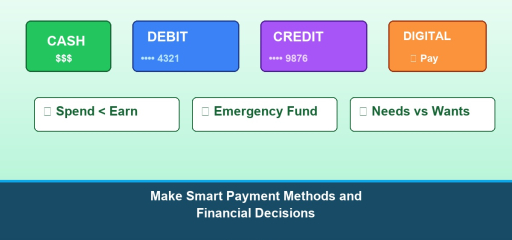
Every time you buy something, you make a choice about how to pay. Cash, debit card, credit card, check, or a digital payment app, each method has trade-offs in convenience, cost, security, and the temptation to overspend. Understanding these trade-offs is at the heart of financial literacy and helps you make smarter money decisions starting right now in 8th grade.
Make Smart Payment Methods and Financial Decisions: what to notice and how to work it
What to notice first
Common student mistake
Key formulas and cues
A reliable path
- Label money valuesSeparate principal, interest, tax, discount, payment, and final cost.
- Convert the percentWrite percent rates as decimals before calculating.
- Compare final amountsThe final value answers most financial questions.
Worked examples
Compare total paid
- Option A total is 6 times 40.
- Option B total is 4 times 55 plus 10.
- Compare the totals.
Notice the tradeoff
- Rewards help only if the balance is paid on time.
- A late fee can erase the reward.
- Include risk and habits in the decision.
Try one before moving on
Make Smart Payment Methods and Financial Decisions: pop-up practice
Being financially responsible means more than just having money in your pocket. It means spending within your means, saving regularly, avoiding unnecessary debt, and making informed choices about every purchase. In this guide we compare the most common payment methods, explore real-world scenarios, and give you practice problems to sharpen your decision-making skills.
Comparing Payment Methods
| Method | Advantages | Disadvantages |
|---|---|---|
| Cash | No fees; helps control spending; accepted almost everywhere | Can be lost or stolen; no purchase record; hard to use online |
| Debit Card | Convenient; money comes directly from your bank; works online | Fraud risk; overdraft fees if balance is low; limited dispute protection |
| Credit Card | Builds credit history; purchase protection; rewards/cashback | High interest if not paid in full; temptation to overspend; possible annual fees |
| Check | Paper trail; good for large payments like rent | Slow to process; can bounce if account balance is too low |
| Digital / App Payment | Fast; convenient for online and in-person tap-to-pay | Requires technology; privacy concerns; potential for impulse buying |
There is no single “best” payment method for every situation. The right choice depends on the cost, convenience, and risk involved in each transaction.
Key Principles of Financial Responsibility
- Spend less than you earn and save the difference.
- Avoid high-interest debt, pay credit card balances in full each month.
- Build an emergency fund for unexpected expenses (car repair, medical bill, broken phone).
- Plan before buying, distinguish needs from wants.
- Track your spending so you know exactly where your money goes.
The costs of financial irresponsibility can be severe: late fees, high interest charges, a damaged credit score, a debt spiral, increased stress, and fewer options in the future.
Step-by-Step Examples
Example 1, Saving vs. Borrowing
Eli wants a \(\$300\) gaming console. He has \(\$200\) in savings. Should he wait and save, or use a credit card?
Solution:
- Option A (Save): Save \(\$50\)/month for 2 months, then pay \(\$300\) cash. Total cost: \(\$300\). Interest: \(\$0\).
- Option B (Credit card at 20%): Charge \(\$300\), pay over 6 months. Approximate interest: \(300 \times 0.20 \times 0.5 = \$30\). Total cost: \(\$330\).
Option A saves \(\$30\) and avoids debt entirely.
Example 2, Choosing a Payment Method
Name one advantage and one disadvantage of using a debit card instead of cash.
Solution:
- Advantage: More convenient, works online and at stores without carrying bills.
- Disadvantage: If stolen, a thief could access your bank account. Overdraft fees are also possible if your balance drops too low.
Example 3, Emergency Fund vs. Credit Card
A \(\$500\) appliance repair is needed. Option A: charge it at 18% for 6 months. Option B: pay from an emergency fund.
Solution:
- Option A interest: \(I \approx 500 \times 0.18 \times 0.5 = \$45\). Total: \(\$545\).
- Option B cost: \(\$500\) (no interest, no debt).
Option B is better, no interest, no debt. Replenish the emergency fund afterward.
Video Lesson
Watch this video for additional examples and a step-by-step walkthrough:
Practice Problems
- You need to buy a \(\$5\) lunch at school. What is the most practical payment method?
- A family is paying \(\$1{,}200\) in rent. Why might they use a check?
- Mia uses her credit card for \(\$50\) in groceries and pays the full balance each month. Is this financially responsible? Explain.
- Jakeem borrows \(\$200\) from a payday lender and is charged a \(\$30\) fee per \(\$100\) for two weeks. What is the total fee? Is this responsible?
- Name two benefits of building good credit.
- Sofia has \(\$500\) in savings and wants a \(\$450\) phone. Her friend says to use a credit card. What should she do?
- Give one advantage and one disadvantage of using a digital payment app.
- Tyler earns \(\$600\)/month and saves \(\$20\). His friend earns \(\$600\)/month and saves \(\$200\). Who is more financially responsible?
- Ella wants a \(\$1{,}200\) laptop. Plan A: save \(\$200\)/month for 6 months and pay cash. Plan B: credit card at 20%, minimum payments for 14 months. How much does each plan cost?
- A store offers an \(\$800\) TV for \(\$50\)/month at 0% interest for 18 months. Is this a good deal?
Solutions
- Cash, small purchase, no fees needed, quick and simple.
- A check provides a paper trail and proof of payment, which protects both the tenant and the landlord.
- Yes, paying the full balance means zero interest charges and builds a positive credit history over time.
- Total fee: \(2 \times \$30 = \$60\). That is 30% in just 2 weeks, or roughly 780% annualized. Not responsible, payday loans are a debt trap.
- (1) Lower interest rates on future loans. (2) Easier approval for mortgages, apartments, and other financial products.
- Pay cash. She has enough money, so she avoids interest entirely and keeps \(\$50\) as a small cushion.
- Advantage: Fast and convenient for both online and in-store purchases. Disadvantage: Security risk if the app is hacked or your phone is stolen.
- Tyler saves \(\frac{20}{600} \approx 3.3\%\) of his income. His friend saves \(\frac{200}{600} \approx 33\%\). The friend is significantly more responsible financially.
- Plan A: \(\$200 \times 6 = \$1{,}200\) total (no interest). Plan B: approximately \(\$140\) in interest; total ≈ \(\$1{,}340\). Plan A saves about \(\$140\).
- The deal is good if every payment is made on time: \(16 \times \$50 = \$800\) (the remaining 2 months cover the balance). The risk: a missed payment can trigger back-interest on the full original balance, making the TV much more expensive.
Real-World Applications
Budgeting: Tracking your income and expenses each month, whether you earn money from chores, a part-time job, or an allowance, helps you see where your money goes and where you can save more.
Credit Scores: A credit score is a number (usually 300 to 850) that reflects how reliably you repay debts. A higher score means lower interest rates on future loans and better financial opportunities. Building good habits now, like paying bills on time, pays off for decades.
Common Mistakes to Avoid
- Using a credit card as “free money.” A credit card is a short-term loan. If you don’t pay the full balance each month, interest charges can add up fast.
- Not having an emergency fund. Without savings, unexpected expenses force you into high-interest debt.
- Ignoring the long-term cost. A low monthly payment stretched over many months often costs far more in total than paying upfront.
- Impulse buying with digital wallets. The ease of tap-to-pay can lead to spending more than planned.
Study Tips
- Always consider cost, convenience, and risk for every payment decision.
- A credit card paid in full each month = builds credit + earns rewards. A credit card with a carried balance = expensive debt.
- When comparing options, calculate the total cost, not just whether you can afford the monthly payment.
Frequently Asked Questions
What is the safest payment method?
No method is perfectly safe in every situation. Credit cards offer the best fraud protection (you can dispute charges), but they carry the risk of high interest. Cash has zero fraud risk for online theft but can be lost or stolen physically. Choose based on the specific situation.
Should I ever use a credit card?
Yes, when used responsibly. Paying the full balance each month builds your credit history, earns rewards, and provides purchase protection. The key rule: never charge more than you can pay off in full when the bill arrives.
How much of my income should I save?
A common guideline is to save at least 10%, 20% of your income. Even saving a small amount consistently, like \(\$20\) per week, adds up over time and creates a financial cushion for emergencies.

Related to This Article
More math articles
- Top 5 Free Websites for ASTB-E Math Preparation
- Household Chemistry: Soap and Concentration Labels
- Measurements – Time
- Algebra 2 Formula Flashcards
- Grade 4 ELA Tests: A Clear Parent Guide to Reading, Writing, and Test-Day Readiness
- Understanding Fractions Definition
- The Best Grade 5 Math Book for Florida Students
- How to Solve Special Systems
- Introduction to Limits: A First Look at Calculus for 2026
- Portable Power Tools: Action, Control, and Safety
What people say about "Smart Payment Methods and Financial Decisions"?
No one replied yet.