SSAT Elementary, Middle & Upper Level
SSAT Practice: Free SSAT Math Practice Tests, Topics & Flashcards
Review SSAT with practice, topic lessons, and study tools. Start with elementary level, middle level, upper level, then use your practice results to choose the next skill.

What is the SSAT?
The SSAT is an admissions test used by many independent schools. The Middle Level is for students in grades 5-7 and the Upper Level for grades 8-11. Each has two scored Quantitative (math) sections of 25 questions and 30 minutes, plus Verbal and Reading sections, an unscored writing sample and an unscored experimental section. The full test takes 3 hours 10 minutes. Schools set their own score expectations.
- Math sections
- 2 Quantitative sections, 25 questions and 30 minutes each (50 questions)
- Total time
- 3 hours 10 minutes, with two 10-minute breaks
- Calculator
- Not permitted
- Scoring
- +1 per correct answer, minus 1/4 point per wrong answer (Middle and Upper)
- Levels
- Elementary (grades 3-4), Middle (grades 5-7), Upper (grades 8-11)
Source: SSAT (admission.org) official information. Rules and dates can change, so confirm with the official site or your test center.
SSAT Test Outline
The SSAT has three levels and four student-facing sections. The Writing Sample is unscored, but schools receive it with the score report.
SSAT Elementary Level
Grades 3–4 · about 2 hr 5 min. Includes Quantitative, Verbal, Reading, a Writing Sample, and an experimental section.
SSAT Middle Level
Grades 5–7 · about 3 hr 10 min. Includes Quantitative, Verbal, Reading, a Writing Sample, and an experimental section.
SSAT Upper Level
Grades 8–11 · about 3 hr 10 min. Includes Quantitative, Verbal, Reading, a Writing Sample, and an experimental section.
SSAT Practice Tests
Choose a practice activity. Independent practice results are study feedback, not official test scores.
SSAT Flashcards
Open a vocabulary or formula resource. Availability and scope are described below.
SSAT Study Guides
Compare the actual book titles and check their product pages before choosing. These are independent preparation resources.
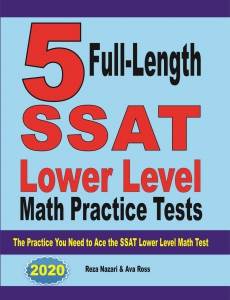
5 Full Length SSAT Lower Level Math Practice Tests: The Practice You Need to Ace the SSAT Lower Level Math Test
Open the product page to check the contents, edition, format, and purchase options.
View book & purchase options → $17.99 · PDF

SSAT Middle Level Math for Beginners: The Ultimate Step by Step Guide to Preparing for the SSAT Middle Level Math Test
Open the product page to check the contents, edition, format, and purchase options.
View book & purchase options → $17.99 · PDF

SSAT Upper Level Math for Beginners 2026: The Ultimate Step by Step Guide to Preparing for the SSAT Upper Level Math Test
Open the product page to check the contents, edition, format, and purchase options.
View book & purchase options → $17.99 · PDF
SSAT Quick Review
Review one skill, try its practice, and use the result to choose your next step.
WORD KNOWLEDGE · CHOOSE A LEVEL
SSAT Vocabulary Flashcards
Choose the deck that matches the student’s SSAT level. Each set uses age-appropriate examples and numbered cards.
Jump into SSAT
The student’s current grade determines which SSAT level to explore.
SSAT Elementary Level
Grades 3–4 · 2 hr 5 min. Explore the sections and choose a focused study path.
SSAT Middle Level
Grades 5–7 · 3 hr 10 min. Explore the sections and choose a focused study path.
SSAT Upper Level
Grades 8–11 · 3 hr 10 min. Explore the sections and choose a focused study path.
Join students who study with a clearer path
A clear plan starts with the right level, a realistic practice target, and time to learn from mistakes. The Experimental section is unscored; focus preparation on the reported sections.
Start With A Practice Test
Take a diagnostic first
Use an appropriate practice set to see which skills feel familiar and which need review.
Know what is tested
Check the level and section outline before choosing what to study.
Fix one weak skill
Review your work and select one specific idea or question type for the next session.
Move into mixed practice
Return to a broader practice set after focused review, with time left to check your work.
SSAT Test Snapshot
Free Resources And Official Guides
Use current official materials to confirm test format. Site resources are labeled by level so students can practice the right skills.
Official SSAT overview and practice options
Check current test levels, formats, and official practice materials with the assessment provider.
SSAT Elementary Level
Grades 3–4 · 2 hr 5 min. Explore the sections and choose a focused study path.
SSAT Middle Level
Grades 5–7 · 3 hr 10 min. Explore the sections and choose a focused study path.
SSAT Upper Level
Grades 8–11 · 3 hr 10 min. Explore the sections and choose a focused study path.
SSAT Skill Quizzes
Quantitative (Math)
Review math concepts and solve problems without a calculator.
Verbal
Build vocabulary and identify relationships between words.
Reading
Use passage evidence to understand ideas, details, and author choices.
Writing Sample
Plan a focused response. This section is unscored, but schools receive the sample.
Experimental Section
This mixed-question section is unscored; focus preparation on the reported sections.
SSAT Levels and Sections: Learn and Practice
Choose an SSAT level, then open the mathematics, verbal, or reading study Online Center. Use the vocabulary decks for focused word practice.
3 levels · math · verbal · reading
Elementary Level
Middle Level
SSAT Skills Worth Reviewing
Rushing the directions
Pause long enough to identify exactly what the question asks.
Choosing before checking
Check the evidence or work before settling on an answer.
Repeating the same mistake
Keep a short error note and return to the skill later.
Skipping review
Use a few minutes at the end to check unanswered or uncertain items.
Choose Your SSAT Prep Tool
Official SSAT overview and practice options
Check current test levels, formats, and official practice materials with the assessment provider.
SSAT Elementary Level
Grades 3–4 · 2 hr 5 min. Explore the sections and choose a focused study path.
SSAT Middle Level
Grades 5–7 · 3 hr 10 min. Explore the sections and choose a focused study path.
SSAT Upper Level
Grades 8–11 · 3 hr 10 min. Explore the sections and choose a focused study path.
SSAT Practice Paths
Foundations Path
Review directions and core ideas first. Keep sessions brief and deliberate.
Core Skills Path
Choose one skill family at a time, practice, and learn from errors.
Mixed Practice Path
Combine skills after focused work and build a steady test-day routine.
SSAT for Beginners
Start with the format
Learn what the section includes and how much time is available.
Use short practice
Work on a small set or a brief writing task, then stop to review.
Build one skill at a time
Choose your next session from the errors or questions you marked.
Return to mixed review
Connect focused practice with the full test format before test day.
Choose The Right SSAT Study Materials
Choose materials that match the student’s SSAT level and the section being practiced. Official test details are available from the assessment provider.
Official SSAT Candidate Information
Confirm current test format, level, and registration details directly with the provider.
Focused section practice
Use the relevant section Online Center to plan a short lesson, practice session, and review.
4-Week SSAT Study Roadmap
Week 1: Set a baseline
Confirm the correct level for the student’s current grade.
Week 2: Practice one skill
Read the level snapshot and note the section timing.
Week 3: Add mixed review
Choose one section Online Center and work on one skill at a time.
Week 4: Use test-mode practice
Return for mixed review and use official materials to learn current test directions.
SSAT FAQ
Which SSAT level should a student take?
Elementary is for grades 3–4, Middle for grades 5–7, and Upper for grades 8–11. Confirm current eligibility with the official provider.
Is the Writing Sample scored?
No. It is unscored, but schools receiving the score report also receive the sample.
Is the experimental section scored?
No. It is used to evaluate future test questions and is not part of reported section scores.
Where should families check the latest details?
Review the official SSAT information and current Candidate Handbook before registration.
Related Online Centers
SSAT Elementary Level
Grades 3–4 · 2 hr 5 min. Explore the sections and choose a focused study path.
SSAT Middle Level
Grades 5–7 · 3 hr 10 min. Explore the sections and choose a focused study path.
SSAT Upper Level
Grades 8–11 · 3 hr 10 min. Explore the sections and choose a focused study path.
Make This Your SSAT Starting Point
Start with the student’s level, then follow the section that needs the most practice.
A USEFUL NEXT STEP
SSAT: study questions
How many math questions are on the SSAT?
The Middle and Upper Level SSAT each have two Quantitative sections with 25 questions each, for 50 math questions. Each section is 30 minutes. The unscored experimental section may also include a few math questions, but they do not count toward your score.
What math topics are on the SSAT?
The Quantitative sections test arithmetic, elementary algebra, geometry and other math concepts. Expect fractions, decimals, percents, ratios, number properties, simple equations, word problems, area and perimeter, and reading data from tables and graphs. Upper Level questions go further into algebra and geometry than Middle Level questions.
Can you use a calculator on the SSAT?
No. Calculators are not permitted on the SSAT Quantitative sections at the Middle or Upper Level. Practice mental math and paper-and-pencil methods for fractions, percents, ratios and multi-step word problems, so you can finish each 25-question section within its 30-minute limit.
Is there a penalty for guessing on the SSAT?
Yes, on the Middle and Upper Levels. You earn one point for each correct answer and lose a quarter point for each wrong answer. Skipped questions do not change your score. The Elementary Level has no penalty for wrong answers. Guess when you can rule out at least one choice.
How can I practice for SSAT math online?
The test owner offers a free online Mini-Practice Test with 30 questions and a score report, plus paid Online Practice and official guide books with full-length practice tests. Mix timed practice sections with review of missed problems, and use flash cards for formulas and math vocabulary.
What can I study in this SSAT Online Center?
Use this page to review elementary level, middle level, upper level. Open a topic lesson or quiz, review an error, and return to mixed practice. The resources are independent preparation materials.
How should I use the SSAT resources?
Choose a topic or practice activity from this Online Center. Review the linked explanation, try the practice, and use the result to decide what to study next. Check each resource’s directions for its format and access requirements.
Resources from Effortless Math · Editorial standards