Enhanced ACT · Math, English, Reading & Science
ACT Practice Tests: Free ACT Math Practice Test & Subject Review
Choose ACT practice and review for English, Math, Reading, Science, or Writing. For Math, use the topic lessons, flashcards, and practice feedback to work on one weak skill at a time.

MEET THE TEST
Know the ACT before you start.
Explore the skills, open a subject Online Center, and build a test plan that fits your goals.
English
Edit for clarity and correctness.
- Grammar & punctuation
- Sentence structure & word choice
- Organization, purpose & style
Study tip
Check how an edit fits the passage’s meaning, tone, and grammar. The shortest answer works only when it is clear and complete.
Math
Solve problems and connect ideas.
- Number & quantity, algebra
- Functions & graphs
- Geometry & measurement
- Statistics & probability
Study tip
Label what you know, identify what the question asks, and estimate when you can. Use your calculator to check a plan you understand.
Reading
Read closely and use evidence.
- Main ideas & supporting details
- Inference & evidence
- Vocabulary in context
- Text structure & paired passages
Study tip
Return to the relevant lines before choosing an answer. A reasonable idea still needs support from the passage.
Make the plan yours.
Select either optional section to update your plan. Neither affects your Composite.
Science
Make sense of scientific information.
- Interpret graphs & tables
- Analyze experiments
- Compare scientific viewpoints
Study tip
Read axis labels, units, and the legend. For experiments, identify what changed and what was measured before comparing results.
Writing
Develop a clear, supported argument.
- Analyze different perspectives
- Build & support your position
- Organize and develop your essay
Study tip
Choose a clear position, consider another perspective, and outline your reasons and examples before writing the essay.
Test format checked October 5, 2026 against ACT’s official overview. Standard ACT time limits shown. Science and Writing are optional for national testing; school-day choices may depend on your school or district. See ACT’s official test details Prepared by the Effortless Math team. Editorial standards.
FIND YOUR FOCUS
One ACT. Five places to prepare.
Choose a subject to find its review and practice resources.
ACT English
Grammar, punctuation & clear writing
Open English Online Center Core sectionACT Math
Algebra, functions, geometry & data
Explore Math resources Core sectionACT Reading
Main ideas, evidence & inference
Open Reading Online Center Optional sectionACT Science
Graphs, experiments & scientific reasoning
Open Science Online Center Optional sectionACT Writing
An organized argument with clear support
Open Writing Online CenterEnglish, Math, and Reading form the ACT Composite score. Science and Writing are optional for national testing; school-day choices can depend on your school or district. Check the current ACT format ↗
QUICK ANSWERS
ACT questions, answered.
Understand the format, then choose your next study step.
What subjects are on the current ACT?
The ACT core sections are English, Math, and Reading. Science and Writing are optional additions for national testing. School-day testing choices can depend on your school or district.
ACT’s official test details ↗How long is the ACT?
The core ACT has 131 questions and 125 minutes of testing time: English has 50 questions in 35 minutes, Math has 45 questions in 50 minutes, and Reading has 36 questions in 40 minutes. Science adds 40 questions and 40 minutes. Writing adds one essay prompt and 40 minutes. These totals exclude breaks and check-in.
ACT’s official test details ↗Does Science or Writing affect the ACT Composite score?
No. The current ACT Composite score uses English, Math, and Reading. Optional Science and Writing results are reported separately. Check your college or program’s requirements before deciding which sections to take.
ACT’s official test details ↗Where can I find free ACT practice and flashcards?
This ACT Online Center provides six free online ACT Math practice tests, Math lessons, printable resources, and flashcards. Its English, Reading, Science, and Writing Online Centers offer subject review and practice resources. Use the resource buttons above to open the tools in a popup.
Is this an official ACT website?
No. Effortless Math is an independent test-preparation publisher. Its practice questions, explanations, and study guides are preparation resources, and practice scores are study feedback rather than official ACT scores. For registration, test policies, and official practice, visit ACT.
ACT’s official test details ↗GO DEEPER IN MATH
Your ACT Math practice & review library
Six online tests, topic lessons, printable practice, and worked examples. Choose the resource that matches your next step.
ACT resources
Choose the book that matches how you want to study. These are ACT Math guides; English, Reading, Science, and Writing resources are in the subject Online Centers.
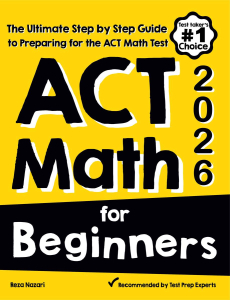
ACT Math for Beginners 2026
Build a steady foundation with step-by-step lessons, worked examples, and practice.
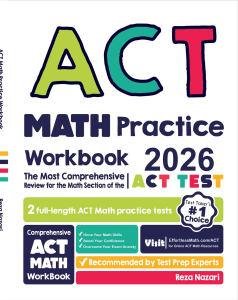
ACT Math Practice Workbook 2026
Give the topics you find difficult more practice, then return to a mixed test.
Prices shown are current store prices. Any eligible offer is applied at checkout.
Free ACT Math Practice Test
Take a free, full-length ACT Math practice test in the enhanced format: 45 questions in 50 minutes, with a calculator allowed throughout. You get an instant 1–36 scaled score, step-by-step solutions and a topic breakdown, so you know exactly what to review next.
Take the free ACT Math practice test → More timed ACT Math tests ACT Math topics covered
ACT Math Practice Tests 2–6
Five additional ACT Math simulations, each with 45 questions, a 50-minute timer, an estimated score, topic feedback, and step-by-step explanations.
ACT Math Practice Test 2
A fresh full-length test covering ACT Math topics across the section.
Start Test →
ACT Math Practice Test 3
Build pacing and accuracy with another complete timed simulation.
Start Test →
ACT Math Practice Test 4
Use the topic breakdown to decide what deserves another review.
Start Test →
ACT Math Practice Test 5
Practice moving between algebra, functions, geometry, and data questions.
Start Test →
ACT Math Practice Test 6
Finish with a final timed set and review every uncertain answer.
Start Test →
Scores on these independent practice tests are for study only; they are not ACT scores. ACT® is a registered trademark of ACT, Inc. This page is not sponsored or endorsed by ACT.
Free interactive practice
ACT Study Lab: Flashcards, Question of the Day and Study Plan
Short, active practice for the ACT: flip ACT Math flashcards for the formulas you must know without a formula sheet, learn the English rules behind punctuation and style questions, pick up Science reading tips, answer a new question every day and build a week-by-week plan for your test date.
ACT Math flashcards
The formulas and facts you need with no formula sheet on test day, plus quick “solve it” problems and strategy, grouped by topic. Mark each card “Got it” or “Review again”; cards you miss collect in your review list.
Keys: Space flip · ← → move · 1 review again · 2 got it
See all 60 cards as a list
ACT English rules
The punctuation, grammar, transition and style rules behind ACT English questions, each with an example and a fix.
Keys: Space flip · ← → move · 1 review again · 2 got it
See all 24 cards as a list
ACT Science tips
How to read graphs and tables, compare experiments and handle conflicting viewpoints in the optional Science test.
Keys: Space flip · ← → move · 1 review again · 2 got it
See all 10 cards as a list
ACT question of the day
A new original practice question every day. Answer it to keep your streak going.
Algebra and Functions
Show the answer
Answer: B. 34 = 81, so the log is 4.
ACT study plan by test date
Pick your test date and how much time you have each day. You get a week-by-week plan that starts with a practice test, rotates through the main topics and ends with a light final review.
National ACT dates and regular registration deadlines for 2026–27. Deadlines and test-center availability can change, so confirm on act.org before you register.
On this page
Jump into ACT Math
See it. Understand it. Try it.
ACT Math Quick Review turns each skill into a clear explanation, a visual example, and a chance to practice. Start with one topic, then move through the ACT skill map at your own pace.
Six ways into ACT Math
Each review begins with a visual explanation and ends with a chance to practice.
Join students who study with a clearer path
This ACT Math study center connects lessons, worksheets, practice tests, books, and Quick Review so students can choose a clear next step.
This is an independent ACT Math preparation resource from the Effortless Math team. The ACT program does not endorse this page.
50 Interactive ACT Math Practice Tests
You have 50 full-length ACT Math practice tests to work through. Each has 45 questions, a 50-minute timer, instant scoring, and answer explanations. Choose a test below.
Tests 1–10
Take Tests 1–10 online. Each interactive test includes a timer, instant scoring, and answer explanations. PDF downloads are below.
- Test 1 online · Book Test 1 PDF
- Test 2 online · Book Test 2 PDF
- Test 3 online · Book Test 3 PDF
- Test 4 online · Book Test 4 PDF
- Test 5 online · Book Test 5 PDF
- Test 6 online · Book Test 6 PDF
- Test 7 online · Book Test 7 PDF
- Test 8 online · Book Test 8 PDF
- Test 9 online · Book Test 9 PDF
- Test 10 online · Book Test 10 PDF
Tests 11–50
More full-length interactive tests for fresh practice. Open a group to choose your next test.
Tests 11–20
Tests 21–30
Tests 31–40
ACT Math Snapshot
questions on ACT Math
minutes for the Math section
Preparing for Higher Math
Integrating Essential Skills
ACT Math Test Outline
Use this skill map to find a topic family, then open a lesson, a practice set, or ACT Quick Review when you are ready.
Number Sense and Rational Numbers
Use number properties and rational numbers accurately in multi-step problems.
Topics covered
- Comparing and Ordering Integers
- Integers and Absolute Value
- Adding and Subtracting Integers
- Multiplying and Dividing Integers
- Factors Multiples GCF and LCM
- Adding and Subtracting Fractions
- Multiplying Mixed Numbers
- Multiplying and Dividing Fractions
- Adding and Subtracting Decimals
- Multiplying and Dividing Decimals
- Converting Fractions Decimals and Percents
- Real World Problems with Rational Numbers
Ratios, Percents, and Rates
Compare quantities, convert units, and solve percent and rate problems.
Topics covered
- Simplifying Ratios
- Unit Rates
- Proportional Ratios
- Constant of Proportionality
- Scale Drawings and Scale Factors
- Converting Units of Measurement
- Percent Problems
- Finding the Whole from a Part and Percent
- Percent of Increase and Decrease
- Discount Tax and Tip
- Simple Interest
- Compound Interest
- Tips Commissions and Fees
Exponents, Radicals, and Scientific Notation
Work with powers, roots, rational numbers, and scientific notation.
Topics covered
- Multiplication Property of Exponents
- Division Property of Exponents
- Zero and Negative Exponents
- Negative Exponents and Negative Bases
- Radicals
- Rational and Irrational Numbers
- Scientific Notation
- Operations with Scientific Notation
Expressions, Equations, and Inequalities
Simplify expressions, solve equations, and interpret inequalities.
Topics covered
- When an Expression Is Undefined
- Evaluating One Variable
- Evaluating Two Variables
- Simplifying Variable Expressions
- The Distributive Property
- One Step Equations
- Solving Two Step Equations
- Multi Step Equations
- Equations with Variables on Both Sides
- Literal Equations and Formulas
- One Step Inequalities
- Multi Step Inequalities
- Compound Inequalities
- Graphing Linear Inequalities
Coordinate Geometry and Lines
Use the coordinate plane, slope, line equations, and systems.
Topics covered
- The Coordinate Plane
- Finding Slope
- Graphing Lines
- Point Slope Form
- Standard Form of a Linear Equation
- Writing Linear Equations
- Parallel and Perpendicular Lines
- Systems of Equations
- Finding Midpoint
- Finding Distance of Two Points
Functions
Read function notation, compare functions, and interpret graphs.
Topics covered
- Relations and Functions
- Function Notation
- Domain and Range
- Linear vs Nonlinear Functions
- Comparing Functions
- Interpreting Graphs of Functions
Polynomials and Quadratics
Factor, simplify, and solve polynomial and quadratic problems.
Topics covered
- Adding and Subtracting Polynomials
- Simplifying Polynomials
- Multiplying Binomials
- Special Products of Polynomials
- Factoring with the Greatest Common Factor
- Factoring Trinomials
- Solving Quadratic Equations by Factoring
- The Quadratic Formula
- Graphing Quadratic Functions
- Rational Expressions
Geometry and Measurement
Use angle relationships, shape properties, measurement, and formulas.
Topics covered
- Complementary and Supplementary Angles
- Parallel Lines and Transversals
- Triangles
- Similarity and Ratios
- Area of Triangles
- Area and Perimeter of Quadrilaterals
- Polygons
- Circles
- Area and Perimeter of Composite Figures
- Rectangular Prisms
- Cubes
- Cylinder
- Surface Area of Solids
- Volume and Surface Area of Composite Solids
Data, Statistics, and Probability
Interpret data displays, describe distributions, and reason about probability.
Topics covered
- Weighted Averages and Missing Data Values
- Box Plots and Interquartile Range
- Histograms and Data Displays
- Pie Graph
- Scatter Plots and Lines of Best Fit
- Two Way Frequency Tables
- Probability Problems
- Probability of Compound Events
- Permutations and Combinations
Free ACT Math Formula Review
Review 50 formulas and key relationships, check when to use them, and practice with three worked examples.
AlgebraCheck equations, functions, and sequences.›
Coordinate GeometryReview slope, distance, and line equations.›
Geometry & TrigonometryCheck area, volume, and triangle relationships.›
Statistics & ProbabilityReview averages and probability rules.›
Worked ExamplesApply formulas and check common mistakes.›
ACT Math Skill Quizzes
Choose a skill, answer 10 questions, and review your score and step-by-step solutions. Each quiz opens here in a popup.
Ratios & Proportional Reasoning
Unit rates, proportions, and real-world comparisons.
Start Quiz →
Percents & Financial Math
Percent change, discounts, interest, and money math.
Start Quiz →
Solving Linear Equations
One-step to multi-step equations and literal equations.
Start Quiz →
Linear Functions & Graphs
Slope, intercepts, and writing the equation of a line.
Start Quiz →
Systems of Equations & Inequalities
Substitution, elimination, and matching graphs to solutions.
Start Quiz →
Exponents & Polynomials
Exponent rules and polynomial operations.
Start Quiz →
Quadratic Functions & Equations
Factoring, the quadratic formula, and parabola graphs.
Start Quiz →
Functions
Function notation, evaluating functions, and function operations.
Start Quiz →
Geometry & Measurement
Area, volume, and measurement formulas.
Start Quiz →
Statistics & Probability
Centers, spreads, charts, and probability.
Start Quiz →
ACT Math Topics: Learn, Practice, and Quiz
Choose an ACT topic, open its worksheet for printable practice, then take a short quiz from the same row.
96 topics · worksheets · quizzes
ACT Math Quick Review
Number Sense and Rational Numbers
- Comparing and Ordering Integers WorksheetQuiz
- Integers and Absolute Value WorksheetQuiz
- Adding and Subtracting Integers WorksheetQuiz
- Multiplying and Dividing Integers WorksheetQuiz
- Factors Multiples GCF and LCM WorksheetQuiz
- Adding and Subtracting Fractions WorksheetQuiz
- Multiplying Mixed Numbers WorksheetQuiz
- Multiplying and Dividing Fractions WorksheetQuiz
- Adding and Subtracting Decimals WorksheetQuiz
- Multiplying and Dividing Decimals WorksheetQuiz
- Converting Fractions Decimals and Percents WorksheetQuiz
- Real World Problems with Rational Numbers WorksheetQuiz
Ratios, Percents, and Rates
- Simplifying Ratios WorksheetQuiz
- Unit Rates WorksheetQuiz
- Proportional Ratios WorksheetQuiz
- Constant of Proportionality WorksheetQuiz
- Scale Drawings and Scale Factors WorksheetQuiz
- Converting Units of Measurement WorksheetQuiz
- Percent Problems WorksheetQuiz
- Finding the Whole from a Part and Percent WorksheetQuiz
- Percent of Increase and Decrease WorksheetQuiz
- Discount Tax and Tip WorksheetQuiz
- Simple Interest WorksheetQuiz
- Compound Interest WorksheetQuiz
- Tips Commissions and Fees WorksheetQuiz
Exponents, Radicals, and Scientific Notation
- Multiplication Property of Exponents WorksheetQuiz
- Division Property of Exponents WorksheetQuiz
- Zero and Negative Exponents WorksheetQuiz
- Negative Exponents and Negative Bases WorksheetQuiz
- Radicals WorksheetQuiz
- Rational and Irrational Numbers WorksheetQuiz
- Scientific Notation WorksheetQuiz
- Operations with Scientific Notation WorksheetQuiz
Expressions, Equations, and Inequalities
- When an Expression Is Undefined WorksheetQuiz
- Evaluating One Variable WorksheetQuiz
- Evaluating Two Variables WorksheetQuiz
- Simplifying Variable Expressions WorksheetQuiz
- The Distributive Property WorksheetQuiz
- One Step Equations WorksheetQuiz
- Solving Two Step Equations WorksheetQuiz
- Multi Step Equations WorksheetQuiz
- Equations with Variables on Both Sides WorksheetQuiz
- Literal Equations and Formulas WorksheetQuiz
- One Step Inequalities WorksheetQuiz
- Multi Step Inequalities WorksheetQuiz
- Compound Inequalities WorksheetQuiz
- Graphing Linear Inequalities WorksheetQuiz
Coordinate Geometry and Lines
- The Coordinate Plane WorksheetQuiz
- Finding Slope WorksheetQuiz
- Graphing Lines WorksheetQuiz
- Point Slope Form WorksheetQuiz
- Standard Form of a Linear Equation WorksheetQuiz
- Writing Linear Equations WorksheetQuiz
- Parallel and Perpendicular Lines WorksheetQuiz
- Systems of Equations WorksheetQuiz
- Finding Midpoint WorksheetQuiz
- Finding Distance of Two Points WorksheetQuiz
Functions
Polynomials and Quadratics
- Adding and Subtracting Polynomials WorksheetQuiz
- Simplifying Polynomials WorksheetQuiz
- Multiplying Binomials WorksheetQuiz
- Special Products of Polynomials WorksheetQuiz
- Factoring with the Greatest Common Factor WorksheetQuiz
- Factoring Trinomials WorksheetQuiz
- Solving Quadratic Equations by Factoring WorksheetQuiz
- The Quadratic Formula WorksheetQuiz
- Graphing Quadratic Functions WorksheetQuiz
- Rational Expressions WorksheetQuiz
Geometry and Measurement
- Complementary and Supplementary Angles WorksheetQuiz
- Parallel Lines and Transversals WorksheetQuiz
- Triangles WorksheetQuiz
- Similarity and Ratios WorksheetQuiz
- Area of Triangles WorksheetQuiz
- Area and Perimeter of Quadrilaterals WorksheetQuiz
- Polygons WorksheetQuiz
- Circles WorksheetQuiz
- Area and Perimeter of Composite Figures WorksheetQuiz
- Rectangular Prisms WorksheetQuiz
- Cubes WorksheetQuiz
- Cylinder WorksheetQuiz
- Surface Area of Solids WorksheetQuiz
- Volume and Surface Area of Composite Solids WorksheetQuiz
Data, Statistics, and Probability
- Weighted Averages and Missing Data Values WorksheetQuiz
- Box Plots and Interquartile Range WorksheetQuiz
- Histograms and Data Displays WorksheetQuiz
- Pie Graph WorksheetQuiz
- Scatter Plots and Lines of Best Fit WorksheetQuiz
- Two Way Frequency Tables WorksheetQuiz
- Probability Problems WorksheetQuiz
- Probability of Compound Events WorksheetQuiz
- Permutations and Combinations WorksheetQuiz
ACT Math Mistakes to Watch For
Use a missed or guessed question to choose your next review. Open a worked check, then follow the link to the matching topic. These examples explain the method and are not official test questions.
Signs and fraction operations
Losing a negative sign can change the entire answer. Write the operation before reaching for the calculator.
See a worked check
For -3(2 – 5), finish the parentheses first: -3(-3) = 9. For 1/2 + 1/3, use sixths: 3/6 + 2/6 = 5/6.
Distribution and equations
Distribute to every term, then keep both sides of the equation balanced. Substituting your result catches a missed sign.
See a worked check
3(x – 2) = 12 becomes 3x – 6 = 12, so x = 6. The check is 3(6 – 2) = 12.
Inputs and outputs
Decide if the question gives the input or the output. A function value and the input that produces it require different steps.
See a worked check
If f(x) = 2x + 1, then f(3) = 7. Finding x when f(x) = 3 means solving 2x + 1 = 3, which gives x = 1.
Area, perimeter, and height
Label the measurement you need. A slanted side is not automatically the perpendicular height, and perimeter uses different units from area.
See a worked check
A triangle with base 8 cm and perpendicular height 5 cm has area (8 × 5)/2 = 20 cm². The height must meet the base at a right angle.
Averages and group sizes
Read the labels and count how many values each group contains. Averaging two group averages equally can give the wrong combined result.
See a worked check
A group of 2 with mean 60 and a group of 8 with mean 80 have combined mean (2 × 60 + 8 × 80)/10 = 76.
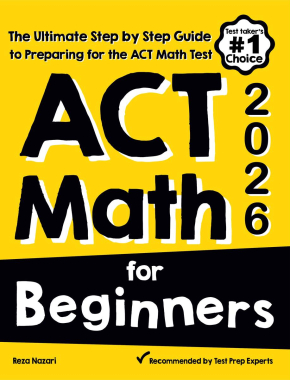
ACT Math for Beginners 2026: The Ultimate Step by Step Guide to Preparing for the ACT Math Test
Start with one lesson. ACT Math for Beginners walks through the method and worked examples before you try the practice problems, so you can revisit the step that gave you trouble.
- Best first book for students who need structure
- Step-by-step lessons before mixed practice
- Pairs naturally with the free guides and topic lessons on this online center
- Use the online practice tests to check your progress
Start from the basics
The book rebuilds the topic sequence before asking students to move into timed practice.
Use worked examples
Students can see the move, copy the method, then try similar problems on their own.
Drill one skill at a time
The structure supports focused practice instead of scattered review.
Move into confidence practice
After the book path, the online center connects students to worksheets, flashcards, and test-style questions.
How to use it
- Read one short lesson.
- Copy the worked example.
- Practice the matching skill from this online center.
- Return to mixed or timed practice after the skill feels stable.
Pair it with free tools
Choose The Right ACT Math Book
Use a study guide when you need explanations; choose a workbook when you need more practice with individual topics. The two options below make those starting points easy to compare.
ACT Math for Beginners 2026: The Ultimate Step by Step Guide to Preparing for the ACT Math Test
Need step-by-step explanations?
Start with explanations and worked examples when the basics feel rusty.
View book details → $17.99 · PDF
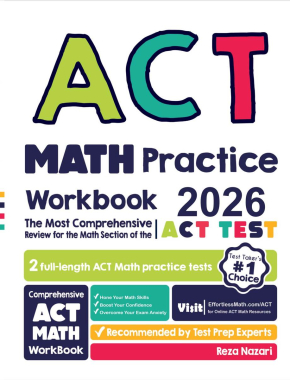
ACT Math Practice Workbook 2026: The Most Comprehensive Review for the Math Section of the ACT Test
Need extra topic practice?
Work on the topics you miss, then return to a mixed practice set.
View book details → $19.99 · PDF
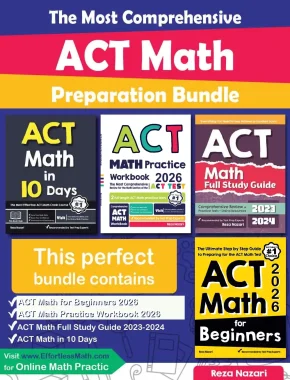
The Most Comprehensive ACT Math Preparation Bundle: Includes ACT Math Prep Books, Workbooks, and Practice Tests
Recommended practice resource

ACT Math Comprehensive Prep Bundle: A Perfect Resource for ACT Math Test Takers
Recommended practice resource

10 Full Length ACT Math Practice Tests: The Practice You Need to Ace the ACT Math Test
Recommended practice resource

ACT Math Test Prep: The Ultimate Guide to ACT Math + 2 Full-Length Practice Tests
Recommended practice resource
ACT Math FAQ
What should I practice first for ACT Math?
Start with Pre-algebra fluency and essential skills. Then use a short mixed practice set to see which skill should come next.
How should I use this ACT Math Online Center?
Begin with the main starting resource, choose one weak skill from the map, practice it, then return to the online center for the next topic or a timed review.
Are there free resources on this page?
Yes. The online center links to free Effortless Math resources such as Enhanced ACT Math Practice Test PDF, ACT Math Flashcards, Enhanced ACT Math 2026.
Which ACT Math skills matter most?
The highest-value areas include Pre-algebra fluency and essential skills; Algebra, equations, inequalities, and systems; Functions, graph interpretation, and modeling. Use the skill map as a checklist rather than trying to study everything at once.
When should I use a book or workbook?
Use a book when the student needs a structured sequence, repeated practice, or a printed path that is easier to follow than scattered online links.
Related Online Centers
Make This Your ACT Math Starting Point
Bookmark this online center, choose one weak area, and use the linked practice pages and books to move from scattered review to a clear study path.