YOUR ACT STUDY COMPANION
The Best ACT Math Prep Book for a Stress-Free Score Boost
The ACT math section has a particular kind of pressure. It is sixty questions, and the clock is tight. The math itself is not exotic — it is the algebra, geometry, and a little trigonometry you have seen in school — but the test asks you to move through it quickly and accurately, question after question, without losing your nerve.

The ACT math section has a particular kind of pressure. It is sixty questions, and the clock is tight. The math itself is not exotic — it is the algebra, geometry, and a little trigonometry you have seen in school — but the test asks you to move through it quickly and accurately, question after question, without losing your nerve.
That combination is why so many students underperform on ACT math relative to what they actually know. The fix is not anxiety and cramming. It is calm, thorough preparation with a book that rebuilds the math and trains the pace. Here is the one we recommend.
Our pick: ACT Math for Beginners
ACT Math for Beginners is built for a steady, stress-free climb. It does not assume you remember everything from your algebra and geometry classes. It teaches each topic the ACT covers, from the ground up, with clear explanations, worked examples, and practice — then connects it all to the way the ACT actually asks questions.
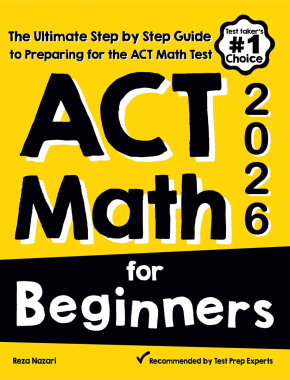
The “stress-free” part is not just a nice phrase. When you genuinely understand the math, the ACT’s time pressure stops being frightening. You are not deciphering each problem under the clock — you are recognizing it and executing. Real understanding is what makes a timed test feel calm. This book is built to produce that understanding.
What ACT math covers
The ACT math section draws from the standard high school curriculum:
- Pre-algebra and elementary algebra — numbers, fractions, percents, basic equations, and inequalities
- Intermediate algebra — quadratics, systems, functions, and exponents
- Coordinate geometry — the coordinate plane, lines, slope, and graphing
- Plane geometry — angles, triangles, circles, area, perimeter, and volume
- Trigonometry — basic right-triangle trig and a few core identities
Nothing here is beyond a typical student. The challenge is breadth and speed: you need every topic reasonably solid, because you cannot afford to stall on any one of them. A book that covers the whole range evenly — without deep gaps — is exactly what ACT math rewards.
Why this book works for the ACT
- It covers the full ACT range evenly. No topic is left thin, so you never hit a question type you were never taught.
- It teaches before it tests. Each concept is explained and demonstrated first — the right order for a student who may be rusty.
- It builds speed through fluency. The book’s practice makes each skill automatic, and automatic skills are fast skills.
- It includes full practice tests. Realistic, timed practice is the only way to train ACT pace — and it is built in.
How to study with it
A two-month plan that produces a calm, prepared test-taker:
- Week 1: Take a full, timed practice test. Note both your score and which topics cost you the most.
- Weeks 2–4: Rebuild algebra — the largest slice of the test.
- Weeks 5–6: Coordinate and plane geometry.
- Week 7: Trigonometry and any leftover weak spots.
- Week 8: Full timed practice tests, then targeted review.
The ACT-specific habit that matters most: practice with the clock from the start. ACT math gives you only about a minute per question on average. If every practice run is timed, that pace becomes second nature — and pace, more than raw difficulty, is what separates ACT scores. Also build a simple rule for hard questions: if one is not coming, mark it, move on, and return to it. A single stubborn problem should never cost you five easy ones.
Who this book is for
- Students starting ACT prep who want to build steadily rather than cram
- Students who freeze under time pressure and need fluency to feel calm
- Sophomores and juniors planning ahead
- Self-studiers who need a book that teaches without a tutor
- Retakers aiming to lift a math score that did not reflect their ability
Common ACT math mistakes
- Always practicing untimed. The ACT’s challenge is pace. Untimed practice never trains it.
- Getting stuck on one hard question. Every question is worth the same. Mark it, move on, come back.
- Ignoring geometry and trig. Students over-focus on algebra and leave easy geometry points on the table.
- Not reviewing mistakes. Your wrong answers are the most efficient study guide you will ever get — use them.
Frequently asked questions
What is the best ACT math prep book?
The best ACT math book is one that matches where you are starting. If your algebra and geometry feel rusty, choose a book that reteaches each topic from the ground up with worked examples, like ACT Math for Beginners, and then shows how the ACT phrases those questions. Students already scoring well may get more from timed practice tests. Either way, finish with full-length practice.
How many questions are in ACT math?
On the current enhanced ACT, the math section has 45 questions in 50 minutes, a little over a minute per question. Older prep materials describe 60 questions in 60 minutes, so check the date on any book or practice test you use. The pace is still tight, which is why practicing under timed conditions matters as much as reviewing the math itself.
How do I get better at ACT math?
Find your weak topics first with a timed practice test, then rebuild them one at a time. Most ACT math draws on pre-algebra, algebra, geometry and some trigonometry from high school. Review a topic, do a set of untimed problems, then mix it into timed sets. Keep an error log so you can see whether misses come from content gaps, careless slips or running out of time.
What are some ACT math tips and strategies?
Answer every question, since the ACT does not penalize wrong answers. Work easier questions quickly and come back to the hard ones, and plug answer choices back in when solving algebraically would take longer. Draw and label diagrams for geometry, and reread what the question actually asks before choosing. A calculator is allowed on the whole math section, but use it only when it saves time.
Is there an ACT math formula sheet?
No, the ACT does not give you a formula sheet, so you need to know key formulas by heart. Focus on area and perimeter of common shapes, the Pythagorean theorem, slope and the equation of a line, the quadratic formula, SOH-CAH-TOA, and basic probability and percent formulas. Making your own one-page sheet and quizzing yourself from it is a good way to memorize them.
Is an ACT math prep book or a prep course better?
It depends on how you study. A good prep book is affordable and lets you move at your own pace, which suits motivated students who can follow a plan. A course adds a set schedule and someone to answer questions, which helps if you struggle to stay consistent. Many students do well with a book plus regular timed practice tests to track progress.
The bottom line
ACT math does not reward panic — it rewards fluency. When you genuinely understand the material and have trained the pace, sixty questions in a tight window stops being scary and becomes routine. ACT Math for Beginners is built to take you there: every topic rebuilt from the ground up, then practiced until it is fast and automatic.
Start early, study steadily, always practice with the clock, and review every mistake. A strong, stress-free ACT math score is well within reach.

Related to This Article
More math articles
- How to Solve the Absolute Value of Rational Numbers?
- Overview of the CLEP College Mathematics Test
- How to Find Discriminant of Quadratic Equation?
- 4th Grade CMAS Math Worksheets: FREE & Printable
- Delegate, Trustee, and Politico Models of Representation
- How to Help Your 6th Grade Student Prepare for the California CAASPP Math Test
- The Ultimate PSAT 10 Math Formula Cheat Sheet
- ASWB Three-Option Questions: Use Evidence to Eliminate a Distractor (2027 Prep)
- Diving Deep with Division: How to Handle Four-digit Numbers with Two-digit Divisors
- How many questions are on the SAT Test?























What people say about "The Best ACT Math Prep Book"?
No one replied yet.