CLEP U.S. History I 094: Dred Scott and Constitutional Crisis
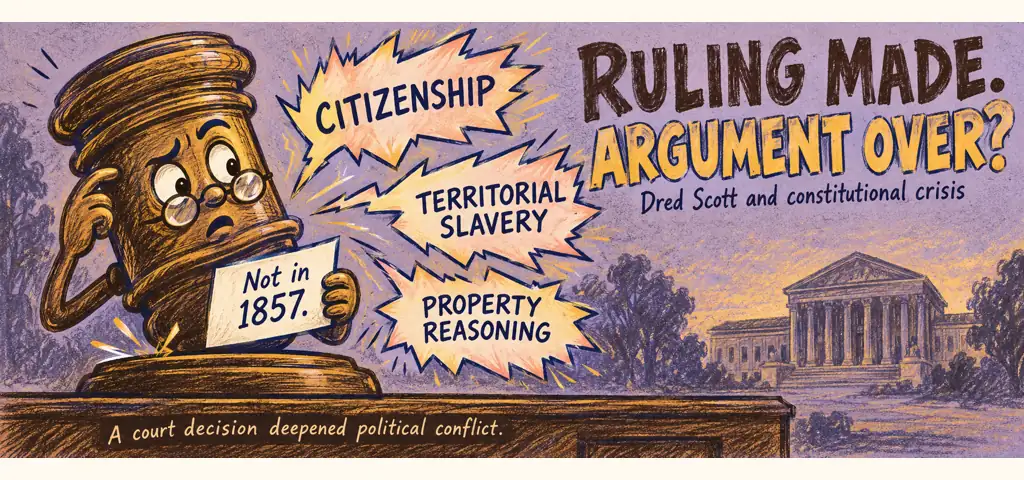
Lesson 17.5 of Chapter 17 of the U.S. History to 1877 study guide on Effortless Math covers CLEP U.S. History I 094: Dred Scott and Constitutional Crisis: the key terms, the core ideas, and worked examples showing how this topic is tested on the exam.
U.S. History to 1877 | Chapter 17 | Lesson 17.5
In Dred Scott v. Sandford (1857), Chief Justice Roger B. Taney’s opinion declared that Black people descended from enslaved Africans were not citizens within the Constitution’s meaning and that Congress lacked power to prohibit slavery in the territories. The decision invalidated the Missouri Compromise restriction and threatened the Republican claim that Congress could contain slavery. Taney reasoned that enslaved people were property protected by the Fifth Amendment, a reading Republicans fiercely rejected.
The decision did not require every territory to enact a slave code, and it did not settle politics. Instead, it deepened suspicion that slaveholders would nationalize slavery. Abraham Lincoln accepted the judgment for the parties while arguing that citizens could oppose its reasoning and seek change through elections and appointments.
The distinction between judgment and precedent matters. Scott lost his claim, while Taney’s broader constitutional reasoning attempted to remove territorial restriction from ordinary congressional politics. Republicans argued that a coordinated series of national actions might protect slavery everywhere. Stephen Douglas tried to preserve popular sovereignty by emphasizing local police regulations. Rather than ending argument, the ruling forced each coalition to explain how its program could operate under the Court’s logic.
historysourceNative holding matrix: Dred Scott v. Sandford Question. Taney opinion. Political consequence. National citizenship. Descendants of enslaved Africans were excluded from constitutional citizenship in the opinion’s reasoning. Direct attack on Black citizenship claims. Congress in territories. Congress could not prohibit slavery in federal territory. Missouri restriction invalidated. Republican containment challenged. Property/due process. Enslaved persons treated as constitutionally protected property. Slaveholder access framed as a Fifth Amendment issue. check. Read the holdings against the official report, Dred Scott v. Sandford, 60 U.S. 393 (1857), LOC item usrep060393. Then compare the political response preserved in Political Debates Between Hon. Abraham Lincoln and Hon. Stephen A. Douglas (1860), LOC item 12007439. The debate volume records partisan constitutional argument. It is not part of the Court’s judgment. historysource
Modeled holding analysis Separate a case’s holdings: citizenship, federal territorial power, and property reasoning. An answer about “separate but equal” belongs to Plessy after this exam period. Popular sovereignty was a political policy, not Dred Scott’s holding.
See the history take shape
This CrashCourse lesson supplies a second explanation of the same period. Note where chronology, cause, and perspective connect.
Video: The Dred Scott Decision: Crash Course Black American History #16, CrashCourse.
Check your understanding
- The Court held that Congress lacked power to
- admit a territory as a new state.
- prohibit slavery within a federal territory.
- regulate interstate and international commerce.
- establish courts below the Supreme Court.
- declare war against a foreign nation.
- Republicans objected because the decision
- abolished property rights.
- admitted Kansas free.
- repealed the Fugitive Slave Act.
- undermined containment of slavery.
- ended judicial review.
- Select all elements of the opinion:
- denial of national citizenship,
- territorial-slavery ruling,
- property reasoning,
- separate-but-equal doctrine,
- invalidation of the Missouri restriction.
- Explain why a Supreme Court decision can intensify rather than settle political conflict.
Write a brief response using a named fact from the lesson.
Open the answers and reasoning
Independent preparation. CLEP is a registered trademark of the College Board, which does not endorse this lesson.

Related to This Article
More math articles
- Mini Baccarat Is Faster — Which Quietly Costs You More
- What Is the Best Calculator for Geometry?
- 8th Grade WVGSA Math Worksheets: FREE & Printable
- CLEP U.S. History I 070: Abolitionists and Antislavery Politics
- Free Grade 7 English Worksheets for Vermont Students
- The Ultimate 6th Grade MAAP Math Course (+FREE Worksheets)
- Majority Rule and Minority Rights
- 7th Grade MEAP Math Practice Test Questions
- Freedom of association
- Wisconsin FORWARD Grade 8 Math Free Worksheets: Free Printable PDFs Covering Every Grade 8 Skill


















What people say about "Dred Scott and Constitutional Crisis"?
No one replied yet.