CLEP U.S. History I 093: Republican Party and the Collapse of the Whigs
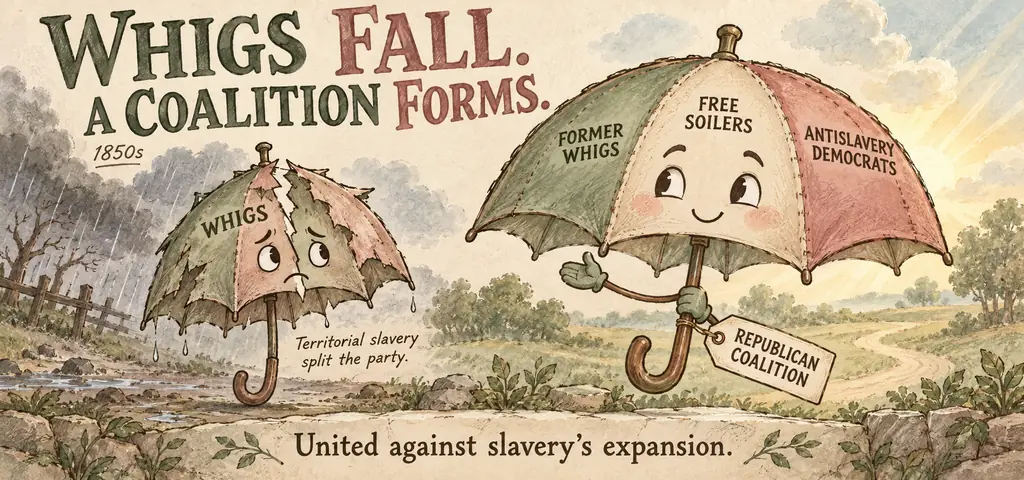
Lesson 17.4 of Chapter 17 of the U.S. History to 1877 study guide on Effortless Math covers CLEP U.S. History I 093: Republican Party and the Collapse of the Whigs: the key terms, the core ideas, and worked examples showing how this topic is tested on the exam.
U.S. History to 1877 | Chapter 17 | Lesson 17.4
The Whigs fractured because northern and southern members could not maintain one position on territorial slavery. The Republican Party brought together former Whigs, Free Soilers, antislavery Democrats, and other opponents of expansion. Its central national position was not immediate abolition in every state. It was resistance to slavery’s extension, often tied to free labor, homesteads, internal improvements, and a belief that slaveholding interests wielded excessive national power.
Party replacement changed the incentives of national politics. The Whigs had once competed across sections on banking, tariffs, and development, but the Compromise of 1850 and Kansas-Nebraska made a shared territorial position increasingly costly. Nativist and anti-Nebraska organizations competed for displaced voters before Republicans became the strongest northern coalition. The resulting party was broad rather than ideologically uniform: moral antislavery, free-labor economics, resentment of “Slave Power,” and older Whig development policies overlapped without becoming the same argument.
Modeled platform reading A platform opposing “the twin relics of barbarism: polygamy and slavery” in the territories combines moral language with a jurisdictional policy. Underline the geographic noun: territories. Then compare nearby planks on homesteads or internal improvements. The evidence supports a coalition organized around containment. It does not prove the party proposed federal emancipation inside every slave state or endorsed equal civil rights.
A focused video lesson
Watch this account from WeTheHistorians with one question in mind: which evidence makes the lesson's strongest claim hold up?
Video: Week 36 {May 4-10, 2014} Rise & Fall of the Whig Party, WeTheHistorians.
Check your understanding
- Republicans first united nationally around opposition to
- protective tariffs for domestic manufacturers.
- western homesteads for independent farmers.
- federal support for internal improvements.
- Catholic immigration and naturalized voters.
- slavery’s expansion into federal territories.
- Whig collapse was accelerated by
- renewed agreement over a national banking program.
- western growth that eased conflict between the sections.
- sectional disagreement over the expansion of slavery.
- Democratic recruitment of antislavery Whigs in the North.
- a nativist settlement of the territorial slavery issue.
- Select all groups entering the Republican coalition:
- former Whigs,
- Free Soilers,
- antislavery Democrats,
- some reformers,
- every southern Democrat.
- Explain why opposing expansion did not necessarily mean supporting immediate abolition.
Write a brief response using a named fact from the lesson.
Open the answers and reasoning
Independent preparation. CLEP is a registered trademark of the College Board, which does not endorse this lesson.

Related to This Article
More math articles
- Indiana Grade 2 English Worksheets — Free and Printable
- In-Depth Analysis of Vector Function Derivatives: Theory and Practical Applications
- How is the TABE Test Scored?
- 5th Grade Common Core Math FREE Sample Practice Questions
- Understanding How to Use Debit and Credit Cards for Payments
- 10 Most Common 5th Grade Common Core Math Questions
- Setting and Context
- How to Unravel Constant and Identity Functions
- Back to School Essentials: Why “Pre-Algebra for Beginners” Should Be on Your List
- The Secret Decoder Ring of Proportional Relationships: How to Find The Constant of Proportionality














What people say about "The Republican Party and the Collapse of the Whigs"?
No one replied yet.