CLEP U.S. History I 083: Gold Rush, Migration, and the Compromise of 1850
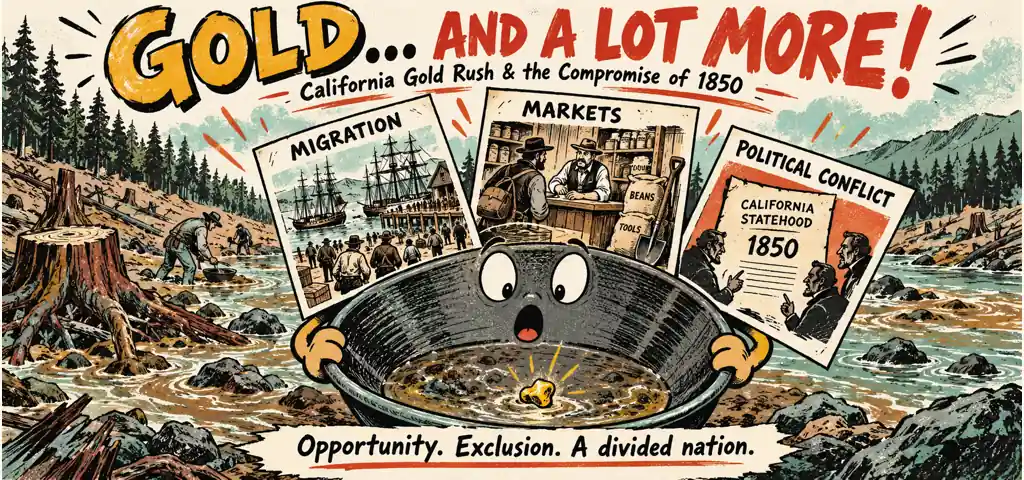
Lesson 15.5 of Chapter 15 of the U.S. History to 1877 study guide on Effortless Math covers CLEP U.S. History I 083: Gold Rush, Migration, and the Compromise of 1850: the key terms, the core ideas, and worked examples showing how this topic is tested on the exam.
U.S. History to 1877 | Chapter 15 | Lesson 15.5
The discovery of gold in California in 1848 accelerated global migration. People came from the eastern United States, Latin America, Europe, China, Australia, and Pacific communities. Mining camps became markets. Merchants and transport providers often earned steadier profits than miners. Mining damaged rivers and landscapes. Violence and discriminatory taxes targeted Native people, Mexicans, Chileans, Chinese miners, and other groups. California’s rapid population growth produced a demand for statehood before Congress had created a territorial government.
Gold also altered the balance among forms of labor. Miners depended on merchants, laundries, shipping, food production, and wage work even while celebrating independent prospecting. California entered as a free state, but freedom did not mean racial equality: state and local policies restricted testimony, taxation, residence, and economic competition. Native Californians faced disease, hunger, forced labor, state-supported militia violence, and loss of land. The economic boom and the coercive order grew together.
Watch, then test the claim
Watch this account from Pursuit of History with one question in mind: which evidence makes the lesson's strongest claim hold up?
Video: The California Gold Rush, Pursuit of History.
Check your understanding
- Which Compromise of 1850 provision generated especially strong northern resistance?
- Organization of Utah and New Mexico without a slavery restriction.
- The strengthened Fugitive Slave Act.
- California’s admission as a free state.
- Settlement of the Texas boundary and debt.
- The end of the slave trade in the District of Columbia.
- The Gold Rush was transnational because
- overland migration from eastern states supplied nearly every miner.
- movement from Mexico ended after the 1848 transfer of sovereignty.
- Pacific shipping mattered only after the mining boom ended.
- migrants arrived from across the Pacific and Atlantic worlds.
- foreign merchants could trade but foreign miners did not participate.
- Select all Compromise provisions:
- free California,
- Utah and New Mexico territories,
- Texas boundary/debt settlement,
- end of the D.C. slave trade,
- stronger fugitive law.
- Explain how the Gold Rush connected economic opportunity with racial exclusion and environmental change.
Write a brief response using a named fact from the lesson.
Open the answers and reasoning
Independent preparation. CLEP is a registered trademark of the College Board, which does not endorse this lesson.

Related to This Article
More math articles
- Visualizing Multiplication: How to Use Arrays to Multiply Fractions by Whole Numbers
- SAT vs. ACT Math: Which Test Is Easier in 2026?
- Government, Politics, and Power
- Free Grade 6 English Worksheets for Florida Students
- Select and special committees
- A Deep Dive into the nth Term Test for Divergence
- Top 10 HiSET Math Practice Questions
- CLEP U.S. History I 003: Spanish Conquest and Colonial Systems
- How to Add and Subtract Radical Expressions? (+FREE Worksheet!)
- How to Find Discontinuities of Rational Functions?




















What people say about "The Gold Rush and the Compromise of 1850"?
No one replied yet.