CLEP U.S. History I 092: Kansas-Nebraska Act and Bleeding Kansas
Lesson 17.3 of Chapter 17 of the U.S. History to 1877 study guide on Effortless Math covers CLEP U.S. History I 092: Kansas-Nebraska Act and Bleeding Kansas: the key terms, the core ideas, and worked examples showing how this topic is tested on the exam.
U.S. History to 1877 | Chapter 17 | Lesson 17.3
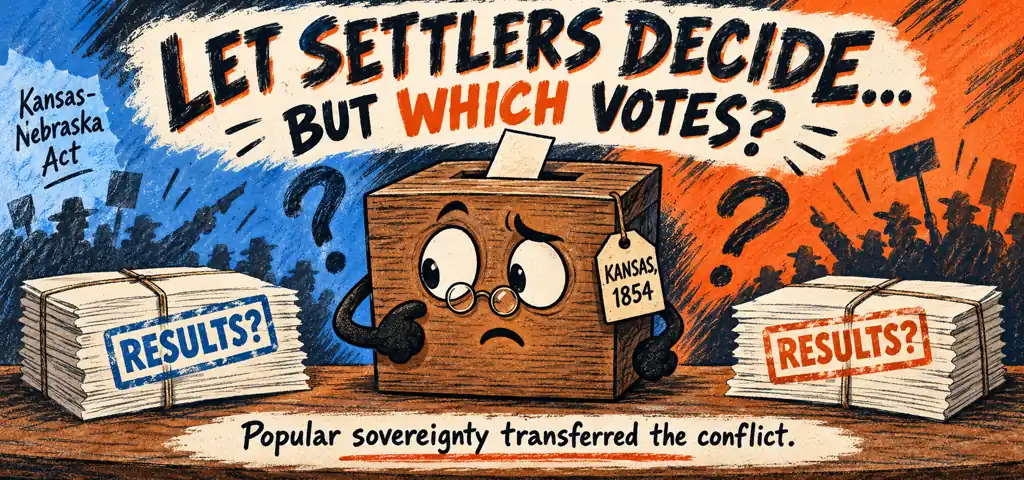
Stephen Douglas’s Kansas-Nebraska Act organized territories using popular sovereignty and effectively repealed the Missouri Compromise restriction north of 36°30′. Proslavery and antislavery settlers rushed into Kansas. Competing governments, fraudulent voting, armed conflict, the sack of Lawrence, and John Brown’s killings at Pottawatomie made “Bleeding Kansas” a national symbol. Popular sovereignty did not remove Congress from the issue. It moved the conflict into territorial institutions where both sides disputed who counted as a legitimate settler and voter.
The dispute was institutional before it became military. Elections affected the territorial legislature, which would shape slavery law and a future state constitution. Cross-border voting, competing constitutional conventions, rival seats of government, and presidential decisions made the phrase “let the settlers decide” incomplete: somebody still had to define the electorate, certify results, and recognize a government. Newspaper coverage then nationalized local violence, allowing each section to treat Kansas as proof of the other’s bad faith.
Modeled causation The act did more than cause violence. It destroyed trust in an old settlement, weakened northern Democrats, and accelerated Republican organization. If a question asks for the political consequence, “party realignment” is stronger than a battlefield detail.
Watch the topic in context
Mr. Chet Laubach offers a visual route through this topic. As you watch, compare its explanation with the source limits in the written lesson.
Video: Mr. L – APUSH – Compromise of 1850, Kansas Nebraska Act, Bleeding Kansas, Caning of Sumner (updated), Mr. Chet Laubach.
Check your understanding
- The act’s most important sectional effect was to
- authorize Congress to abolish slavery within existing states.
- admit Kansas immediately under a free-state constitution.
- restore the Missouri restriction north of 36°30′.
- reopen federal land previously closed to slavery by that restriction.
- reserve the organized territories for displaced Native nations.
- Bleeding Kansas exposed the weakness of popular sovereignty because
- residents agreed on voter eligibility but disputed the timing of statehood.
- rival settlers and governments fought over which votes were legitimate.
- Congress had already imposed one binding rule for territorial elections.
- the governor’s election certificates won acceptance from both coalitions.
- one constitutional convention represented both sides of the slavery dispute.
- Select all consequences:
- violence,
- party realignment,
- distrust of compromise,
- competing governments,
- permanent sectional peace.
- Explain why popular sovereignty transferred rather than solved the dispute.
Write a brief response using a named fact from the lesson.
Open the answers and reasoning
Independent preparation. CLEP is a registered trademark of the College Board, which does not endorse this lesson.

Related to This Article
More math articles
- The Best Grade 7 Math Book for Arizona Students
- Free Grade 8 English Worksheets for Washington Students
- 3rd Grade Wisconsin Forward Math Worksheets: FREE & Printable
- How to Master the Average Rate of Change
- House Rules Committee
- Ratio, Proportion and Percentages Puzzle – Challenge 27
- Algebra Puzzle – Challenge 33
- Algebra Puzzle – Challenge 31
- Full-Length 6th Grade STAAR Math Practice Test
- Overcoming Mental Blocks in Algebra: A Student’s Guide























What people say about "The Kansas-Nebraska Act and Bleeding Kansas"?
No one replied yet.