CLEP U.S. History I 088: Free Black Communities and Racial Exclusion
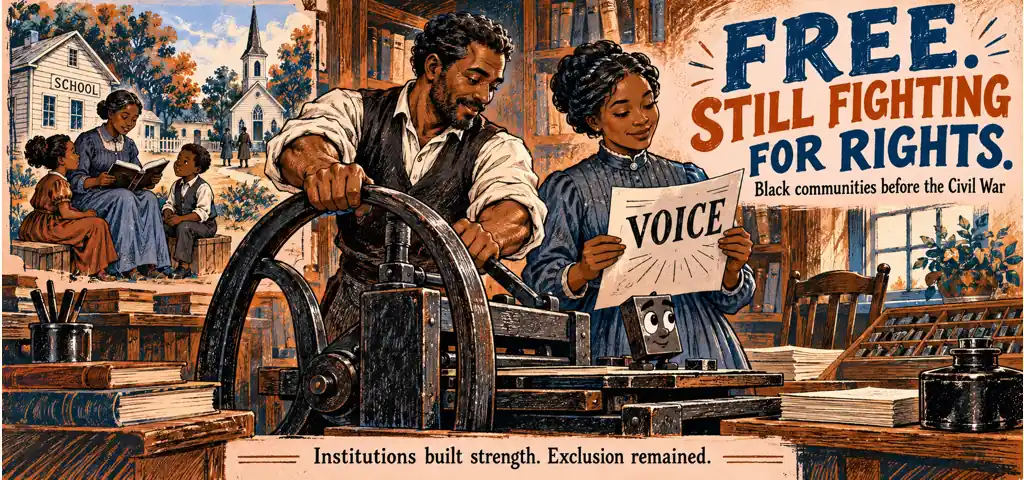
Lesson 16.4 of Chapter 16 of the U.S. History to 1877 study guide on Effortless Math covers CLEP U.S. History I 088: Free Black Communities and Racial Exclusion: the key terms, the core ideas, and worked examples showing how this topic is tested on the exam.
U.S. History to 1877 | Chapter 16 | Lesson 16.4
Free Black populations grew through birth, manumission, self-purchase, escape, and northern emancipation. Black churches, mutual-aid societies, schools, conventions, newspapers, and abolition organizations created spaces for worship, education, political strategy, and support. Leaders such as Richard Allen, David Walker, Maria Stewart, Frederick Douglass, and many less famous organizers challenged slavery and northern discrimination.
Freedom did not mean equality. Several states restricted Black voting, testimony, schooling, movement, jury service, or settlement. White mobs attacked Black neighborhoods and abolitionist institutions. Employers confined many workers to low-paid occupations. The Fugitive Slave Acts endangered free Black people as well as freedom seekers because weak procedures invited kidnapping and denied accused people normal protections.
Black conventions made citizenship claims collective and public. Delegates debated education, migration, abolition, voting rights, labor, and strategies for self-protection, while Black newspapers carried arguments beyond the meeting hall. Churches supplied physical space, leadership networks, and mutual aid. These institutions did not compensate for exclusion as though the state no longer mattered. They created capacity to challenge law and survive its unequal operation.
Watch the topic in context
Watch this account from Black History in Two Minutes or so with one question in mind: which evidence makes the lesson's strongest claim hold up?
Video: Free Black Americans Before Civil War, Black History in Two Minutes or so.
Check your understanding
- Which institution most directly supported independent Black political and community life?
- white-controlled benevolent societies speaking for Black residents.
- occasional interracial abolition committees alone.
- municipal poor-relief boards controlled by white voters.
- major-party ward organizations that restricted Black participation.
- Black churches and mutual-aid organizations.
- Why did fugitive-slave enforcement endanger free Black people?
- Local juries reviewed each removal claim before a certificate issued.
- Claimants faced demanding evidence rules and several automatic appeals.
- Limited hearings could enable false claims and kidnapping.
- Federal enforcement stopped at the borders of free states.
- Accused residents could testify and obtain a full criminal trial.
- Select all forms of racial exclusion free Black communities confronted:
- voting restrictions,
- occupational limits,
- segregated schools,
- mob violence,
- settlement restrictions.
- Explain why “free” and “equal citizen” cannot be used as synonyms in the antebellum era.
Write a brief response using a named fact from the lesson.
Open the answers and reasoning
Independent preparation. CLEP is a registered trademark of the College Board, which does not endorse this lesson.

Related to This Article
More math articles
- Bridging the Gap: From Basic Math to Algebra with “Pre-Algebra for Beginners”
- Decoding the Depths: A Dive into the Composite Floor Function
- Cabinet departments
- How to Add and Subtract Polynomials? (+FREE Worksheet!)
- Cell Division: Mitosis and Meiosis
- 10 Most Common 4th Grade Georgia Milestones Assessment System Math Questions
- How to Line Up Decimals: The Orderly Approach to Decimal Numbers
- Free Nebraska Grade 2 English Worksheets
- FREE 6th Grade PSSA Math Practice Test
- New Hampshire Algebra 1 Free Worksheets: Printable Standards-Aligned Algebra 1 Practice with Answers













What people say about "Free Black Communities and Racial Exclusion"?
No one replied yet.