CLEP U.S. History I 091: Fugitive Slave Act and Resistance
Lesson 17.2 of Chapter 17 of the U.S. History to 1877 study guide on Effortless Math covers CLEP U.S. History I 091: Fugitive Slave Act and Resistance: the key terms, the core ideas, and worked examples showing how this topic is tested on the exam.
U.S. History to 1877 | Chapter 17 | Lesson 17.2
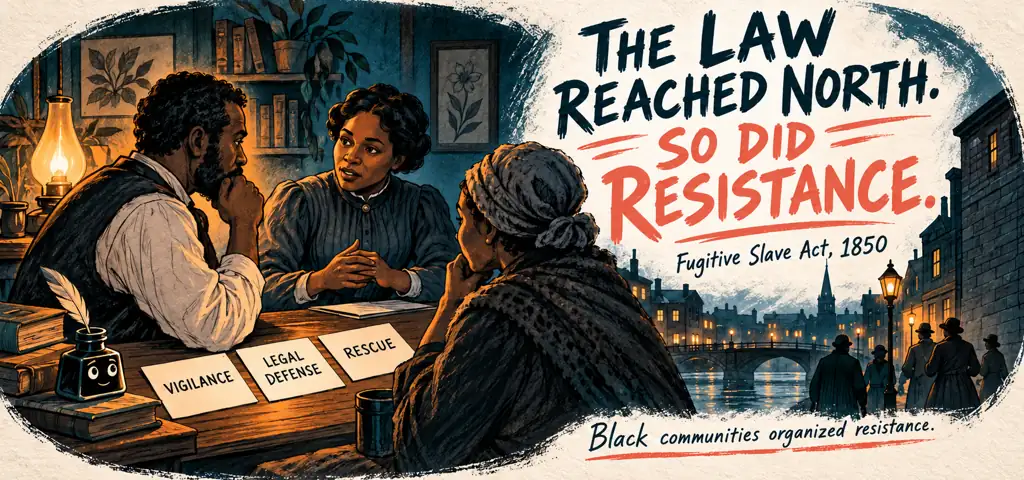
The Fugitive Slave Act of 1850 created federal commissioners, denied alleged fugitives normal jury protections, and required assistance in recapture. It made slavery’s enforcement visible in northern streets and courts. Black communities organized vigilance and rescue. Abolitionists aided resistance. Several states enacted personal-liberty laws. Slaveholders saw resistance as proof that the North would not honor constitutional obligations. Northerners who were not abolitionists could still object to coercion and weak procedure.
The statute also shaped evidence and incentives. Commissioners received fees that differed depending on whether a person was remanded or released, alleged fugitives could not testify on their own behalf, and federal officials could call on bystanders. Defenders called the law necessary enforcement of the Constitution’s fugitive-service clause. Critics treated its procedure as a denial of due process and its compulsory assistance as moral complicity. Rescue cases therefore became contests over both federal supremacy and the reliability of legal process.
Modeled analysis A rescue account can reveal federal supremacy, due process, Black community action, and slavery’s national reach. Build the inference in steps: identify who issued the warrant, what protections the accused lacked, who mobilized, and how officials responded. Then choose the issue named in the stem. A dramatic crowd scene alone cannot tell you whether a personal-liberty law was constitutional or whether every northern resident resisted.
Watch, then test the claim
Use this lesson from Left Page to review the period and its central historical problem. Pause when the video reaches the turning point named above.
Video: "Higher Law": Resistance to the Fugitive Slave Act, Left Page.
Check your understanding
- Northern resistance grew partly because the act
- required a local jury to approve each removal.
- limited federal enforcement to the slave states.
- denied accused people ordinary procedural protections.
- allowed the accused to testify before a state judge.
- gave state courts final review of federal certificates.
- Personal-liberty laws attempted to
- require state officials to assist federal commissioners.
- restrict free Black residents from testifying in court.
- extend federal marshals’ authority over local police.
- make state treasuries pay federal rendition expenses.
- add state safeguards against abusive rendition procedures.
- Select all responses to enforcement:
- vigilance committees,
- legal defense,
- rescues,
- personal-liberty laws,
- universal northern compliance.
- Explain how the act nationalized conflict over slavery.
Write a brief response using a named fact from the lesson.
Open the answers and reasoning
Independent preparation. CLEP is a registered trademark of the College Board, which does not endorse this lesson.

Related to This Article
More math articles
- Scientific polling
- 10 Most Common PSAT 10 Math Questions
- How to Use Area Models to Add Fractions with Like Denominators
- Slope Fields Simplified: Understanding the Core of Differential Equations
- The Best Grade 7 ELA Practice Tests for Tennessee Students
- 10 Most Common 4th Grade STAAR Math Questions
- Top 10 Free Websites for ATI TEAS 7 Math Preparation
- Wisconsin FORWARD Grade 6 Math Free Worksheets: Free Printable PDFs Covering Every Grade 6 Skill
- Public appeals and the “bully pulpit”
- 10 Most Common 7th Grade FSA Math Questions























What people say about "The Fugitive Slave Act and Resistance"?
No one replied yet.