PSAT/NMSQT, PSAT 10 & PSAT 8/9 Math
PSAT Math Practice Test: Free Practice, Lessons & Study Guide
PSAT Math is the same four-domain digital test at three levels: PSAT/NMSQT, PSAT 10 and PSAT 8/9. Each practice test here has 44 questions and a 70-minute timer, with an estimated score and full explanations. A free formula sheet and topic lessons help you fix what you missed.
What is the PSAT/NMSQT?
The PSAT/NMSQT and PSAT 10 are College Board tests taken at school on the Bluebook app. The PSAT/NMSQT is given in October, mostly to 11th graders, and is the qualifying test for the National Merit Scholarship Program. The PSAT 10 is given to 10th graders in spring. Both have 98 questions in 2 hours 14 minutes, including a 44-question, 70-minute Math section, scored 320 to 1520.
- Math section
- 44 questions, 70 minutes, 2 adaptive modules
- Total test
- 98 questions, 2 hours 14 minutes
- Score range
- 320-1520 total; Math 160-760
- Math benchmark
- 480 (grade 10), 510 (grade 11)
- Calculator
- Allowed on the entire Math section; Desmos built into Bluebook
Source: College Board official information. Rules and dates can change, so confirm with the official site or your test center.
PSAT Math Test Outline
PSAT 8/9, PSAT 10, and PSAT/NMSQT share a two-module Math section. Explore the level that matches your test, then use its practice and topic resources.
PSAT 8/9 Math
Build the math foundations assessed in the PSAT 8/9, with all four content domains appearing across its two timed modules.
Topics covered
- Algebra
- Advanced Math
- Problem-Solving and Data Analysis
- Geometry
PSAT 10 Math
Practice algebra, advanced math, problem-solving and data analysis, and geometry and trigonometry across two modules.
Topics covered
- Algebra
- Advanced Math
- Problem-Solving and Data Analysis
- Geometry and Trigonometry
PSAT/NMSQT Math
Review the PSAT/NMSQT Math section and connect practice to the same four domains used on PSAT 10.
Topics covered
- Algebra
- Advanced Math
- Problem-Solving and Data Analysis
- Geometry and Trigonometry
Four PSAT Math Domains
Use the College Board domain map to connect a missed question to the math skill it measures.
Topics covered
- Algebra
- Advanced Math
- Problem-Solving and Data Analysis
- Geometry and Trigonometry on PSAT 10/NMSQT; geometry on PSAT 8/9
PSAT/NMSQT Practice Tests
Choose a practice activity. Independent practice results are study feedback, not official test scores.
PSAT/NMSQT Flashcards
Open a vocabulary or formula resource. Availability and scope are described below.
PSAT/NMSQT Study Guides
Compare the actual book titles and check their product pages before choosing. These are independent preparation resources.
PSAT Math for Beginners 2027: The Ultimate Step by Step Guide to Preparing for the PSAT Math Test
Open the product page to check the contents, edition, format, and purchase options.
View book & purchase options → $17.99 · PDF

PSAT Math Practice Workbook 2027: The Most Comprehensive Review for the Math Section of the PSAT Test
Open the product page to check the contents, edition, format, and purchase options.
View book & purchase options → $19.99 · PDF

PSAT Math Full Study Guide: Comprehensive Review + Practice Tests + Online Resources
Open the product page to check the contents, edition, format, and purchase options.
View book & purchase options → $16.99 · PDF
PSAT/NMSQT Quick Review
Review one skill, try its practice, and use the result to choose your next step.
6 Free Full-Length PSAT Math Practice Tests
Using Digital PSAT Math Complete Prep? Your book includes access to 50 full-length interactive practice tests. Use the QR codes in your book to open those tests. The six free tests below are a separate collection.
Take a complete PSAT Math simulation online. Each test has 44 questions, a 70-minute timer, two module labels, 33 multiple-choice items, 11 student-produced responses, an estimated PSAT Math score, topic breakdowns, and full explanations.
PSAT Math Practice Test 1
44 questions, 70 minutes, 33 multiple-choice items, 11 student-produced responses, instant score report, explanations, and topic review.
PSAT Math Practice Test 2
44 questions, 70 minutes, 33 multiple-choice items, 11 student-produced responses, instant score report, explanations, and topic review.
PSAT Math Practice Test 3
44 questions, 70 minutes, 33 multiple-choice items, 11 student-produced responses, instant score report, explanations, and topic review.
PSAT Math Practice Test 4
44 questions, 70 minutes, 33 multiple-choice items, 11 student-produced responses, instant score report, explanations, and topic review.
PSAT Math Practice Test 5
44 questions, 70 minutes, 33 multiple-choice items, 11 student-produced responses, instant score report, explanations, and topic review.
PSAT Math Practice Test 6
44 questions, 70 minutes, 33 multiple-choice items, 11 student-produced responses, instant score report, explanations, and topic review.
Free interactive practice
PSAT Study Lab: Flashcards, Question of the Day and Study Plan
Short, active practice for the digital PSAT: flip PSAT Math flashcards for formulas, key concepts and Desmos moves, learn the grammar rules behind Reading and Writing questions, quiz yourself on vocabulary in context, answer a new question every day and build a week-by-week plan for your test date.
PSAT Math flashcards
Formulas, concepts, quick “solve it” problems and Desmos tips, grouped by the four PSAT Math content domains. Mark each card “Got it” or “Review again”; cards you miss collect in your review list.
Keys: Space flip · ← → move · 1 review again · 2 got it
See all 54 cards as a list
PSAT Reading and Writing grammar rules
The punctuation, agreement, modifier and transition rules tested in Standard English Conventions and Expression of Ideas questions, each with an example and a fix.
Keys: Space flip · ← → move · 1 review again · 2 got it
See all 23 cards as a list
PSAT vocabulary in context
1,000 words, each in a context sentence. Study with flashcards, then test yourself with a four-choice quiz; words you miss come back more often.
Keys: Space flip · ← → move · 1 review again · 2 got it
PSAT question of the day
A new original practice question every day. Answer it to keep your streak going.
Geometry and Trigonometry
Show the answer
Answer: A. Complete the square: (x − 2)2 + (y + 3)2 = 12 + 4 + 9 = 25, so r = 5.
PSAT study plan by test date
Pick your test date and how much time you have each day. You get a week-by-week plan that starts with a practice test, rotates through the main topics and ends with a light final review.
PSAT/NMSQT, PSAT 10 and PSAT 8/9 are given at school, so your school sets the date.
Jump into PSAT Math
See it. Understand it. Try it.
PSAT Math Quick Review turns each idea into a picture, a clear explanation, and a worked example. Start with the basics, or jump to the skill you want to learn.
Six ways into PSAT Math
Every lesson starts with a visual explanation and ends with a chance to practice.
Free PSAT Math Formula Sheet PDF
Open the complete PSAT Math formula guide, review the pages online, then print or save the PDF when you are ready.
Complete ReviewStudy the key formulas in one focused guide.›
Page-by-Page ReviewMove through the formulas at your own pace.›
Online StudyKeep the guide open while you practice problems.›
Print When ReadyUse the print option after you finish reviewing.›
Download for LaterSave the PDF when you want an offline copy.›
PSAT Math Skill Quizzes
Short, focused quizzes, pick one skill, answer 10 questions, get instant scoring and full step-by-step solutions. Each opens right here in a popup.
Ratios & Proportional Reasoning
Unit rates, proportions, and real-world comparisons.
Start Quiz →
Percents & Financial Math
Percent change, discounts, interest, and money math.
Start Quiz →
Solving Linear Equations
One-step to multi-step equations and literal equations.
Start Quiz →
Linear Functions & Graphs
Slope, intercepts, and writing the equation of a line.
Start Quiz →
Systems of Equations & Inequalities
Substitution, elimination, and matching graphs to solutions.
Start Quiz →
Exponents & Polynomials
Exponent rules and polynomial operations.
Start Quiz →
Quadratic Functions & Equations
Factoring, the quadratic formula, and parabola graphs.
Start Quiz →
Functions
Function notation, evaluating functions, and function operations.
Start Quiz →
Geometry & Measurement
Area, volume, and measurement formulas.
Start Quiz →
Statistics & Probability
Centers, spreads, charts, and probability.
Start Quiz →
PSAT Math Topics: Learn, Practice, and Quiz
Choose a topic, open its worksheet for printable practice, then take a short quiz from the same row.
96 topics · worksheets · quizzes
Number Sense and Rational Numbers
- Comparing and Ordering Integers WorksheetQuiz
- Integers and Absolute Value WorksheetQuiz
- Adding and Subtracting Integers WorksheetQuiz
- Multiplying and Dividing Integers WorksheetQuiz
- Factors Multiples GCF and LCM WorksheetQuiz
- Adding and Subtracting Fractions WorksheetQuiz
- Multiplying Mixed Numbers WorksheetQuiz
- Multiplying and Dividing Fractions WorksheetQuiz
- Adding and Subtracting Decimals WorksheetQuiz
- Multiplying and Dividing Decimals WorksheetQuiz
- Converting Fractions Decimals and Percents WorksheetQuiz
- Real World Problems with Rational Numbers WorksheetQuiz
Ratios, Percents, and Rates
- Simplifying Ratios WorksheetQuiz
- Unit Rates WorksheetQuiz
- Proportional Ratios WorksheetQuiz
- Constant of Proportionality WorksheetQuiz
- Scale Drawings and Scale Factors WorksheetQuiz
- Converting Units of Measurement WorksheetQuiz
- Percent Problems WorksheetQuiz
- Finding the Whole from a Part and Percent WorksheetQuiz
- Percent of Increase and Decrease WorksheetQuiz
- Discount Tax and Tip WorksheetQuiz
- Simple Interest WorksheetQuiz
- Compound Interest WorksheetQuiz
- Tips Commissions and Fees WorksheetQuiz
Exponents, Radicals, and Scientific Notation
- Multiplication Property of Exponents WorksheetQuiz
- Division Property of Exponents WorksheetQuiz
- Zero and Negative Exponents WorksheetQuiz
- Negative Exponents and Negative Bases WorksheetQuiz
- Radicals WorksheetQuiz
- Rational and Irrational Numbers WorksheetQuiz
- Scientific Notation WorksheetQuiz
- Operations with Scientific Notation WorksheetQuiz
Expressions, Equations, and Inequalities
- When an Expression Is Undefined WorksheetQuiz
- Evaluating One Variable WorksheetQuiz
- Evaluating Two Variables WorksheetQuiz
- Simplifying Variable Expressions WorksheetQuiz
- The Distributive Property WorksheetQuiz
- One Step Equations WorksheetQuiz
- Solving Two Step Equations WorksheetQuiz
- Multi Step Equations WorksheetQuiz
- Equations with Variables on Both Sides WorksheetQuiz
- Literal Equations and Formulas WorksheetQuiz
- One Step Inequalities WorksheetQuiz
- Multi Step Inequalities WorksheetQuiz
- Compound Inequalities WorksheetQuiz
- Graphing Linear Inequalities WorksheetQuiz
Coordinate Geometry and Lines
- The Coordinate Plane WorksheetQuiz
- Finding Slope WorksheetQuiz
- Graphing Lines WorksheetQuiz
- Point Slope Form WorksheetQuiz
- Standard Form of a Linear Equation WorksheetQuiz
- Writing Linear Equations WorksheetQuiz
- Parallel and Perpendicular Lines WorksheetQuiz
- Systems of Equations WorksheetQuiz
- Finding Midpoint WorksheetQuiz
- Finding Distance of Two Points WorksheetQuiz
Functions
Polynomials and Quadratics
- Adding and Subtracting Polynomials WorksheetQuiz
- Simplifying Polynomials WorksheetQuiz
- Multiplying Binomials WorksheetQuiz
- Special Products of Polynomials WorksheetQuiz
- Factoring with the Greatest Common Factor WorksheetQuiz
- Factoring Trinomials WorksheetQuiz
- Solving Quadratic Equations by Factoring WorksheetQuiz
- The Quadratic Formula WorksheetQuiz
- Graphing Quadratic Functions WorksheetQuiz
- Rational Expressions WorksheetQuiz
Geometry and Measurement
- Complementary and Supplementary Angles WorksheetQuiz
- Parallel Lines and Transversals WorksheetQuiz
- Triangles WorksheetQuiz
- Similarity and Ratios WorksheetQuiz
- Area of Triangles WorksheetQuiz
- Area and Perimeter of Quadrilaterals WorksheetQuiz
- Polygons WorksheetQuiz
- Circles WorksheetQuiz
- Area and Perimeter of Composite Figures WorksheetQuiz
- Rectangular Prisms WorksheetQuiz
- Cubes WorksheetQuiz
- Cylinder WorksheetQuiz
- Surface Area of Solids WorksheetQuiz
- Volume and Surface Area of Composite Solids WorksheetQuiz
Data, Statistics, and Probability
- Weighted Averages and Missing Data Values WorksheetQuiz
- Box Plots and Interquartile Range WorksheetQuiz
- Histograms and Data Displays WorksheetQuiz
- Pie Graph WorksheetQuiz
- Scatter Plots and Lines of Best Fit WorksheetQuiz
- Two Way Frequency Tables WorksheetQuiz
- Probability Problems WorksheetQuiz
- Probability of Compound Events WorksheetQuiz
- Permutations and Combinations WorksheetQuiz
PSAT Math Mistakes to Watch For
Use a missed or guessed question to choose your next review. Open a worked check, then follow the link to the matching topic. These examples explain the method and are not official test questions.
Negative signs and powers
Parentheses decide whether a negative sign is part of the base. Copy the expression carefully before evaluating it.
See a worked check
(-2)² = 4 because the base is -2. In -2², square 2 first, then apply the negative sign: -4.
Adding fractions
Adding denominators does not create a common unit. Rewrite the fractions with the same denominator, then add their numerators.
See a worked check
1/3 + 1/4 = 4/12 + 3/12 = 7/12. The denominator stays 12.
Distributing to a whole expression
Multiplication outside parentheses applies to each term. Keep the minus sign attached to its term as you expand.
See a worked check
2(3x – 4) = 6x – 8. Expanding only the first term would leave an incorrect constant.
Confusing area and perimeter
Sketch the shape and write the unit next to the requested measurement. A boundary length and the space inside a figure use different formulas.
See a worked check
A square with side 12 cm has perimeter 4 × 12 = 48 cm and area 12 × 12 = 144 cm².
Reading the full data set
Count every value when finding a mean, and read graph scales before comparing heights. A missing zero can change the result.
See a worked check
The mean of 0, 4, and 11 is (0 + 4 + 11)/3 = 5. There are three values, even though one is zero.
Choose The Right PSAT Math Book
Use a study guide when you need explanations; choose a workbook when you need more practice with individual topics. The two options below make those starting points easy to compare.
PSAT Math for Beginners 2027: The Ultimate Step by Step Guide to Preparing for the PSAT Math Test
Need step-by-step explanations?
Start with explanations and worked examples when the basics feel rusty.
View book details → $17.99 · PDF

PSAT Math Practice Workbook 2027: The Most Comprehensive Review for the Math Section of the PSAT Test
Need extra topic practice?
Work on the topics you miss, then return to a mixed practice set.
View book details → $19.99 · PDF
PSAT Math Full Study Guide: Comprehensive Review + Practice Tests + Online Resources
Recommended practice resource
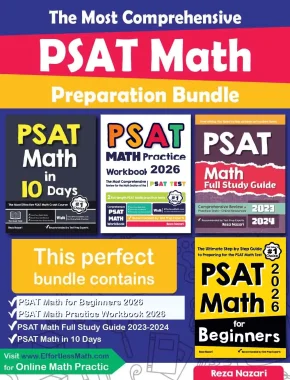
The Most Comprehensive PSAT Math 2027 Preparation Bundle: Includes PSAT Math Prep Books, Workbooks, and Practice Tests
Recommended practice resource
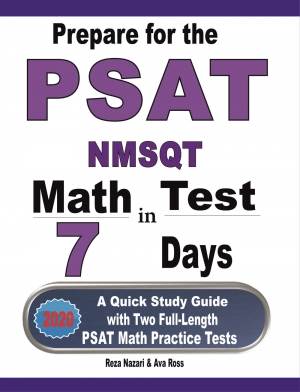
Prepare for the PSAT / NMSQT Math Test in 7 Days: A Quick Study Guide with Two Full-Length PSAT Math Practice Tests
Recommended practice resource
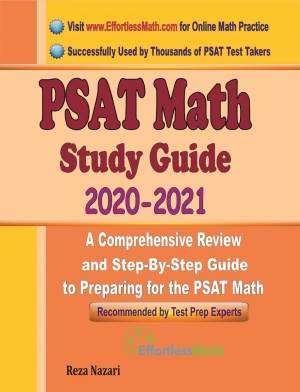
PSAT Math Study Guide 2027 – 2027: A Comprehensive Review and Step-By-Step Guide to Preparing for the PSAT Math
Recommended practice resource
PSAT Math FAQ
How many math questions are on the PSAT?
The PSAT/NMSQT and PSAT 10 Math section has 44 questions in two modules, with 70 minutes total. The first module has a mix of easy, medium and hard questions. The second module adapts and is harder or easier based on your performance. Some questions ask you to type in an answer.
What math topics are on the PSAT?
PSAT math covers Algebra, Advanced Math, Problem-Solving and Data Analysis, and Geometry and Trigonometry. Expect linear equations, systems and inequalities, quadratic and exponential functions, ratios, percentages, statistics and probability, plus area, volume, triangles, circles and right-triangle trigonometry. Algebra and Advanced Math make up the largest share.
What is a good PSAT math score?
PSAT math scores range from 160 to 760. College Board's grade-level math benchmark is 480 for 10th graders and 510 for 11th graders. Meeting the benchmark means you are on track for college readiness. National Merit qualifying cutoffs are set by the National Merit Scholarship Corporation and vary by state and year.
Is the PSAT/NMSQT different from the PSAT 10?
The two tests have the same content, format and score scale. The difference is timing and purpose. The PSAT/NMSQT is given in October, mostly to 11th graders, and it is the qualifying test for National Merit. The PSAT 10 is given to 10th graders in spring and is not used for National Merit.
How should I practice for PSAT math?
Start with a free full-length practice test in the Bluebook app to see the adaptive format and the built-in Desmos calculator. Then work on your weakest skill areas with targeted practice questions, such as linear equations or data analysis. Finish with another timed practice test to check your progress.
What should I practice first for PSAT Math?
Begin with a short mixed set for your PSAT level. Review the skills behind your missed or guessed questions; if basic arithmetic slows you down, work on that foundation before returning to algebra and the other tested domains.
How should I use this PSAT Math Online Center?
Begin with the main starting resource, choose one weak skill from the map, practice it, then return to the online center for the next topic or a timed review.
Are there free resources on this page?
Yes. The online center links to free Effortless Math resources such as PSAT Math Course, Free PSAT Math Practice Test, PSAT Math Study Guide.
Which PSAT Math skills matter most?
Use the four tested domains to organize review: Algebra, Advanced Math, Problem-Solving and Data Analysis, and Geometry and Trigonometry for PSAT 10/NMSQT (Geometry for PSAT 8/9). Use missed questions to choose a specific skill within a domain, rather than assuming every student needs the same starting topic.
When should I use a book or workbook?
Use a book when the student needs a structured sequence, repeated practice, or a printed path that is easier to follow than scattered online links.
Related Online Centers
Make This Your PSAT Math Starting Point
Bookmark this online center, choose one weak area, and use the linked practice pages and books to move from scattered review to a clear study path.
How this PSAT Math Online Center supports your review
This test prep online center is part of the Effortless Math library for PSAT Math. We connect lessons, worksheets, practice tests, books, and tools so students can study with a clearer next step.

This is an independent Effortless Math PSAT Math preparation online center. Official exam, standards, or curriculum owners do not endorse this page.
Start With A Practice Test
Choose the PSAT level your school has scheduled, then use mixed practice to identify a review target. Note whether a miss came from a concept, setting up an equation, interpreting data, or checking an answer; review that skill before a fresh attempt.
Take a diagnostic first
Start with mixed practice. Mark every missed question by topic instead of only looking at the score.
Know what is tested
Use the outline or official structure to see which skills matter most before adding more study time.
Fix one weak skill
Choose one target, such as Number sense, and practice it before returning to a full mixed set.
Move into lessons or books
After the first test, use lessons, flashcards, worksheets, or the recommended book path for structure.
Additional review links
These links revisit the practice and course resources above.

PSAT Math for Beginners 2027: The Ultimate Step by Step Guide to Preparing for the PSAT Math Test
For structured review, compare the guide’s contents and edition with your test requirements before choosing it.
- Compare the contents with your study needs
- Step-by-step lessons before mixed practice
- Pairs naturally with the free guides and topic lessons on this online center
- A clear sequence from foundational lessons to mixed practice
Start from the basics
The book rebuilds the topic sequence before asking students to move into timed practice.
Use worked examples
Students can see the move, copy the method, then try similar problems on their own.
Drill one skill at a time
The structure supports focused practice instead of scattered review.
Move into confidence practice
After the book path, the online center connects students to worksheets, flashcards, and test-style questions.
How to use it
- Read one short lesson.
- Copy the worked example.
- Practice the matching skill from this online center.
- Return to mixed or timed practice after the skill feels stable.
Pair it with free tools
A USEFUL NEXT STEP
PSAT Math: study questions
How is the PSAT/NMSQT structured?
The digital PSAT/NMSQT has Reading and Writing and Math sections. Reading and Writing has 54 questions in 64 minutes; Math has 44 questions in 70 minutes. Standard testing time is 2 hours and 14 minutes, excluding breaks.
Official source ↗Which PSAT level should I choose?
Use the resources for the test your school has scheduled: PSAT/NMSQT, PSAT 10, or PSAT 8/9. This Online Center links to Math preparation for each level. Check with your school if you are unsure which version you will take.
Official source ↗Are these official PSAT preparation materials?
Effortless Math is an independent publisher. Its original materials are preparation resources, and practice results are study feedback rather than official scores. Use the test provider’s website for registration, policies, and official practice.
Official source ↗Resources from Effortless Math · Editorial standards · Test details checked October 5, 2026