Distributive Property: Examples, Signs and Equations
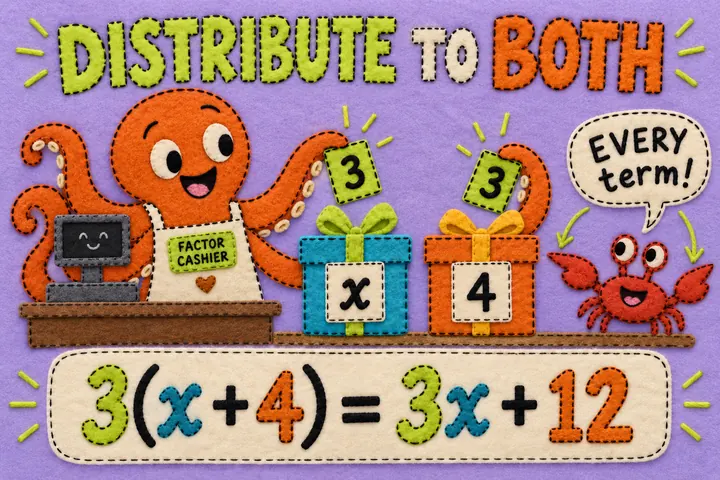
Use the distributive property to multiply a factor by every term in parentheses. For example, \(3(x+4)=3x+12\). Keep each term’s sign, then combine like terms. Use the examples below to compare expanding an expression with solving an equation.
Solving Equations with the Distributive Property: what to notice and how to work it
What to notice first
Common student mistake
Key formulas and cues
A reliable path
- Simplify each sideDistribute and combine like terms before moving variables.
- Collect variablesUse inverse operations to get variable terms on one side and constants on the other.
- Check in the originalSubstitute the solution into the original equation to check both sides.
Worked examples
Distribute, then solve
- Distribute 3: \(3x+6=21\).
- Subtract 6, then divide by 3: \(3x=15\), so \(x=5\).
- Check in the original: \(3(5+2)=21\).
Distribute with variables on both sides
- Distribute 2: \(4x-6=2x+10\).
- Subtract \(2x\) and add 6: \(2x=16\).
- Divide by 2, then check: \(2(2(8)-3)=26=2(8)+10\).
Try one before moving on
Equation warm-up: pop-up practice
What Is the Distributive Property?
The distributive property states that multiplying a number by a sum (or difference) is the same as multiplying that number by each addend and then adding (or subtracting) the results:

\(a(b + c) = \text{ ab } + \text{ ac }\)
\(a(b – c) = \text{ ab } – \text{ ac }\)
This works for any real numbers a, b, and c, and it works with variables too.
How to Apply the Distributive Property
With Numbers
Multiply the outside factor by each term inside the parentheses.
- \(3(2 + 4) = 3 \times 2 + 3 \times 4 = 6 + 12 = 18\) ✓ (same as \(3 \times 6 = 18\))
- \(5(6 – 3) = 5 \times 6 – 5 \times 3 = 30 – 15 = 15\) ✓
With Variables
The process is identical — multiply the outside term by every term inside.
- \(3(x + 4) = 3x + 12\)
- \(5(2x – 3) = 10x – 15\)
With a Negative Factor
A negative sign outside the parentheses flips the sign of every term inside.
- \(-2(x + 6) = -2x – 12\)
- \(-(x + 9) = -x – 9\)
Step-by-Step Summary
- Identify the factor being multiplied outside the parentheses.
- Multiply that factor by the first term inside the parentheses.
- Multiply that factor by the second term (and every additional term).
- Keep the same operation (+ or −) between the resulting terms.
- Combine like terms if possible.
Watch: The Distributive Property (Algebra Basics)
Math Antics introduces the distributive property in its general algebraic form with clear examples:
The Distributive Property – Worked Examples
Example 1: Expand \(4(x + 5)\).
Multiply 4 by each term: \(4 \times x = 4x\) and \(4 \times 5 = 20\).
Result: \(4x + 20\). Check (\(x = 2\)): \(4(7) = 28 = 4(2)+20 = 28\) ✓
Example 2: Expand \(5(2x – 3)\).
Multiply 5 by each term: \(5 \times 2x = 10x\) and \(5 \times (-3) = -15\).
Result: \(10x – 15\).
Example 3: Expand \(-2(x + 6)\).
\(\text{ Multiply } -2\) by each term: \((-2) \times x = -2x\) and \((-2) \times 6 = -12\).
Result: \(-2x – 12\).
Example 4: Simplify \(3(x + 2) + 4(x – 1)\).
Distribute: \(3x + 6 + 4x – 4\). Combine like terms: \(7x + 2\).
More Practice: Distributive Property with Algebraic Expressions
Khan Academy applies the distributive property to algebraic expressions with additional examples:
Exercises for the Distributive Property
Expand each expression using the distributive property.
- \(4(x + 5)\)
- \(-3(2x – 1)\)
- \(6(3 + x)\)
- \(2(5x – 4)\)
- \(-(x + 9)\)
- \(3(x + 2) + 4(x – 1)\)
Answers
- \(4x + 20\)
- \(-6x + 3\)
- \(18 + 6x\)
- \(10x – 8\)
- \(-x – 9\)
- \(7x + 2\)
Free The Distributive Property Worksheet
Ready to practice on your own? Download our free The Distributive Property worksheet below, work through each problem at your own pace, and then check your answers. If a few give you trouble, scroll back up to the worked examples and try again, steady practice is the surest way to master The Distributive Property before a quiz or test.
Download Variables Expressions and Properties Worksheet
Frequently Asked Questions
Does the distributive property work with subtraction?
Yes. \(a(b – c) = \text{ ab } – \text{ ac }\). Treat subtraction as adding a negative: \(a(b + (-c)) = \text{ ab } – \text{ ac }\).
Can I use the distributive property in reverse (factoring)?
Yes, that is called factoring out the GCF. For example, \(6x + 12 = 6(x + 2)\) because 6 is common to both terms.
Why does distributing a negative sign flip all the signs?
Because you are multiplying every term inside \(\text{ by } -1\). Multiplying \(\text{ by } -1\) reverses the sign: \((-1) \times a = -a\) and \((-1) \times (-a) = a\).
Related Topics
- Order of Operations
- Translate Phrases into an Algebraic Statement
- Multiplying and Dividing Integers
- Integers and Absolute Value
- Exponential Growth and Decay
For connected lessons, use the Algebra 1 learning center. For another explanation of the rule, see the OpenStax distributive property lesson.

Related to This Article
More math articles
- Comparing and Ordering Numbers for 5th Grade: Tips and Practice
- Pennsylvania PSSA Grade 6 Math Free Worksheets: Free Printable PDF Worksheets for Every Skill
- GED Test: Everything You Need to Know
- Institutional conflict and cooperation
- Free Grade 3 English Worksheets for Vermont Students
- Arizona AASA Grade 4 Math Free Worksheets: Printable Practice for Every Fourth-Grade Math Skill
- Baccarat Scoreboards: What the Big Eye Road Actually Tracks
- Conference committees
- Geometry Puzzle – Challenge 71
- How to Find Fractions of Time Units
What people say about "Distributive Property: Examples, Signs and Equations"?
No one replied yet.