YOUR PSAT/NMSQT STUDY COMPANION
The Ultimate PSAT Math Course (+FREE Worksheets & Tests)
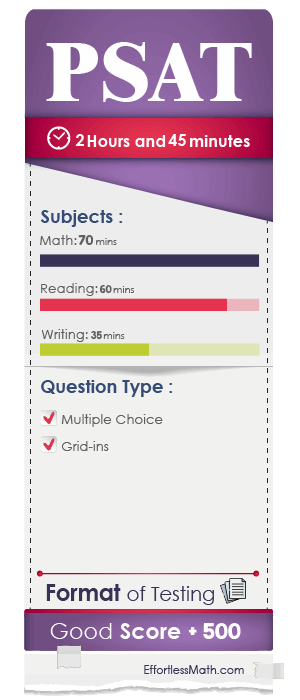
PSAT math runs 44 questions in 70 minutes across two adaptive modules, covering algebra, advanced maths, problem solving and data analysis, and a little geometry and trigonometry. This free course teaches every tested topic in order, with worksheets and practice tests for each.
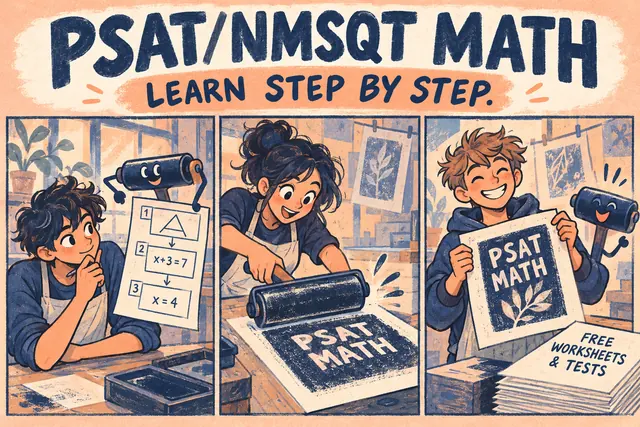
PSAT math runs 44 questions in 70 minutes across two adaptive modules, covering algebra, advanced math, problem solving and data analysis, and a little geometry and trigonometry. This free course teaches every tested topic in order, with worksheets and practice tests for each.
Quick answer: PSAT math has 44 questions in two 35-minute modules, and a calculator is allowed on all of it. The topics fall into four domains: Algebra (about 35%), Advanced Math (about 32.5%), Problem-Solving and Data Analysis (about 20%), and Geometry and Trigonometry (about 12.5%). Linear equations, functions, percents, data and right triangles show up the most.
If you want an online comprehensive free PSAT Math course so you can do better in your studies in mathematics as well as learn about every needed math concept required to pass the exam, stay here on this site.
Here’s a totally thorough course that covers all the topics for the PSAT Math exam.
This ideal PSAT Math course is the sole product you’ll require to do well when taking the PSAT Math examination.
This course for PSAT Mathematics as well as an additional Effortless Math Education source is downloaded by thousands of people who plan to take the PSAT exam every year. It helps them go over the areas of the test like the basic core materials and math reviews, and they will then know where they are strong or weak so they can get a better score via the PSAT test.
No schedule to follow at all. Just learn at a speed you can handle. Each of the lessons has examples, exercises, activities, and notes which will help them learn about as well as comprehend all the needed exam concepts.
There is also a FREE
Learn how to prepare for the PSAT Math assessment:
How to Prepare for the PSAT Math Test?
The Absolute Best Book to Ace the PSAT Math Test
racting Mixed Numbers
Real Numbers and Integers
- Adding and Subtracting Integers
- Multiplying and Dividing Integers
- Order of Operations
- Ordering Integers and Numbers
- Integers and Absolute Value
Proportions, Ratios, and Percent
- Simplifying Ratios
- Proportional Ratios
- Similarity and Ratios
- Percentage Calculations
- Percent Problems
- Discount, Tax and Tip
- Percent of Increase and Decrease
- Simple Interest
Algebraic Expressions
- Simplifying Variable Expressions
- Simplifying Polynomial Expressions
- Translate Phrases into an Algebraic Statement
- The Distributive Property
- Evaluating One Variable Expressions
- Evaluating Two Variables Expressions
- Combining like Terms
Equations and Inequalities
- One-Step Equations
- Multi-Step Equations
- Graphing Single, Variable Inequalities
- One-Step Inequalities
- Multi-Step Inequalities
- Systems of Equations
Linear Functions
- Finding Slope
- Graphing Lines Using Standard Form
- Graphing Lines Using Slope-Intercept Form
- Writing Linear Equations
- Graphing Linear Inequalities
- Finding Midpoint
- Finding Distance of Two Points
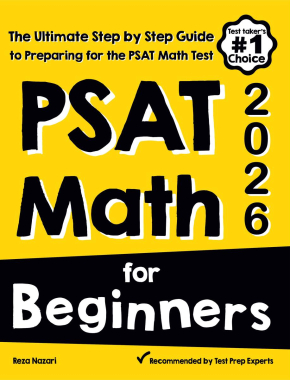
Need more practice? PSAT Math for Beginners 2026 covers PSAT math step by step, with practice problems and answers. Look inside · $17.99
Exponents and Radicals
- Multiplication Property of Exponents
- Division Property of Exponents
- Zero and Negative Exponents
- Powers of Products and Quotients
- Negative Exponents and Negative Bases
- Scientific Notation
- Radicals
Polynomials
- Writing Polynomials in Standard Form
- Simplifying Polynomials
- Adding and Subtracting Polynomials
- Multiplying Monomials
- Multiplying and Dividing Monomials
- Multiplying a Polynomial and a Monomial
- Multiplying Binomials
- Factoring Trinomials
- Operations with Polynomials
Geometry and Solid Figures
Statistics and Probability
- Mean, Median, Mode, and Range
- Histograms
- Pie Graph
- Probability Problems
- Combinations and Permutations
Functions
- Function Notation
- Adding and Subtracting Functions
- Multiplying and Dividing Functions
- Composition of Functions
Quadratic
- Solving a Quadratic Equation
- Graphing Quadratic Functions
- Solving Quadratic Inequalities
- Graphing Quadratic Inequalities
Matrices
Logarithms
Complex Numbers
- Adding and Subtracting Complex Numbers
- Multiplying and Dividing Complex Numbers
- Rationalizing Imaginary Denominators
Trigonometric Functions
- Trig Ratios of General Angles
- Coterminal Angles and Reference Angles
- Angles and Angle Measure
- Evaluating Trigonometric Function
- Missing Sides and Angles of a Right Triangle
- Arc Length and Sector Area
Take a FREE For education statistics and research, visit the National Center for Education Statistics.
College Entrance Tests
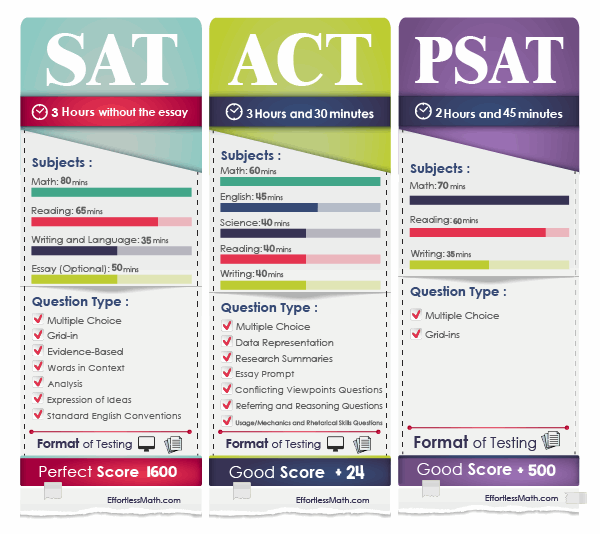
Looking for the best resource to help you succeed on the PSAT Math test?
The Best Books to Ace the PSAT Math Test
PSAT Math Topics by Domain
The College Board groups every PSAT math question into four domains. Use this table to see what to study and how much each area counts.
| Domain | Share of test | Topics |
|---|---|---|
| Algebra | About 35% | Linear equations in one and two variables, linear functions, systems of two linear equations, linear inequalities |
| Advanced Math | About 32.5% | Equivalent expressions, nonlinear equations and systems, nonlinear functions such as quadratics and exponentials |
| Problem-Solving and Data Analysis | About 20% | Ratios, rates, proportions and units; percentages; one-variable data and measures of center and spread; scatterplots and models; probability and conditional probability; sample statistics and margin of error; evaluating statistical claims |
| Geometry and Trigonometry | About 12.5% | Area and volume; lines, angles and triangles; right triangles and trigonometry; circles |
Algebra and Advanced Math together make up about two-thirds of the test, so start there.
A Simple Study Order for PSAT Math
- Linear equations and functions. Solve equations like 3x + 7 = 22 (x = 5), find slopes, and write y = mx + b from a graph or table.
- Systems and inequalities. Solve two equations at once by substitution or elimination.
- Quadratics and exponentials. Factor, use the quadratic formula, and read growth and decay models.
- Percents, ratios and data. Practice percent change, unit rates, mean and median, and reading scatterplots.
- Geometry and trig. Review area and volume, triangle angle facts, the Pythagorean theorem, sine, cosine and tangent, and circles.
- Timed practice. Take a full practice test and review every miss by topic.
Frequently Asked Questions
What math is on the PSAT?
PSAT math covers four domains: Algebra (about 35% of questions), Advanced Math (about 32.5%), Problem-Solving and Data Analysis (about 20%), and Geometry and Trigonometry (about 12.5%). In practice, that means lots of linear equations and systems, functions and quadratics, percents, ratios and data tables, plus a few questions on area, angles and right triangles.
What math do you need to know for the PSAT?
You need solid Algebra 1 and Geometry skills, plus a few Algebra 2 topics such as quadratics, exponential functions and nonlinear systems. Precalculus and calculus are not tested. If you can solve 2x + 5 = 17 quickly, find a slope from two points and work out a percent increase, you already have much of the foundation.
Is trig on the PSAT?
Yes, but only a small amount. Geometry and Trigonometry together make up roughly 5 or 6 of the 44 math questions. The trig part centers on right triangles: sine, cosine and tangent as side ratios, and the fact that sin x° = cos(90° − x°). For example, if sin 30° = 0.5, then cos 60° = 0.5 as well.
How do I study for PSAT math?
Start with Algebra, since it is the largest domain, then move to Advanced Math, Problem-Solving and Data Analysis, and finally Geometry and Trigonometry. Work one topic at a time with a lesson and a worksheet, keep a list of the question types you miss, and take a timed practice test every week or two to check your pacing.
How is the PSAT math section structured?
The digital PSAT/NMSQT math section has 44 questions split into two adaptive modules of 22 questions, with 35 minutes for each module. How you do on the first module decides whether the second is easier or harder. A calculator is allowed throughout, and the testing app includes a built-in Desmos graphing calculator.
Where can I find PSAT math practice worksheets?
The free PSAT math course here pairs each tested topic with a worksheet and a practice test, so you can learn a skill and practice it right away. Begin with linear equations and functions, which appear most often, then branch out to quadratics, percents and data. Check every answer and redo any problem you missed a day later.

Related to This Article
More math articles
- The Ultimate KAP Algebra 1 Course (+FREE Worksheets)
- 8th Grade OAA Math Worksheets: FREE & Printable
- Set Calculator — Union, Intersection & Difference (Free)
- Points, Lines, and Rays for 4th Grade
- New Hampshire Algebra 1 Free Worksheets: Printable Standards-Aligned Algebra 1 Practice with Answers
- Hearings and markups
- Jungle Bargains: A Guide How to Find the Original Price Using Sale Prices
- Free Grade 4 English Worksheets for Michigan Students
- What is the Relationship between Dilations and Angles in Geometry
- 3rd Grade MAP Math Practice Worksheets: Free Printable PDFs






What people say about "PSAT Math Topics: Free Course with Lessons and Tests"?
No one replied yet.