How to Calculate the Area of Trapezoids? (+FREE Worksheet!)
Picture a trapezoid like a slice of bread sitting on its short edge with the wider crust at the top. To find its area, you average the two parallel sides (the bases), then multiply that average by the height between them. In plain steps: add the two bases, multiply by the height, then divide by 2. The height has to be the straight perpendicular distance, not the slanted side. Once you see the formula as just an average times a height, trapezoids stop being intimidating.
Key takeaways:
- A trapezoid has exactly one pair of parallel sides (the bases).
- Area formula: \(A = \dfrac{1}{2}(b_1 + b_2)h\).
- Height is the perpendicular distance between the two parallel sides - not a slanted side.
- Add the two bases first, then multiply by the height, then halve.
- The same formula handles trapezoids in any orientation.
Learn more about trapezoids and how to calculate their areas by using the trapezoid area formula.

Watch this practice video for additional examples and reinforcement:
Related Topics
- How to Find the volume and surface area of Rectangular Prisms
- How to Solve Triangles Problems
- How to Solve Pythagorean Theorem Problems
- How to Find Volume and Surface Area of Cubes
- How to Find the Perimeter of Polygons
The Absolute Best Books to Ace Pre-Algebra to Algebra II
A step-by-step guide to calculating the area of Trapezoids
- A quadrilateral with at least one pair of parallel sides is a trapezoid.
- Area of a trapezoid \(= \color{blue}{\frac{1}{2} h(b_{1}+b_{2})}\)

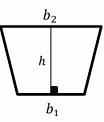
Area of Trapezoids, Example 1:
Calculate the area of the trapezoid.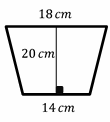 For education statistics and research
Use trapezoid area formula: \(A= \frac{1}{2} h(b_{1}+b_{2 }) \)
\(b_{1}=14 cm, b_{2}=18\) \(cm\) and \(h=20\) \(cm\)
Then: \(A= \frac{1}{2}(20)(14+18)=10(32)=320\) \(cm^2\)
The Best Book to Help You Ace Pre-Algebra
Area of Trapezoids, Example 2:
Calculate the area of the trapezoid.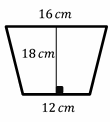
Solution:
Use trapezoid area formula: \(A= \frac{1}{2} h(b_{1}+b_{2 }) \)
\(b_{1}=12 cm, b_{2}=16\) \(cm\) and \(h=18\) \(cm\)
Then: \(A= \frac{1}{2}(18)(12+16)=9(28)=252\) \(cm^2\)
Exercises for Calculating Area of Trapezoids
Calculate the area for each trapezoid.
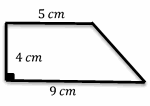
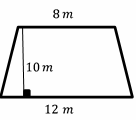
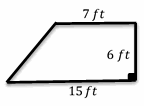
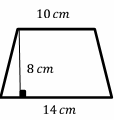
Download Trapezoids Worksheet
- \(\color{blue}{28 \ cm^2}\)
- \(\color{blue}{100 \ m^2}\)
- \(\color{blue}{66 \ ft^2}\)
- \(\color{blue}{96 \ cm^2}\)
The Greatest Books for Students to Ace the Algebra
Recommended EffortlessMath Books
For a deeper walk through every geometry skill from the ground up, Geometry for Beginners covers angles, area, volume, triangles, and transformations with worked examples and plenty of practice. For algebra-heavy geometry topics, the companion Algebra I for Beginners ties the coordinate-plane work back to linear equations.
Frequently Asked Questions
What’s a trapezoid?
A four-sided polygon with exactly one pair of parallel sides. The parallel sides are called the bases (\(b_1\) and \(b_2\)); the other two sides are the legs. Trapezoids can be isosceles (legs equal length), right (one leg perpendicular to the bases), or scalene (legs of different lengths).
What’s the formula for the area of a trapezoid?
\(A = \dfrac{1}{2}(b_1 + b_2)h\). Add the two parallel sides, multiply by the perpendicular height, divide by 2. For a trapezoid with bases 6 and 10 and height 4: \(A = \dfrac{1}{2}(6+10)(4) = \dfrac{1}{2}(16)(4) = 32\) square units.
Why is the formula \(\dfrac{1}{2}(b_1 + b_2)h\)?
You can think of two identical trapezoids glued together making a parallelogram with base \(b_1 + b_2\) and height \(h\). That parallelogram has area \((b_1 + b_2)h\); the trapezoid is half of it. Hence the \(\dfrac{1}{2}\) in the formula.
What counts as the height of a trapezoid?
The perpendicular distance between the two parallel sides – NOT the length of a slanted leg. In a tilted trapezoid, the height is the straight-up-and-down distance from one base to the other, measured at a right angle.
What if the trapezoid is drawn sideways?
The formula still works. Identify the two parallel sides as the bases, regardless of orientation, and the perpendicular distance between them as the height. Don’t be fooled by which side looks like a base – check which two sides are actually parallel.
How do I find the area if only the legs and bases are given?
Find the height first. For a right trapezoid, the leg perpendicular to the bases IS the height. For other trapezoids, use the Pythagorean theorem on the slanted legs to find the perpendicular height, then apply the formula.
Walk me through an example.
Bases 7 cm and 11 cm; height 5 cm. \(A = \dfrac{1}{2}(7+11)(5) = \dfrac{1}{2}(18)(5) = 45\) square cm. Always remember units – the answer should be in square units of whatever length unit you started with.
What’s an isosceles trapezoid?
A trapezoid where the two non-parallel sides (the legs) are equal in length. Isosceles trapezoids have a line of symmetry perpendicular to the bases. The area formula is the same – \(\dfrac{1}{2}(b_1 + b_2)h\) – regardless of whether the trapezoid is isosceles.
Is a parallelogram a special trapezoid?
Depends on the definition you use. Some textbooks say a trapezoid has EXACTLY one pair of parallel sides, which excludes parallelograms. Others say AT LEAST one pair, which includes parallelograms. Both conventions exist; check what your teacher uses. The area formula gives the same answer either way (the parallelogram becomes a degenerate trapezoid).
Where does this skill show up?
Grade 6-8 state tests, geometry class, SAT, ACT, GED, and most standardized math tests. Real-life uses: finding the area of trapezoidal cross-sections (irrigation ditches, building plans, deck designs). Mastering this formula opens the door to area of more complex polygons by splitting them into trapezoids and triangles.
Related EffortlessMath Lessons
If a topic on this page feels rusty, these short lessons go deeper:
- How to identify polygons
- How to find the area of rectangles
- How to find the area of shapes (resource currently unavailable)
- How to find perimeter and area
- How to find the surface area (resource currently unavailable)

Related to This Article
More math articles
- The Best Grade 7 Math Book for New York Students
- FREE 3rd Grade NYSE Math Practice Test
- Economic conditions
- How Probability Models Shape Decision-Making Across Finance, Gaming, And Online Platforms
- 5th Grade MCAS Math Practice Test Questions
- SBAC Algebra 1 Free Worksheets: Free Printable Smarter Balanced Algebra 1 Practice with Keys
- SSAT Middle Level Math Flashcards (Free Online: Formulas, Terms & Concepts)
- SAT vs. ACT Math: Which Test Is Easier in 2026?
- TExES Mathematics 7-12 Flashcards
- Top 10 TSI Math Practice Questions
What people say about "How to Calculate the Area of Trapezoids"?
No one replied yet.