Air Force Officer Qualifying Test · Math
AFOQT Math Practice Test: Free Arithmetic Reasoning & Math Knowledge Prep
Review AFOQT Math with practice, topic lessons, and study tools. Start with number sense and rational numbers, ratios, percents, and rates, exponents, radicals, and scientific notation, then use your practice results to choose the next skill.

What is on the AFOQT math test?
The AFOQT is the Air Force Officer Qualifying Test, taken by Air Force and Space Force officer candidates, including ROTC and OTS applicants. It has 12 subtests over about five hours. The math subtests are Arithmetic Reasoning, with 25 word problems in 29 minutes, and Math Knowledge, with 25 questions in 22 minutes. Both feed the Quantitative and Academic Aptitude composites, and Math Knowledge also counts toward the Pilot, CSO and ABM composites.
- Arithmetic Reasoning
- 25 questions, 29 minutes
- Math Knowledge
- 25 questions, 22 minutes
- Whole test
- 12 subtests, about 5 hours including breaks
- Attempts
- Two attempts, or three with an approved waiver
- Math composites
- AR and MK: Quantitative and Academic Aptitude; MK also: Pilot, CSO, ABM
Source: Pearson VUE AFOQT official information. Rules and dates can change, so confirm with the official site or your test center.
AFOQT Test Outline
The AFOQT has 12 timed subtests. Review the skills in each one, then open its AFOQT Online Center to prepare. Names, timing, and question counts follow the current test overview from Pearson VUE.
Verbal Analogies
Choose the word pair that completes a relationship. State the relationship in plain language before choosing.
Topics covered
- Synonyms and near-synonyms
- Opposites and contrasts
- Part-to-whole relationships
- Cause and effect
- Tool and purpose
Arithmetic Reasoning
Translate quantities and relationships into arithmetic to solve practical word problems.
Topics covered
- Ratios, proportions, and rates
- Percentages and mixtures
- Integers and arithmetic
- Time and distance
- Geometry word problems
Word Knowledge
Recognize a word’s meaning and select the closest synonym.
Topics covered
- Synonyms and word meanings
- Word parts and roots
- Context clues
- Connotation and precision
Math Knowledge
Use mathematical concepts, formulas, and relationships across arithmetic, algebra, and geometry.
Topics covered
- Arithmetic and number operations
- Expressions, equations, and inequalities
- Systems and exponents
- Geometry and measurement
- Coordinate ideas
Reading Comprehension
Read passages closely and understand stated and implied meaning using evidence in the text.
Topics covered
- Main idea and purpose
- Supporting details
- Inference from evidence
- Tone, structure, and point of view
- Meaning of words in context
Situational Judgment
Choose effective responses to interpersonal and leadership situations.
Topics covered
- Identify the immediate issue
- Safety and procedures
- Communication and teamwork
- Responsibility and likely outcomes
Self-Description Inventory
Respond to self-description statements. This inventory is not scored. Follow test-day directions and answer honestly.
Topics covered
- Self-description statements
- Work preferences
- Personality inventory
- Unscored subtest
Physical Science
Review high-school physical science concepts, including forces, physical laws, and simple machines.
Topics covered
- Forces and motion
- Physical laws
- Simple machines
- Matter and energy
Table Reading
Read a coordinate-style table accurately and locate values efficiently.
Topics covered
- Read axes and labels
- Locate row and column values
- Track coordinate pairs
- Compare table entries
Instrument Comprehension
Interpret basic flight instruments, including altitude indicators and magnetic compasses.
Topics covered
- Altitude indicators
- Magnetic compass
- Pitch and bank
- Relate instrument readings
Block Counting
Build spatial awareness by counting blocks in three-dimensional arrangements.
Topics covered
- Read 3D block arrangements
- Count visible blocks
- Track layers and hidden cubes
- Check spatial relationships
Aviation Information
Review basic aviation concepts, flight mechanics, and aircraft information.
Topics covered
- Basic flight principles
- Fixed-wing aircraft
- Rotary aircraft
- Flight mechanics and forces
AFOQT Practice Tests
Choose a practice activity. Independent practice results are study feedback, not official test scores.
AFOQT Flashcards
Open a vocabulary or formula resource. Availability and scope are described below.
AFOQT Study Guides
Compare the actual book titles and check their product pages before choosing. These are independent preparation resources.
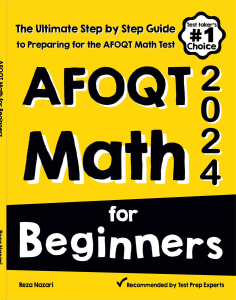
AFOQT Math for Beginners 2026: The Ultimate Step by Step Guide to Preparing for the AFOQT Math Test
Open the product page to check the contents, edition, format, and purchase options.
View book & purchase options → $17.99 · PDF

AFOQT Math Test Prep Bundle: Study Guide + Practice Workbook + Practice Tests
Open the product page to check the contents, edition, format, and purchase options.
View book & purchase options → $36.99 · PDF

AFOQT Math Full Study Guide: Comprehensive Review + Practice Tests + Online Resources
Open the product page to check the contents, edition, format, and purchase options.
View book & purchase options → $16.99 · PDF
AFOQT Quick Review
Review one skill, try its practice, and use the result to choose your next step.
Start with AFOQT subtest Online Centers
Open a focused AFOQT Online Center to see what that section covers, review its topics, and choose a practical next step. The complete outline below connects all 12 subtests.
Arithmetic Reasoning
Translate quantities and relationships into arithmetic to solve practical word problems.
Review this subtest →
Math Knowledge
Use mathematical concepts, formulas, and relationships across arithmetic, algebra, and geometry.
Review this subtest →
Verbal Analogies
Choose the word pair that completes a relationship. State the relationship in plain language before choosing.
Review this subtest →
Word Knowledge
Recognize a word’s meaning and select the closest synonym.
Review this subtest →
Reading Comprehension
Read passages closely and understand stated and implied meaning using evidence in the text.
Review this subtest →
Five helpful starting points; the outline below includes every AFOQT subtest and links to its Online Center.
Jump into AFOQT Math
See it. Understand it. Try it.
AFOQT Math Quick Review turns each idea into a picture, a clear explanation, and a worked example. Start with the basics, or jump to the skill you want to learn.
Six ways into AFOQT Math
Every lesson starts with a visual explanation and ends with a chance to practice.
Join students who study with a clearer path
This test prep online center is part of the Effortless Math library for AFOQT Math. We connect lessons, worksheets, practice tests, books, and tools so students can study with a clearer next step.

This is an independent Effortless Math AFOQT Math preparation online center. Official exam, standards, or curriculum owners do not endorse this page.
Start With A Practice Test
Begin with AFOQT Math practice step, use the result to find weak skills, then review the matching lesson, worksheet, or flashcards before trying again.
Take a diagnostic first
Start with mixed practice. Mark every missed question by topic instead of only looking at the score.
Know what is tested
Use the outline or official structure to see which skills matter most before adding more study time.
Fix one weak skill
Choose one target, such as Arithmetic, and practice it before returning to a full mixed set.
Move into lessons or books
After the first test, use lessons, flashcards, worksheets, or the recommended book path for structure.
AFOQT Math Snapshot
timed AFOQT subtests
quantitative math subtests
combined minutes for Arithmetic Reasoning and Math Knowledge
combined questions across the two math subtests
Free AFOQT Math Formula Sheet PDF
Open the complete AFOQT Math formula guide, review the pages online, then print or save the PDF when you are ready.
Complete ReviewStudy the key formulas in one focused guide.›
Page-by-Page ReviewMove through the formulas at your own pace.›
Online StudyKeep the guide open while you practice problems.›
Print When ReadyUse the print option after you finish reviewing.›
Download for LaterSave the PDF when you want an offline copy.›
AFOQT Math Skill Quizzes
Short, focused quizzes, pick one skill, answer 10 questions, get instant scoring and full step-by-step solutions. Each opens right here in a popup.
Number Sense & Rational Numbers
Integers, number lines, rational numbers, and absolute value.
Start Quiz →
Fractions & Decimals
The fraction and decimal arithmetic that appears everywhere on the test.
Start Quiz →
Ratios & Proportional Reasoning
Unit rates, proportions, and real-world comparisons.
Start Quiz →
Percents & Financial Math
Percent change, discounts, interest, and money math.
Start Quiz →
Equations & Inequalities
Linear equations in one variable, inequalities, and word problems.
Start Quiz →
Linear Functions & Graphs
Slope, intercepts, and writing the equation of a line.
Start Quiz →
Exponents & Polynomials
Exponent rules and polynomial operations.
Start Quiz →
Geometry & Measurement
Area, volume, angles, circles, and coordinate geometry.
Start Quiz →
Statistics & Data
Charts, centers, variability, scatter plots, and data reasoning.
Start Quiz →
Mixed Math Review
A mixed quiz for a quick readiness check across major skills.
Start Quiz →
AFOQT Math Topics: Learn, Practice, and Quiz
Choose a topic, open its worksheet for printable practice, then take a short quiz from the same row.
96 topics · worksheets · quizzes
Number Sense and Rational Numbers
- Comparing and Ordering Integers WorksheetQuiz
- Integers and Absolute Value WorksheetQuiz
- Adding and Subtracting Integers WorksheetQuiz
- Multiplying and Dividing Integers WorksheetQuiz
- Factors Multiples GCF and LCM WorksheetQuiz
- Adding and Subtracting Fractions WorksheetQuiz
- Multiplying Mixed Numbers WorksheetQuiz
- Multiplying and Dividing Fractions WorksheetQuiz
- Adding and Subtracting Decimals WorksheetQuiz
- Multiplying and Dividing Decimals WorksheetQuiz
- Converting Fractions Decimals and Percents WorksheetQuiz
- Real World Problems with Rational Numbers WorksheetQuiz
Ratios, Percents, and Rates
- Simplifying Ratios WorksheetQuiz
- Unit Rates WorksheetQuiz
- Proportional Ratios WorksheetQuiz
- Constant of Proportionality WorksheetQuiz
- Scale Drawings and Scale Factors WorksheetQuiz
- Converting Units of Measurement WorksheetQuiz
- Percent Problems WorksheetQuiz
- Finding the Whole from a Part and Percent WorksheetQuiz
- Percent of Increase and Decrease WorksheetQuiz
- Discount Tax and Tip WorksheetQuiz
- Simple Interest WorksheetQuiz
- Compound Interest WorksheetQuiz
- Tips Commissions and Fees WorksheetQuiz
Exponents, Radicals, and Scientific Notation
- Multiplication Property of Exponents WorksheetQuiz
- Division Property of Exponents WorksheetQuiz
- Zero and Negative Exponents WorksheetQuiz
- Negative Exponents and Negative Bases WorksheetQuiz
- Radicals WorksheetQuiz
- Rational and Irrational Numbers WorksheetQuiz
- Scientific Notation WorksheetQuiz
- Operations with Scientific Notation WorksheetQuiz
Expressions, Equations, and Inequalities
- When an Expression Is Undefined WorksheetQuiz
- Evaluating One Variable WorksheetQuiz
- Evaluating Two Variables WorksheetQuiz
- Simplifying Variable Expressions WorksheetQuiz
- The Distributive Property WorksheetQuiz
- One Step Equations WorksheetQuiz
- Solving Two Step Equations WorksheetQuiz
- Multi Step Equations WorksheetQuiz
- Equations with Variables on Both Sides WorksheetQuiz
- Literal Equations and Formulas WorksheetQuiz
- One Step Inequalities WorksheetQuiz
- Multi Step Inequalities WorksheetQuiz
- Compound Inequalities WorksheetQuiz
- Graphing Linear Inequalities WorksheetQuiz
Coordinate Geometry and Lines
- The Coordinate Plane WorksheetQuiz
- Finding Slope WorksheetQuiz
- Graphing Lines WorksheetQuiz
- Point Slope Form WorksheetQuiz
- Standard Form of a Linear Equation WorksheetQuiz
- Writing Linear Equations WorksheetQuiz
- Parallel and Perpendicular Lines WorksheetQuiz
- Systems of Equations WorksheetQuiz
- Finding Midpoint WorksheetQuiz
- Finding Distance of Two Points WorksheetQuiz
Functions
Polynomials and Quadratics
- Adding and Subtracting Polynomials WorksheetQuiz
- Simplifying Polynomials WorksheetQuiz
- Multiplying Binomials WorksheetQuiz
- Special Products of Polynomials WorksheetQuiz
- Factoring with the Greatest Common Factor WorksheetQuiz
- Factoring Trinomials WorksheetQuiz
- Solving Quadratic Equations by Factoring WorksheetQuiz
- The Quadratic Formula WorksheetQuiz
- Graphing Quadratic Functions WorksheetQuiz
- Rational Expressions WorksheetQuiz
Geometry and Measurement
- Complementary and Supplementary Angles WorksheetQuiz
- Parallel Lines and Transversals WorksheetQuiz
- Triangles WorksheetQuiz
- Similarity and Ratios WorksheetQuiz
- Area of Triangles WorksheetQuiz
- Area and Perimeter of Quadrilaterals WorksheetQuiz
- Polygons WorksheetQuiz
- Circles WorksheetQuiz
- Area and Perimeter of Composite Figures WorksheetQuiz
- Rectangular Prisms WorksheetQuiz
- Cubes WorksheetQuiz
- Cylinder WorksheetQuiz
- Surface Area of Solids WorksheetQuiz
- Volume and Surface Area of Composite Solids WorksheetQuiz
Data, Statistics, and Probability
- Weighted Averages and Missing Data Values WorksheetQuiz
- Box Plots and Interquartile Range WorksheetQuiz
- Histograms and Data Displays WorksheetQuiz
- Pie Graph WorksheetQuiz
- Scatter Plots and Lines of Best Fit WorksheetQuiz
- Two Way Frequency Tables WorksheetQuiz
- Probability Problems WorksheetQuiz
- Probability of Compound Events WorksheetQuiz
- Permutations and Combinations WorksheetQuiz
AFOQT Math Skills Worth Reviewing
This section gives students a practical way to decide what to fix next when a full practice set feels overwhelming.
Arithmetic
If vocabulary, setup, or calculation makes this skill difficult, work through a short focused set before moving on.
Fractions
If vocabulary, setup, or calculation makes this skill difficult, work through a short focused set before moving on.
Algebra
If vocabulary, setup, or calculation makes this skill difficult, work through a short focused set before moving on.
Geometry
If vocabulary, setup, or calculation makes this skill difficult, work through a short focused set before moving on.
Data
If vocabulary, setup, or calculation makes this skill difficult, work through a short focused set before moving on.
Choose Your AFOQT Math Prep Tool
Different students need different entry points. This toolbox gives AFOQT Math review, practice, strategy, and next-step resources a clear place on the page.
AFOQT Math Course
Use the full AFOQT Math course when students need lessons before practice.
Free AFOQT Math Practice Test
Start with a timed practice set or mixed review to find weak areas.
AFOQT Math Study Guide
Use the recommended study guide path when students need structure and printed practice.
AFOQT Math Practice Plan
Turn missed questions into a small weekly review loop.
AFOQT Math Practice Paths
Practice is most useful when students know which stack to pick. These paths turn the resource library into a clear sequence.
Foundations Path
Use this path when a student is just getting oriented with AFOQT Math.
- Arithmetic
- Fractions
Core Skills Path
Use this path for the skills that usually decide AFOQT Math confidence.
- Algebra
- Geometry
Mixed Practice Path
Use this path when the student is ready to connect skills in mixed practice.
- Data
- Pacing

AFOQT Math for Beginners 2026: The Ultimate Step by Step Guide to Preparing for the AFOQT Math Test
For structured review, compare the guide’s contents and edition with your test requirements before choosing it.
- Compare the contents with your study needs
- Step-by-step lessons before mixed practice
- Pairs naturally with the free guides and topic lessons on this online center
- A clear sequence from foundational lessons to mixed practice
Start from the basics
The book rebuilds the topic sequence before asking students to move into timed practice.
Use worked examples
Students can see the move, copy the method, then try similar problems on their own.
Drill one skill at a time
The structure supports focused practice instead of scattered review.
Move into confidence practice
After the book path, the online center connects students to worksheets, flashcards, and test-style questions.
How to use it
- Read one short lesson.
- Copy the worked example.
- Practice the matching skill from this online center.
- Return to mixed or timed practice after the skill feels stable.
Pair it with free tools
Choose The Right AFOQT Math Book
Start with the For Beginners or best first study guide, then use workbooks, full tests, and bundles for extra practice.
AFOQT Math for Beginners 2026: The Ultimate Step by Step Guide to Preparing for the AFOQT Math Test
Recommended practice resource
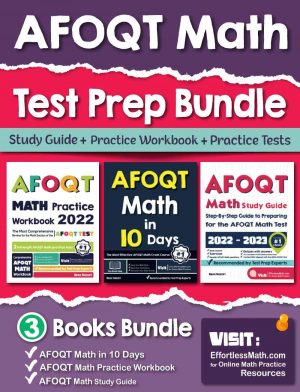
AFOQT Math Test Prep Bundle: Study Guide + Practice Workbook + Practice Tests
Recommended practice resource
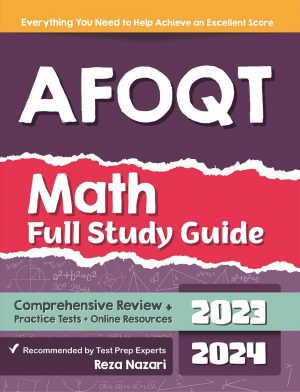
AFOQT Math Full Study Guide: Comprehensive Review + Practice Tests + Online Resources
Recommended practice resource
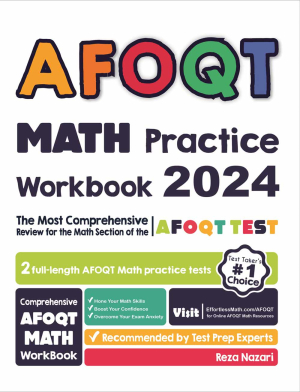
AFOQT Math Practice Workbook: The Most Comprehensive Review for the Math Section of the AFOQT Test
Recommended practice resource
Prepare for the AFOQT Math Test in 7 Days: A Quick Study Guide with Two Full-Length AFOQT Math Practice Tests
Recommended practice resource
4-Week AFOQT Math Study Roadmap
Use four focused weeks to refresh math foundations, practice core AFOQT skills, and build confidence with timed questions.
Refresh number foundations
Review fractions, decimals, integers, ratios, and the steps that feel slow.
Practice applied arithmetic
Work rates, percentages, proportions, mixtures, and multi-step word problems.
Build algebra and geometry skills
Review equations, inequalities, exponents, formulas, and coordinate graphs.
Move into timed mixed practice
Take a timed set, review each miss, and revisit the skills that still need work.
AFOQT Math FAQ
How many math questions are on the AFOQT?
There are 50 math questions across two subtests. Arithmetic Reasoning has 25 word problems in 29 minutes. Math Knowledge has 25 questions in 22 minutes. The Physical Science and Table Reading subtests also use some numbers, but AR and MK are the two math subtests.
What math is on the AFOQT Math Knowledge test?
Pearson VUE describes Math Knowledge as algebra, geometry and arithmetic. Topics include algebra word problems, inequalities, systems of equations, absolute value and exponents. Arithmetic Reasoning covers word problems on ratios, proportions, percents, mixtures, integers, geometry and time-distance problems.
Can you use a calculator on the AFOQT?
The official Form T information pamphlet says scratch paper is provided for calculations and does not list a calculator among allowed materials. Plan to do all math by hand. Practice mental arithmetic, fractions and percents so you can finish 25 Math Knowledge questions in 22 minutes.
Which AFOQT scores use math?
Arithmetic Reasoning and Math Knowledge make up the Quantitative composite and are part of the Academic Aptitude composite. Math Knowledge also counts toward the Pilot, Combat Systems Officer and Air Battle Manager composites. A strong math score can help several composites at once.
How many times can you take the AFOQT?
Pearson VUE says the test is free but limited to two attempts, or three with an approved waiver. Your recruiter or test control officer confirms eligibility and schedules the test. Ask them about the waiting period between attempts before you register.
What should I practice first for AFOQT Math?
Start with Arithmetic, number sense, and operations. Then use a short mixed practice set to see which skill should come next.
How should I use this AFOQT Math Online Center?
Begin with the main starting resource, choose one weak skill from the map, practice it, then return to the online center for the next topic or a timed review.
Are there free resources on this page?
Yes. The online center links to free Effortless Math resources such as AFOQT Math Course, Free AFOQT Math Practice Test, AFOQT Math Study Guide.
Which AFOQT Math skills matter most?
The highest-value areas include Arithmetic, number sense, and operations; Fractions, decimals, percents, ratios, and rates; Algebra, equations, inequalities, and word problems. Use the skill map as a checklist rather than trying to study everything at once.
When should I use a book or workbook?
Use a book when the student needs a structured sequence, repeated practice, or a printed path that is easier to follow than scattered online links.
How should I use the AFOQT Math topic map?
Choose one skill that feels uncertain, review its short lesson and example, then try the matching practice quiz. Return to mixed timed questions after the steps feel comfortable.
Related Online Centers
Make This Your AFOQT Math Starting Point
Bookmark this online center, choose one weak area, and use the linked practice pages and books to move from scattered review to a clear study path.
A USEFUL NEXT STEP
AFOQT Math: study questions
What can I study in this AFOQT Math Online Center?
Use this page to review number sense and rational numbers, ratios, percents, and rates, exponents, radicals, and scientific notation, expressions, equations, and inequalities. Open a topic lesson or quiz, review an error, and return to mixed practice. The resources are independent preparation materials.
How should I use the AFOQT Math resources?
Choose a topic or practice activity from this Online Center. Review the linked explanation, try the practice, and use the result to decide what to study next. Check each resource’s directions for its format and access requirements.
Resources from Effortless Math · Editorial standards