CLEP U.S. History I 090: Wilmot Proviso and Free-Soil Politics
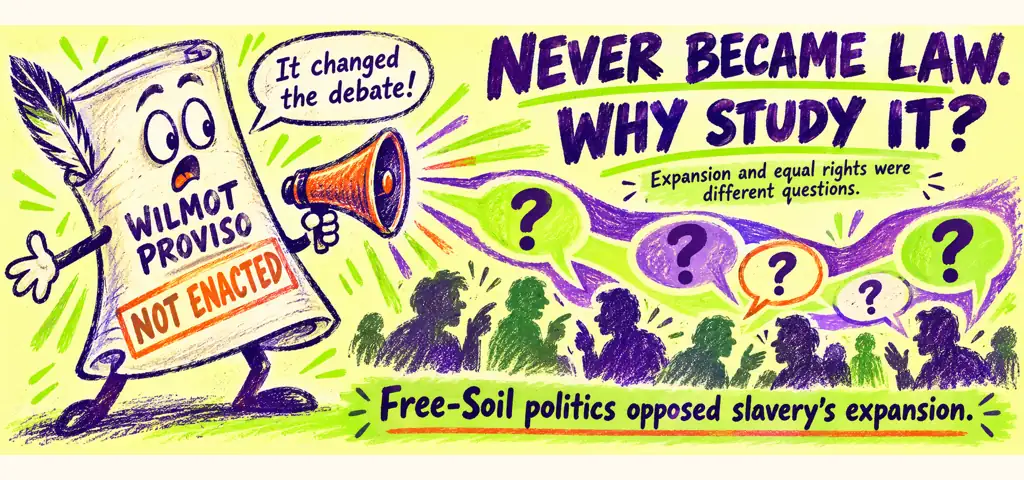
Lesson 17.1 of Chapter 17 of the U.S. History to 1877 study guide on Effortless Math covers CLEP U.S. History I 090: Wilmot Proviso and Free-Soil Politics: the key terms, the core ideas, and worked examples showing how this topic is tested on the exam.
U.S. History to 1877 | Chapter 17 | Lesson 17.1
The Wilmot Proviso proposed barring slavery from territory acquired from Mexico. It repeatedly passed the House and failed in the Senate, revealing sectional voting patterns. Free-Soil politics opposed the expansion of slavery, often because advocates wanted western land for free white labor. That position differed from immediate abolition everywhere. Some Free Soilers opposed slavery morally. Others centered white opportunity and accepted racial exclusion. The distinction explains how antislavery politics could expand without producing agreement on racial equality.
Territorial status made the issue constitutional as well as moral. Supporters treated Congress’s power over territories as authority to exclude slavery. Opponents invoked equal access for slaveholders, property rights, or limits on federal power. Popular sovereignty offered a third formula by assigning the decision to territorial settlers, but it left unresolved when and under what valid institutions they would decide. The Proviso never became law, yet its votes supplied evidence that old party labels were losing their power to contain sectional interests.
Modeled analysis When a platform says “free soil, free labor, free men,” separate policy from moral reach. The phrase attacks territorial slavery and the political power associated with its expansion. Test that inference against the platform’s actual planks on homesteads, citizenship, and existing-state slavery. It does not by itself promise immediate emancipation where slavery already existed or equal civil rights. Treating those positions as identical erases why the coalition could grow.
See the history take shape
Jocz Productions traces the people and chronology behind this lesson. Listen for the evidence that sharpens the written account, then try the questions below.
Video: Wilmot Proviso & Tallmadge Amendment Reviewed, Jocz Productions.
Check your understanding
- The Wilmot Proviso addressed slavery in
- Oregon under its existing territorial law.
- territory acquired from Mexico.
- existing slave states seeking readmission.
- Cuba under a proposed annexation treaty.
- Indian Territory under removal treaties.
- Free-Soil politics differed from immediate abolitionism because it focused on
- ending the interstate trade in enslaved people.
- limiting enforcement of the fugitive-slave clause.
- abolishing slavery in the District of Columbia.
- blocking slavery’s expansion into federal territories.
- requiring gradual emancipation within existing slave states.
- Select all positions that could appear within Free-Soil coalitions:
- moral opposition,
- defense of white labor opportunity,
- opposition to Slave Power,
- universal agreement on racial equality,
- homestead support.
- Explain why antislavery and racial equality are not synonyms.
Write a brief response using a named fact from the lesson.
Open the answers and reasoning
Independent preparation. CLEP is a registered trademark of the College Board, which does not endorse this lesson.

Related to This Article
More math articles
- Organic Chemistry Basics: Carbon Skeletons, Isomers, and Functional Groups
- 7th Grade IAR Math Practice Test Questions
- The Best Grade 8 Math Book for Maryland Students
- Free Grade 5 English Worksheets for North Dakota Students
- Understanding Betting Odds
- Grade 7 Common Core Math Worksheets: 68 Free PDF Links
- Word Problems of Comparing and Ordering Rational Numbers
- 6th Grade Wisconsin Forward Math Worksheets: FREE & Printable
- Pork-barrel legislation
- 6th Grade FSA Math Practice Test Questions















What people say about "The Wilmot Proviso and Free-Soil Politics"?
No one replied yet.