CLEP U.S. History I 087: Antebellum Urban Growth and Public Health
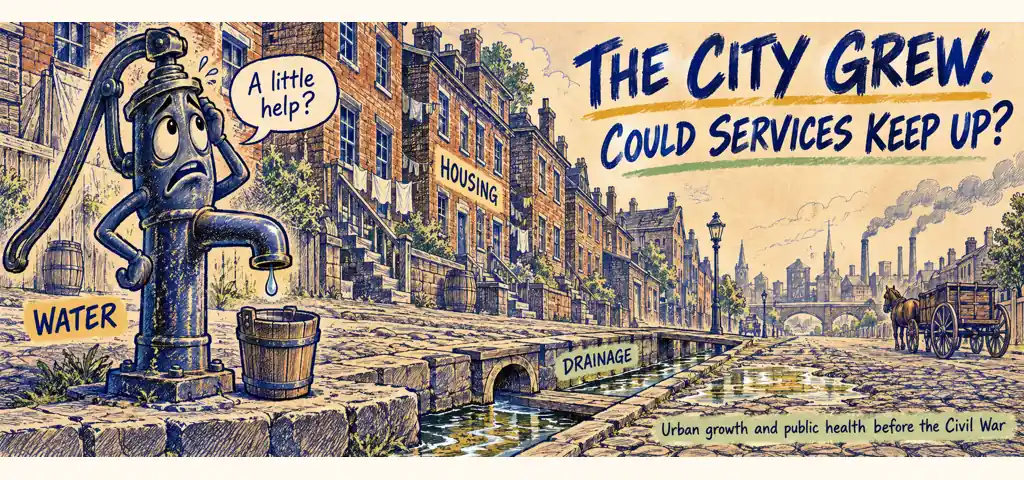
Lesson 16.3 of Chapter 16 of the U.S. History to 1877 study guide on Effortless Math covers CLEP U.S. History I 087: Antebellum Urban Growth and Public Health: the key terms, the core ideas, and worked examples showing how this topic is tested on the exam.
U.S. History to 1877 | Chapter 16 | Lesson 16.3
Ports, canal junctions, river cities, and manufacturing centers expanded quickly. Growth concentrated workers and customers, but municipal services often lagged. Crowded housing, contaminated wells, poor drainage, animals, refuse, and limited sewer systems helped disease spread. Cholera epidemics exposed inequalities: wealthy residents could sometimes leave crowded districts, while poorer families remained near work and shared water sources.
Cities also created new institutions. Volunteer fire companies, police forces, street improvements, almshouses, hospitals, parks, and boards of health expanded unevenly. Political machines exchanged services and patronage for support. Reformers sometimes addressed genuine danger while blaming immigrants or the poor for conditions produced by infrastructure and low wages.
Public-health knowledge changed during the period, so officials did not yet share a modern germ theory of cholera. Many used miasma explanations and emphasized foul smells. Nevertheless, reports that mapped deaths, inspected water, or documented crowding could reveal patterns later understood through contaminated water. Read such a report twice: first for what its authors believed, then for what its observations allow a modern historian to test.
Watch, then test the claim
American History Remix offers a visual route through this topic. As you watch, compare its explanation with the source limits in the written lesson.
Video: American History Remix: Early Urbanization, American History Remix.
Check your understanding
- If cholera cases clustered among households using the same fouled water source, which explanation would the pattern best support?
- Differences in adult literacy rates among city wards.
- The pace of federal land surveys outside the city.
- Changes in tariff rates on imported manufactures.
- Exposure to contaminated water and inadequate sanitation.
- Unequal access to news carried by the telegraph.
- An urban political machine could build electoral support by
- distributing private charity without tracking political allegiance.
- linking jobs and emergency assistance to party loyalty.
- replacing ward patronage with competitive examinations.
- transferring neighborhood relief to federal administrators.
- directing immigrant associations to remain outside electoral politics.
- Select all institutions that expanded as cities responded to growth:
- fire companies,
- police,
- boards of health,
- street and water systems,
- plantation patrols as the universal urban model.
- Explain why blaming disease on immigrant culture can hide a public-health mechanism.
Write a brief response using a named fact from the lesson.
Open the answers and reasoning
Independent preparation. CLEP is a registered trademark of the College Board, which does not endorse this lesson.

Related to This Article
More math articles
- How to Factor Trinomials? (+FREE Worksheet!)
- Full-Length 6th Grade FSA Math Practice Test-Answers and Explanations
- 10 Must-Have Math Teacher Supplies
- The Best Grade 5 ELA Practice Tests for Colorado Students
- Contacting officials
- Integrals: Complete Explanation of the Applications and Use
- Pennsylvania PSSA Grade 8 Math Free Worksheets: Free Printable PDF Worksheets for Every Skill
- How to Get a 36 on ACT Reading: 5 Strategies for the Enhanced ACT
- How to Translate Phrases into an Algebraic Statement? (+FREE Worksheet!)
- How Government Institutions Shape Public Policy












What people say about "Antebellum Urban Growth and Public Health"?
No one replied yet.