RD Exam Calculations: Foodservice Yield and Cost per Portion (2027 Prep)
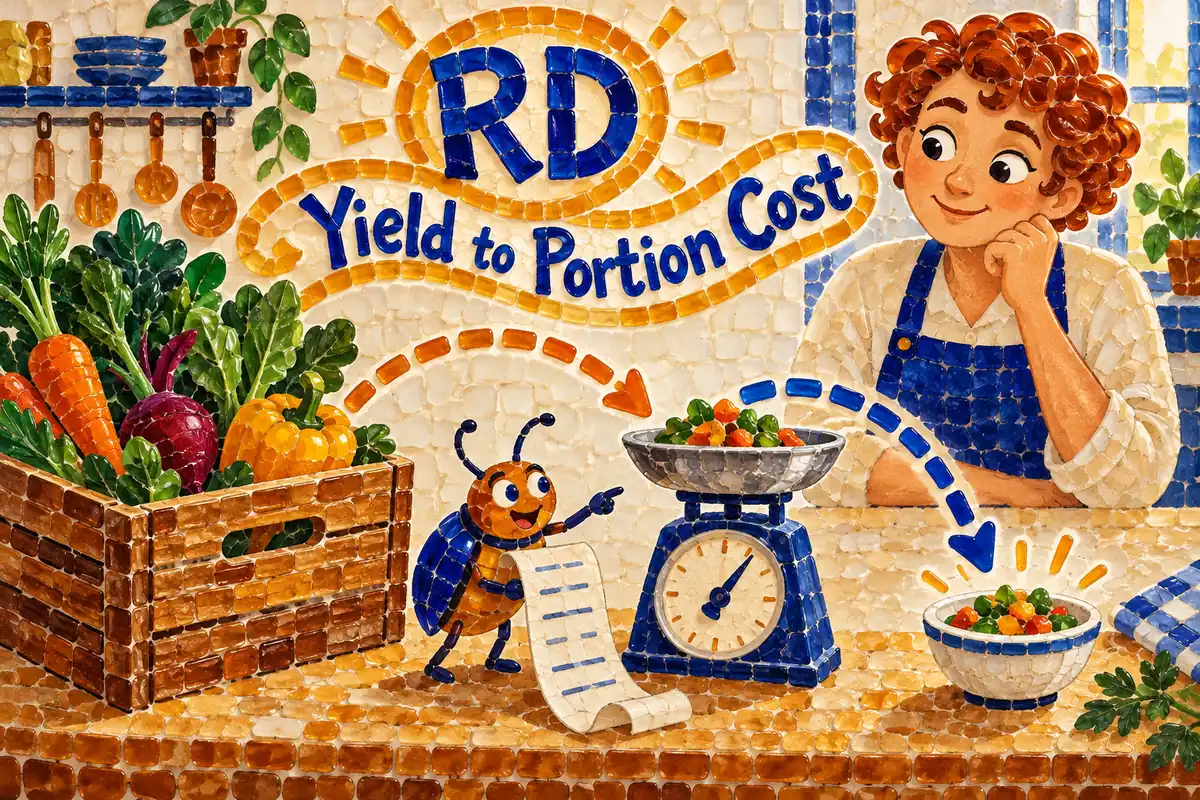
To find raw-food cost per portion, divide the purchase price per kilogram by the usable yield fraction, then multiply by the portion weight in kilograms. Keep the food's state consistent throughout the calculation.
Start with the bowl. In the fictional example below, 150 grams of trimmed vegetables costs $0.72 in raw ingredients, even though buying enough whole cases for 64 portions requires a $54 payment. Both numbers reconcile once you account for the unused food.
We'll follow one purchase through trimming and portioning. All prices and yields are invented for teaching, with no cooking step, labor charge or storage expense included. This example gives you a way to practise the arithmetic. Its invented figures do not predict an examination question or recommend how much food anyone should eat.
Name the food state before using a yield
As purchased, or AP, describes the item in its purchased form. Edible portion, or EP, identifies the usable form specified by your calculation. USDA's Food Buying Guide explains purchase units and usable servings for child nutrition programs, including the need to match a planned portion to the form described in its tables.
Read the description first. A kilogram of whole vegetables and a kilogram of already trimmed vegetables represent different products, so a price comparison needs a common usable basis. Here, EP means trimmed raw vegetables ready for portioning.
Our hypothetical lot weighs 10 kg AP and costs $3.60 per kg AP. Assume trimming leaves 75% usable weight, all discarded trim has zero recovery value, and the same yield applies to every case in the later purchasing example. There is no extra cooking loss in this model.
Convert 75% into a fraction
Write 75% as 0.75. Multiplying the 10 kg purchase by 0.75 gives 7.5 kg EP, while subtraction leaves 2.5 kg of discarded trim. The original purchase still costs 10 kg times $3.60 per kg, or $36.
Keep that $36 visible. It paid for the entire lot, including the part removed during trimming, so the cost assigned to the usable vegetables must recover all $36 under our zero-credit assumption. Write the unit first. Divide $36 by 7.5 kg EP to get $4.80 per kilogram of usable vegetables.
You can also divide $3.60 per kg AP by 0.75, which returns $4.80 per kg EP. This shortcut gives a unit cost, and the denominator's unit matters. Writing only EP cost beside $4.80 would hide the fact that the figure applies to each kilogram of usable food.
Move from kilograms to one portion
Convert the 150 g portion to 0.150 kg by dividing by 1,000. Then multiply 0.150 kg EP by $4.80 per kg EP to get $0.72 per portion. The kilogram units cancel, leaving a dollar amount for the portion.
You can check backward. The 7.5 kg EP lot supplies 50 portions of 0.150 kg each, and 50 portions times $0.72 recovers the original $36 purchase. That check connects the portion cost to the whole lot without changing the assumed yield.
Watch the percentage entry. Use 0.75, not 75. Entering 75 would turn a 10 kg purchase into 750 kg EP. Trimming removes weight, so that result cannot fit this example. Our stated process removes weight, making that result incompatible with the example before you even examine the dollar calculation.
Work backward from 64 portions
For 64 portions, multiply 64 by 0.150 kg EP to obtain 9.6 kg EP needed. Divide that usable requirement by 0.75 to find 12.8 kg AP. Multiplying 12.8 kg AP by $3.60 per kg gives $46.08 of food assigned to those portions.
Purchasing adds another constraint. Suppose the supplier sells this hypothetical product only in 5 kg cases, with no split-case option and the same $3.60 per kg price. The calculated requirement is 12.8 divided by 5, or 2.56 cases.
Order three whole cases. Two cases would supply 10 kg AP and just 7.5 kg EP, enough for the earlier 50 portions. USDA's guide also notes that case purchases can differ from the calculated amount needed, which is why a purchase-unit restriction belongs beside your arithmetic.
Reconcile the $54 purchase with food used
Three cases contain 15 kg AP. At the assumed 75% yield, they supply 11.25 kg EP, enough for 75 portions of 0.150 kg. The invoice is 15 kg times $3.60 per kg, or $54.
After allocating 64 portions, 11 portions remain. Their 1.65 kg EP carries $7.92 at $4.80 per kg, so the $46.08 allocated food cost plus $7.92 remaining inventory equals the $54 purchase. This simplified reconciliation assumes the remainder stays usable and receives that cost allocation.
What if all remaining food is discarded? If this order serves only 64 portions and the entire unused remainder is wasted with no recovery, assigning the full $54 to that order gives $0.84375 per served portion. Rounded to cents, that is $0.84, and its scope includes the remainder's waste.
Label the result before rounding. The $0.72 figure describes food consumed per planned portion under the usable-inventory assumption, while $0.84375 allocates the entire case purchase across only 64 portions. Neither figure includes labor, energy or other operating expenses.
Read the original calculation table
The worked yield-and-cost record (CSV) keeps each operation beside its unit. Read from the 10 kg demonstration lot into the separate 64-portion order, remembering that both use the same assumed price and yield. The table below shows the main checkpoints.
Keep full precision between operations. In this example, 2.56 cases becomes three cases because the supplier requires whole cases, not because ordinary rounding happens to give three. A requirement of 2.1 whole cases would also require three to cover the calculated need.
The blank calculation record (CSV) offers six empty records for a different fictional dataset. Its fields separate usable food cost from whole-case cash outlay and preserve a place to state what happens to the remainder. Record your assumptions before entering a result.
| Checkpoint | Calculation with units | Result |
|---|---|---|
| 10 kg demonstration lot | 10 kg AP x 0.75 | 7.5 kg EP |
| Usable unit cost | $36 / 7.5 kg EP | $4.80 per kg EP |
| 150 g portion | 0.150 kg EP x $4.80/kg EP | $0.72 per portion |
| 64-portion AP requirement | 64 x 0.150 kg EP / 0.75 | 12.8 kg AP |
| Whole-case purchase | ceil(12.8 kg / 5 kg per case) | 3 cases, 15 kg AP, $54 |
| Allocated food / remainder | $46.08 + $7.92 | $54 total reconciled |
Compare suppliers on the same usable basis
Imagine a second fictional supplier offers already trimmed vegetables at $4.60 per kg, with 100% usable yield for this same raw portioning task. One 0.150 kg portion then costs $0.69. This comparison assumes matching quality and no further losses for either usable product.
The whole product's sticker price is lower. Its $3.60 per kg AP becomes $4.80 per kg EP after trimming, which exceeds the second supplier's $4.60 per kg EP. The difference is $0.03 per portion before considering purchase quantities, labor or storage.
Keep the comparison scoped. A real supplier decision would need the actual product specification and observed yield, plus relevant operating costs that this raw-food example leaves out. The hypothetical 75% yield cannot establish how any particular vegetable performs in your kitchen.
How this example maps to CDR's 2027-2031 outline
Start with the new outline. From January 1, 2027, through December 31, 2031, Domain IV is Food Science and Food Systems and carries 15%. CDR lists food cost among its internal menu-development factors, then places portion control and yield analysis under Flow of Food from Procurement to Service 2027-2031 RD Test Specifications and Expanded Study Outline (official CDR PDF).
The previous cycle called Domain IV Foodservice Systems and weighted it at 13%. That cycle listed product yield, cost analysis, portion control, and yield analysis 2022-2026 RD Study Outline (official CDR PDF). Names and weights shifted. Across both outlines, yield and portion work still connect purchasing with food production, though the domain names and grouping differ.
This calculation gives you one applied practice exercise. CDR names broad skill areas. It does not give our 10 kg lot, 75% yield, 5 kg case size, or one required formula. Use the example to practise carrying units and checking assumptions. It cannot predict an exam question.
Check which outline applies on your exam date before choosing what to study. This article practises purchasing arithmetic. Its 150 g portion is fictional, and the amount does not recommend a serving or provide nutrition or treatment advice.
For your next calculation, write the requested unit before choosing an operation. If you need kilograms AP, work backward from usable weight through the yield fraction. If the requested output is dollars per portion, follow the usable unit cost into the portion weight and retain the unit labels beside your answer.
If you want the complete domain checklist and official candidate links, continue at the Effortless Math, Registered Dietitian (RD) Exam Study Hub. It keeps the new outline separate from test-day details that still need confirmation for your appointment.
2027 preparation edition. CDR's official 2022-2026 and 2027-2031 RD outlines, the CDR examination-resources page, and the USDA Food Buying Guide were checked October 15, 2026. The fictional yields, prices, order sizes, and calculations are original teaching inputs. The outline alignment identifies relevant domains and objectives. It does not claim these numbers or formulas appear on the examination. No clinical nutrition guidance or dietary portion recommendation is offered. The cover is conceptual and year-free.

Related to This Article
More math articles
- Commercial Farming and Regional Specialization: Markets, Labor and Evidence
- The Ultimate 6th Grade MCA Math Course (+FREE Worksheets)
- Repeating Patterns
- How to Measure Angles with a Protractor
- Scientific Reasoning in Chemistry: Plan a Fair Test
- 3rd Grade NHSAS Math Worksheets: FREE & Printable
- How to Memorize the Multiplication Table in 7 Days
- The Best Algebra 1 Book for Rhode Island Students
- A 4-Week Grade 6 ELA Study Plan: Reading, Writing, Vocabulary, and Review That Actually Fits Real Life
- Nineteenth Amendment




















What people say about "RD Exam Calculations: Foodservice Yield and Cost per Portion (2027 Prep) - Effortless Math"?
No one replied yet.