How to Use AI to Do Your Homework More Effectively in 2027
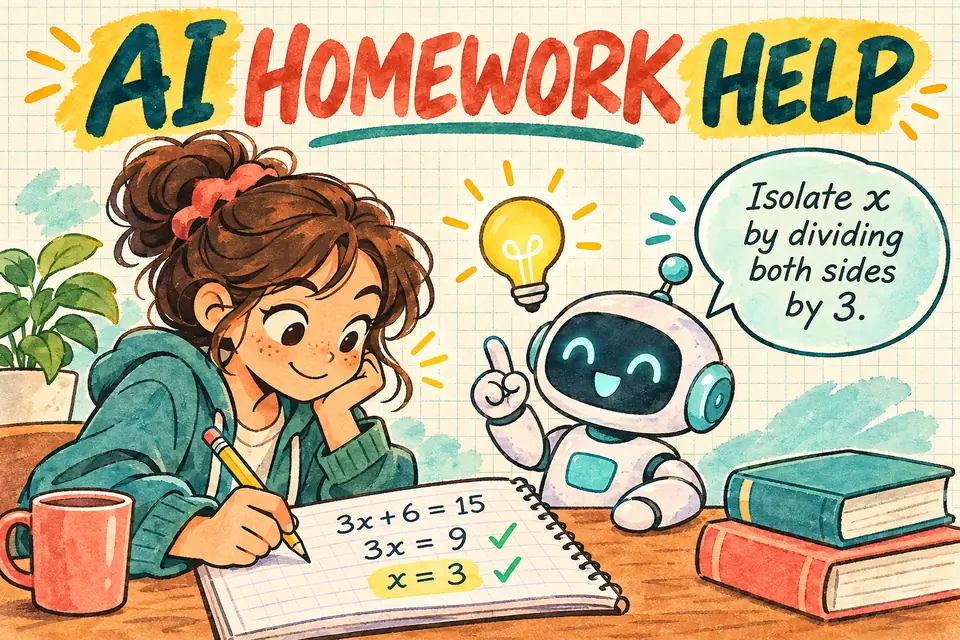
Math homework often becomes frustrating for one simple reason: a textbook shows the formula, but you still don’t know when or how to use it. AI can help close that gap. You can ask it to explain a method, review your calculations, or create new problems that target your weak spots. But there’s a catch: if AI does all the work, you may finish the assignment without learning anything. Here’s how to use AI in a way that actually improves your math skills.
How NOT to Use AI for Homework
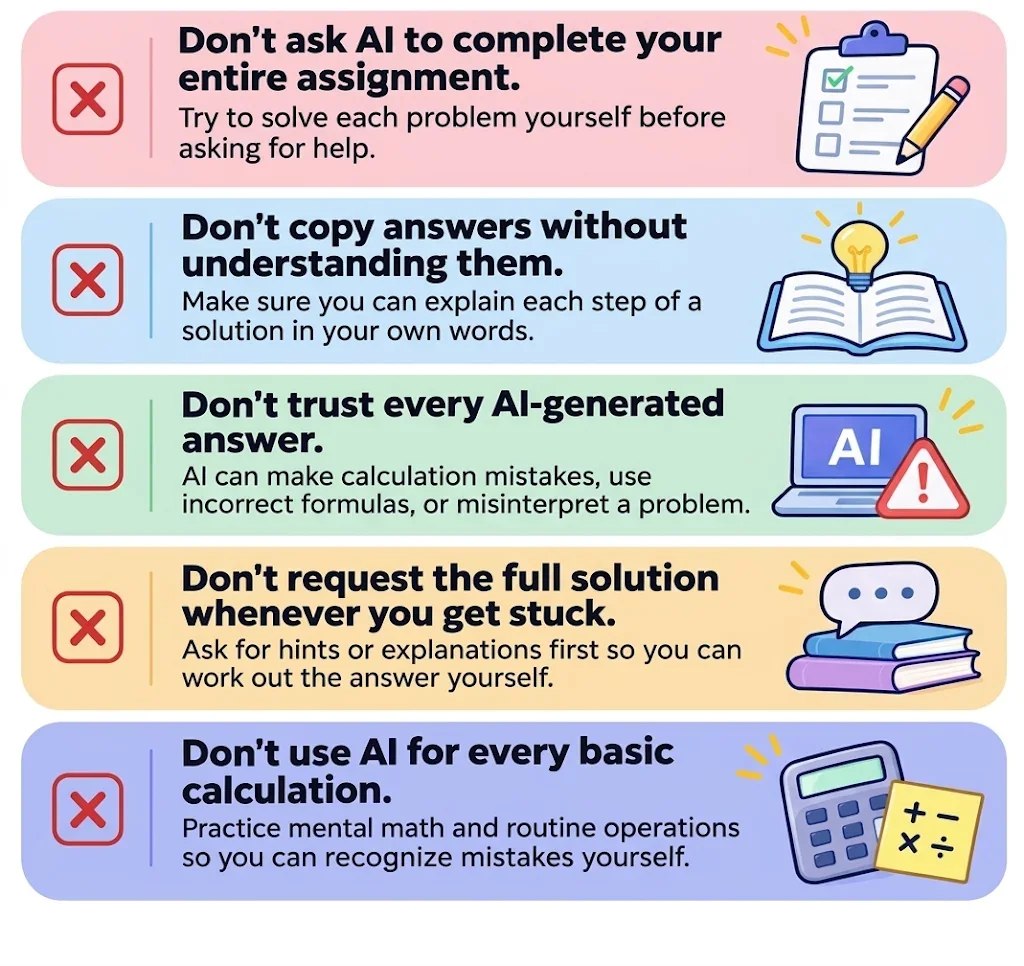
Of course, you can quickly and easily solve math exercises with the help of AI. But just copying the answers won’t help you deal with similar tasks on your own during tests or exams. You could also get into trouble if your teacher recognizes that you used AI to write your explanations or checks your work with an AI detector. To prevent these problems, keep the following common mistakes in mind when you use AI for studying:
How to Use AI to Help With Homework
The best way to use AI for students is to treat it as a tutor, not an answer key. State your grade level, the topic, and exactly where you need help. Be specific about what you’re struggling with and how you want AI to help. Provide as much relevant context as possible, including your grade level, the topic you’re studying, and what you’ve already tried. The more details you share, the better AI can tailor its explanations to your needs.
1. Ask AI to Simplify Difficult Textbook Explanations
Sometimes your textbook already explains a formula or mathematical concept, but the explanation is too complicated to understand. It may contain unfamiliar terms, skip important details, or assume you already know certain rules.
Instead of rereading the same paragraph several times, copy it into an AI chatbot or upload a photo of the page. Ask AI to rewrite the explanation in simpler language while keeping the mathematical meaning unchanged.
Prompt to use:
“I’m having trouble understanding this explanation from my math textbook: [paste explanation]. Rewrite it in simple language suitable for a [your grade level] student. Explain any difficult mathematical terms, but keep all formulas and rules unchanged.”
Alternatively, you can use a text paraphraser to simplify long textbook explanations without writing a detailed prompt. Just paste the original text and review the rewritten version. Check that it preserves every mathematical condition and formula, since even small wording changes can alter the meaning of a math rule.
2. Ask AI to Explain a Similar Problem Step by Step
When a new type of equation appears in your homework, start with a demonstration. Give AI your problem, but request an example with different numbers. This lets you see the process without losing the chance to solve your own question.
Suppose your worksheet asks you to solve 3(x + 2) = 21. Instead of requesting the answer, ask AI to walk through another equation that uses brackets and requires the same operations. Have it name the rule at each step: expand the brackets, simplify both sides, and isolate the variable.
Prompt to use:
“I’m learning linear equations with brackets. Show me a similar problem with different numbers. Explain every step and why you use it. Do not solve my homework equation: 3(x + 2) = 21.”
After the demonstration, close the example and solve your equation on paper. If you can apply the steps without the sample in front of you, the explanation has done its job.
3. Ask for Hints When You Get Stuck
Sometimes you understand the topic but can’t see the next move. A complete AI solution gives away more than you need. Use a hint ladder instead: request the smallest clue that helps you continue, and move to the next level only if you’re still stuck.
- Identify the topic. Ask which concept the question tests.
- Get one clue. Request the next step, without calculations.
- See a separate example. Ask for a short demonstration with different values.
- View the full solution only as a last resort. Then hide it and redo the question from memory.
Prompt to use:
“I’m stuck on this problem: [paste problem]. Give me one hint at a time. Start with the concept I should use. Wait for my reply before you provide another hint or any answer.”
4. Ask AI Which Mathematical Method to Use
Some math questions are difficult before you even touch the numbers. You may know several formulas but struggle to choose one. Ask AI to explain the clues in the question, not the calculation.
Take quadratic equations. One question may factor neatly, while another may call for the quadratic formula. AI can help you compare the structures: Are there simple factors? Is the equation in standard form? Does the question ask for exact roots or an approximation?
Prompt to use:
“Look at this quadratic equation: [paste equation]. Which method should I try first—factoring, completing the square, or the quadratic formula? Explain the features that support your choice. Don’t solve it.”
5. Use AI to Break Down Complicated Word Problems
Math word problems can be difficult because you need to identify important information and turn it into equations before you can solve them. AI can help you break down the problem by identifying known values, unknown variables, and the relationships between them.
For example, if a taxi charges a $4 starting fee plus $2 per mile and the total fare is $18, AI can help you identify the relevant values and set up the equation without solving it.
Prompt to use:
“Help me understand this math word problem: [paste problem]. Identify the known values, define the unknown variable, and show how to turn the information into an equation. Don’t solve it for me.”
Once you have the equation, try to solve it independently.
6. Use AI to Improve Your Written Math Explanations
In geometry proofs, word problems, and more advanced courses, the final number isn’t always enough. You may need to justify a formula, define a variable, or explain why a result follows from the previous line. AI can help improve the written part without changing your calculations.
Paste the explanation you wrote and ask AI for clearer wording. If the suggested text sounds too robotic or unnatural, you can also humanize AI-generated text to make it sound more natural. Just make sure the final explanation reflects your own reasoning.
Beyond spelling and punctuation, AI can clarify grammar distinctions, such as having vs. having had, so your mathematical reasoning reads clearly and accurately.
Prompt to use:
“Review the explanation that accompanies my math solution. Correct grammar and unclear wording. Keep every equation, mathematical claim, and step unchanged. Tell me if a sentence fails to explain the operation clearly.”
7. Let AI Check Your Work and Explain Mistakes
An incorrect answer can teach you more than a correct one if you know exactly where your reasoning failed. First, give the question a genuine attempt. Set an eight-minute timer if you need a limit, and write every line – even the ones you suspect are wrong.
Next, type your calculations or upload a clear photo. Ask AI to audit your steps rather than replace them. It should find the first incorrect line, explain why it fails, and stop. Correct that line and finish the rest yourself.
Prompt to use:
“Here is the original problem and my solution: [paste both]. Check my work line by line. Find the first incorrect step, explain why it is wrong, and stop. Don’t give me the final answer.”
8. Generate Similar Problems for Extra Practice
One correct solution doesn’t prove that you understand a method. You might simply remember the sequence of steps from the example. Ask AI to create new questions that test the same skill with different setups.
For linear equations, request a mix of brackets, fractions, and variables on both sides. For geometry, change the diagram or the known measurements. Include at least one look-alike problem that needs a different technique. That question tests whether you recognize the underlying structure instead of following a pattern automatically.
Prompt to use:
“Create four algebra problems that use the same method as this one: [paste problem]. Change the numbers and layouts. Add one problem that looks similar but needs a different method. Don’t label the different one and don’t reveal answers yet.”
Solve the set without help. Afterward, ask for an answer key and a brief explanation of which method each question required. If you miss the look-alike, review the rule that distinguishes it from the others.
How Can Students Use AI? Key Steps to Follow
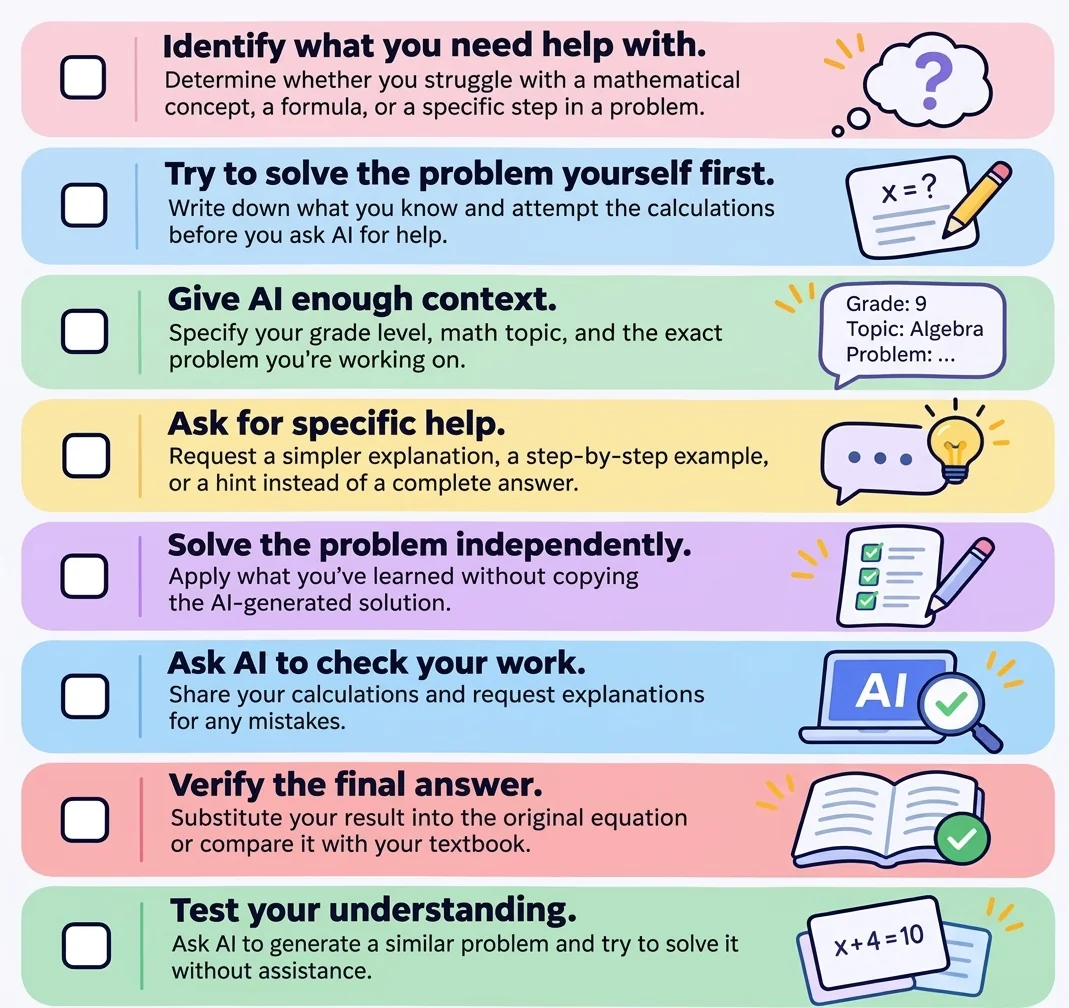
Follow this simple checklist to learn how to use AI to study and get the most out of your math homework.
Conclusion
Now we’ve explained how to use AI effectively for math homework without violating policies on responsible AI use. The key is to view artificial intelligence as a helpful tool, not as a substitute for your own work.
Use it to understand difficult concepts, get hints, check your calculations, and practice with similar problems. Always verify AI-generated answers and make sure you understand each step before moving on. This way, you can improve your math skills, complete homework more efficiently, and prepare for tests without relying entirely on AI.
Frequently Asked Questions
Can AI Solve Math Problems From Pictures?
Yes. Many AI tools let you upload photos of handwritten equations, textbook exercises, or worksheets. However, AI may misread numbers, mathematical symbols, or handwritten text, so check that it understands the problem correctly before you follow its solution.
What Should I Do If AI Gives Me the Wrong Math Answer?
First, check the calculations and substitute the result into the original equation when possible. If the answer still seems incorrect, compare it with your textbook or class notes. You can also ask AI to solve the problem using a different method, but verify the new result as well.
What If AI Uses a Math Method I Haven’t Learned Yet?
Tell AI your grade level and which methods your teacher has covered. Then ask it to explain the problem using only those methods. For example, if you haven’t learned the quadratic formula, ask AI to show whether you can solve the equation through factoring instead.
Can AI Help Me Prepare for Math Exams?
Yes. AI can create practice tests based on your syllabus, quiz you on formulas, and generate problems of different difficulty levels. You can also ask it to set up a mock exam without hints or answers until you finish.

Related to This Article
More math articles
- How to Find Midpoint? (+FREE Worksheet!)
- Best Financial Calculators in the Market
- Ideal Weight Calculator
- Quaker Pennsylvania: Toleration, Diversity and Its Limits
- 7th Grade MEAP Math Worksheets: FREE & Printable
- Using a Comparison Matrix
- Battle of the Decimals: Using Grids for Easy Comparisons
- What Math Can Teach Us About Everyday Decision-Making
- How to Change Base Formula for Logarithms?
- How to Interpret Remainders of Division Two-digit Numbers By One-digit Numbers




What people say about "How to Use AI to Do Your Homework More Effectively in 2027"?
No one replied yet.