CLEP U.S. History I 015: Quaker Pennsylvania and Negotiated Diversity
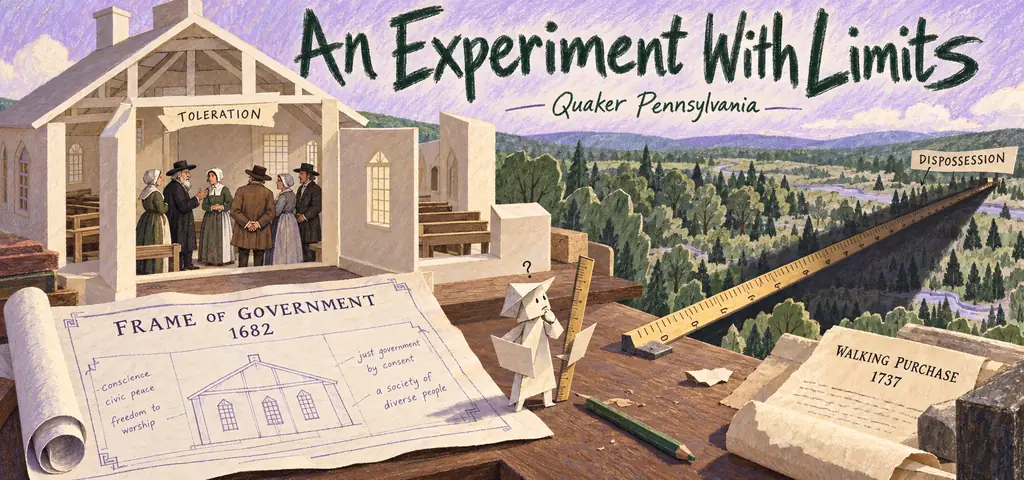
Lesson 3.5 of Chapter 3 of the U.S. History to 1877 study guide on Effortless Math covers CLEP U.S. History I 015: Quaker Pennsylvania and Negotiated Diversity: the key terms, the core ideas, and worked examples showing how this topic is tested on the exam.
U.S. History to 1877 | Chapter 3 | Lesson 3.5
William Penn received Pennsylvania in 1681 as a proprietary colony and a “holy experiment.” Quakers believed that divine light was available to every person, rejected a paid clergy, and refused customary gestures of social deference. Their meetings allowed women significant religious participation, though public and household authority remained unequal. Having experienced persecution, Penn promoted broad Christian toleration and representative government.
Pennsylvania attracted English Quakers, German-speaking farmers and religious minorities, Scots-Irish migrants, and others with promises of land and relative liberty. Philadelphia became a major port, while fertile farms exported wheat and flour. The colony’s prosperity rested on family labor, commerce, indentured service, and slavery. Quaker antislavery developed gradually. Early Quaker inclusion did not prevent members from enslaving people.
Penn initially pursued land agreements with Lenape communities and cultivated diplomacy. Those relations were more peaceful than many neighboring examples, but they did not remain equitable. Rapid immigration increased land hunger. After Penn lost active control, provincial leaders used the fraudulent Walking Purchase of 1737 to claim far more Lenape land than Native negotiators understood they had ceded. Scots-Irish settlement farther west also brought violent conflict.
Pennsylvania therefore tests the phrase “negotiated diversity.” Political bargaining among ethnic and religious groups was unavoidable. Pacifist Quaker legislators faced frontier demands for military spending. German communities maintained language and church traditions. Yet the people with the least influence: Native nations, enslaved Africans, servants, and poor settlers: could be excluded from celebrated compromises. Negotiation describes a process. It does not guarantee just outcomes.
Watch, then test the claim
Study Hall traces the people and chronology behind this lesson. Listen for the evidence that sharpens the written account, then try the questions below.
Video: Proprietary Colonies | US History to 1865 | Study Hall, Study Hall.
Check your understanding
- Which paired institution most clearly expressed Penn’s early “holy experiment”?
- compulsory Quaker worship and appointed local councils
- restricted English immigration and military frontier government
- grain regulation without political representation
- broad Christian toleration and an elected representative assembly
- conquest-based expansion and an established Anglican church
- What does the Walking Purchase most clearly show about Pennsylvania’s development?
- Religious pluralism made proprietary readings of land agreements generally fair.
- Grain prosperity reduced settlers’ incentive to acquire additional farms.
- Land hunger turned disputed documents and measurement into dispossession.
- Immigration limits strengthened Lenape influence over proprietary officials.
- Quaker pacifism sharply limited coercion in Native negotiations.
- Select all that apply. Which advertised conditions especially attracted migrants to early Pennsylvania?
- militia-conditioned land grants on the frontier
- purchasable farmland in a commercial colony
- toleration across several Christian denominations
- townships reserved for English Quaker meetings
- representative institutions for qualified freemen
- Evaluate one achievement and one limit of Pennsylvania’s negotiated diversity.
Write a brief response using a named fact from the lesson.
Open the answers and reasoning
Independent preparation. CLEP is a registered trademark of the College Board, which does not endorse this lesson.

Related to This Article
More math articles
- Top 10 TSI Math Test-taking Tips
- Getting Better at Math: Realistic Tips and Suggestions
- 4th Grade WY-TOPP Math Worksheets: FREE & Printable
- Full-Length GED Math Practice Test
- How to Unlock the Path to Success: “TExES Core Subjects Math for Beginners” In-Depth Solution Manual
- Nevada SBAC Grade 3 Math at Home — 49 Free Single-Skill PDF Worksheets
- How to Sketch and Describe Function Graphs? (+FREE Worksheet!)
- The Best ACT Math Worksheets: FREE & Printable
- How to Solve Simple Interest Problems? (+FREE Worksheet!)
- How to Solve Mixture Word Problems: Step-by-Step Guide for 2026



















What people say about "Quaker Pennsylvania and Negotiated Diversity"?
No one replied yet.