CLEP U.S. History I 014: Dutch New Netherland and Plural Middle Colonies
Lesson 3.4 of Chapter 3 of the U.S. History to 1877 study guide on Effortless Math covers CLEP U.S. History I 014: Dutch New Netherland and Plural Middle Colonies: the key terms, the core ideas, and worked examples showing how this topic is tested on the exam.
U.S. History to 1877 | Chapter 3 | Lesson 3.4
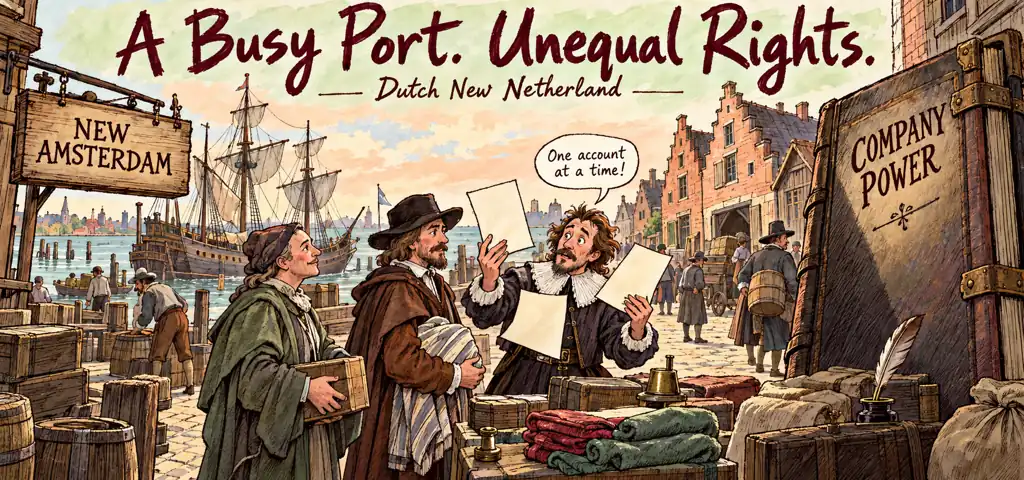
New Netherland occupied a valuable commercial corridor from New Amsterdam through the Hudson River toward the fur trade. The Dutch West India Company governed with profit in mind. It offered patroonships: large estates granted to investors who settled tenants: and attracted merchants, artisans, farmers, and laborers from varied backgrounds. New Amsterdam included Dutch, Walloon, Jewish, African, Scandinavian, German, and other residents. Diversity arose more from commercial pragmatism than from a declaration of equal rights.
The colony relied on both free and unfree labor. The company enslaved Africans, some of whom obtained “half-freedom” after years of petitioning: they could farm and support families while owing payments and remaining legally constrained. Their children remained enslaved. The arrangement demonstrates that partial rights could coexist with a durable system of bondage. It also reveals enslaved people’s negotiation within extremely unequal conditions.
Dutch trade with the Haudenosaunee strengthened a major alliance and linked the interior to Atlantic markets. Firearms and competition affected Native diplomacy and warfare. Closer to New Amsterdam, disputes over land and tribute led to destructive conflicts, including Kieft’s War. Again, commercial colonization required alliance in one relationship while producing dispossession in another.
England seized the colony in 1664 and renamed New Amsterdam New York. English rulers retained many property arrangements and the colony’s diverse population. The larger middle-colony region: New York, New Jersey, Pennsylvania, and Delaware: combined productive grain farms, ports, ethnic variety, and multiple Christian denominations. It is useful to call these “plural” colonies, but plural does not mean equal. Enslavement, tenant-landlord conflict, anti-Catholic prejudice, and limits on women’s and poor men’s authority remained.
See the history take shape
This TIMELINE lesson supplies a second explanation of the same period. Note where chronology, cause, and perspective connect.
Video: New York City (1609-1789) Colonial Manhattan NYC New Amsterdam Dutch colony New Netherland Holland, TIMELINE.
Check your understanding
- Which land arrangement best defines a New Netherland patroonship?
- equal freeholds assigned after a short labor term
- common fields allocated by a local gathered congregation
- headrights awarded for each Atlantic passage a sponsor financed
- company farms worked without private investors or tenants
- a large investor estate populated by tenants
- What best explains New Amsterdam’s unusually varied population?
- Political rights expanded at roughly the same rate as port entry.
- Dutch Reformed membership served as the usual condition for residence.
- Local trade mattered more than the colony’s Atlantic shipping connections.
- Congregational leaders, rather than company officials, directed migration policy.
- Company commerce recruited merchants, artisans, sailors, and laborers of varied origins.
- Select all that apply. New Netherland included
- Atlantic-linked fur commerce
- a congregational covenant governing New Amsterdam admissions
- an elected assembly controlling company appointments
- enslaved African labor in company enterprises
- a Haudenosaunee alliance supporting the interior trade
- Explain how commerce could encourage diversity without producing equality.
Write a brief response using a named fact from the lesson.
Open the answers and reasoning
Independent preparation. CLEP is a registered trademark of the College Board, which does not endorse this lesson.

Related to This Article
More math articles
- The Great Society, the War on Poverty, and Federal Education Policy
- Precedent and stare decisis
- CLEP U.S. History I 081: Mexican-American War and the Treaty of Guadalupe Hidalgo
- 10 Most Common 4th Grade Common Core Math Questions
- 4th Grade NSCAS Math Worksheets: FREE & Printable
- SSAT Middle-Level Math Worksheets: FREE & Printable
- How to Solve Word Problems: Guessing and Checking
- Culture
- Number Properties Puzzle – Challenge 5
- How to Find Mean Absolute Deviation?





















What people say about "Dutch New Netherland and the Middle Colonies"?
No one replied yet.