CLEP U.S. History I 013: New England Towns, Family, and Economy
Lesson 3.3 of Chapter 3 of the U.S. History to 1877 study guide on Effortless Math covers CLEP U.S. History I 013: New England Towns, Family, and Economy: the key terms, the core ideas, and worked examples showing how this topic is tested on the exam.
U.S. History to 1877 | Chapter 3 | Lesson 3.3
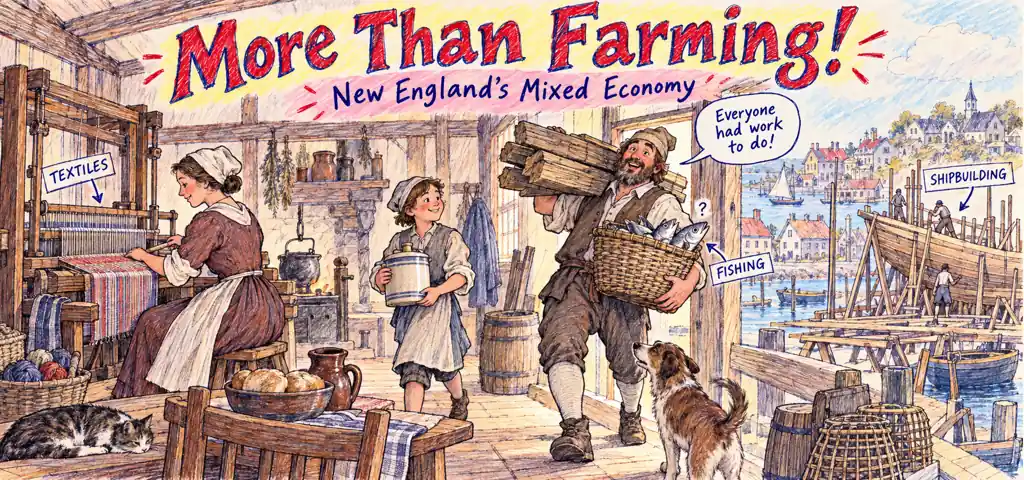
New England’s environment and migration pattern encouraged a mixed economy rather than a staple-crop plantation system. Shorter growing seasons and varied soils supported household farming but made tobacco or rice monoculture less attractive. Families raised food, kept livestock, and produced goods for local exchange. Coastal communities developed fishing, shipbuilding, and Atlantic commerce. Merchants exported fish and timber, carried Caribbean sugar and molasses, and supplied plantation regions.
Family migration produced relatively balanced sex ratios and, after initial disease, longer life expectancy than in the early Chesapeake. Households were units of production. Men formally controlled most property and political rights. Women managed dairy work, gardens, textile production, child care, and many transactions. Children’s labor was essential. Patriarchy was real, but daily survival required skill and negotiation from every household member.
Compact towns helped residents maintain churches, schools, roads, and common lands. A 1647 Massachusetts law required towns of a certain size to support schooling, partly so people could read Scripture. Literacy was still unequal, and education aimed at religious and civic order rather than modern universal opportunity. Harvard College, founded in 1636, trained ministers and educated elite men.
Population growth pushed children and new migrants into frontier areas claimed by Native nations. The Pequot War of 1636-1637 and King Philip’s War of 1675-1676 reveal that town-centered settlement did not mean peaceful isolation. King Philip’s War, led on the Native side by Metacom and multiple allies, devastated both Native and English communities. Colonial victory opened more land while killing, displacing, or enslaving many Native people. The region’s family success and territorial violence were causally connected through expansion.
A focused video lesson
Watch this account from Khan Academy with one question in mind: which evidence makes the lesson's strongest claim hold up?
Video: Society and religion in the New England colonies | AP US History | Khan Academy, Khan Academy.
Check your understanding
- Which export pattern best fits coastal New England’s mixed economy?
- cod, timber, shipbuilding, and Atlantic carrying
- tobacco leaf and plantation-grown wheat
- tidal rice and processed indigo
- iron bars replacing most maritime commerce
- furs moving only through inland markets
- Which demographic mechanism most directly connected New England family growth to King Philip’s War?
- Falling birthrates reduced town populations and encouraged English withdrawal.
- Family growth increased English demand for new farms on Native land.
- Balanced migration reduced demand for farms beyond established towns.
- Wampanoag leaders accepted expanding English courts as neutral institutions.
- Crown limits on new settlement prevented territorial conflict from developing.
- Select all that apply. Which activities commonly joined several members of a New England household to wider exchange?
- a hired drover moving a merchant’s cattle
- household dairying and sale of surpluses
- grain retained for the next planting
- household textile production for wider exchange
- a minister’s salary funded by a town rate
- Explain one link between New England’s demographic growth and Native dispossession.
Write a brief response using a named fact from the lesson.
Open the answers and reasoning
Independent preparation. CLEP is a registered trademark of the College Board, which does not endorse this lesson.

Related to This Article
More math articles
- The Best Grade 5 Math Book for New Mexico Students
- FREE 6th Grade FSA Math Practice Test
- Waves, Heat, and Temperature
- The Ultimate ISEE Middle Level Math Formula Cheat Sheet
- A payoff matrix must be read player by player
- The Ultimate SAT Math Formula Cheat Sheet
- Free Grade 3 English Worksheets for Colorado Students
- The Best Algebra 1 Book for New Hampshire Students
- 5th Grade MCAS Math Practice Test Questions
- Prime and Composite Numbers for 4th Grade



















What people say about "New England Towns, Family and Economy"?
No one replied yet.