CLEP U.S. History I 012: Dissent, Religious Liberty, and Colonial Authority
Lesson 3.2 of Chapter 3 of the U.S. History to 1877 study guide on Effortless Math covers CLEP U.S. History I 012: Dissent, Religious Liberty, and Colonial Authority: the key terms, the core ideas, and worked examples showing how this topic is tested on the exam.
U.S. History to 1877 | Chapter 3 | Lesson 3.2
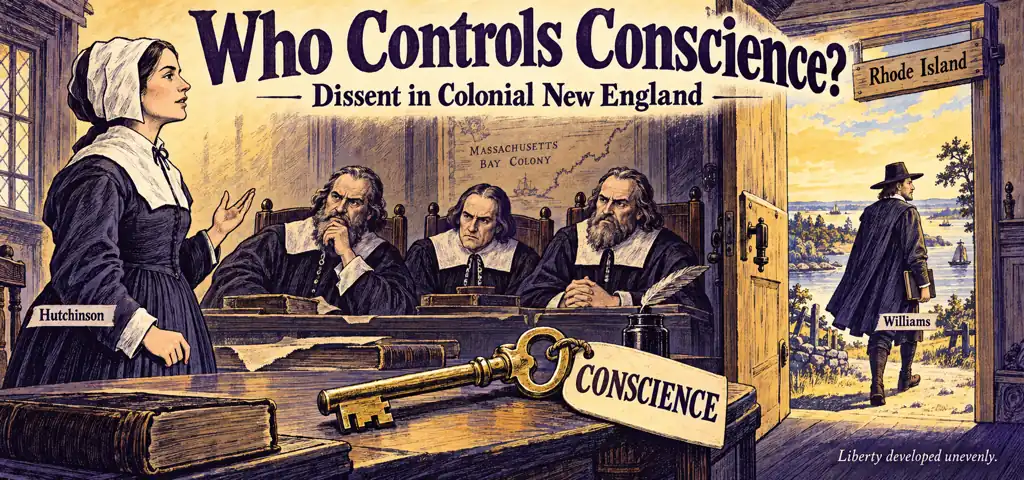
Because Massachusetts leaders believed religious error could endanger the whole community, dissent became a political issue. Roger Williams argued that civil officials should not punish religious belief and that English claims to Native land required legitimate purchase. Banished in 1635, he founded Rhode Island, which protected a wider range of worship and separated civil authority from compulsory faith more fully than Massachusetts did.
Anne Hutchinson challenged authorities through meetings in which she discussed sermons and criticized ministers. Her claim that divine grace could be known inwardly appeared to weaken clerical authority. Her prominence as a woman leading mixed religious discussion also disturbed a patriarchal order. Tried and banished in 1637, Hutchinson later moved to Rhode Island. Her case joined theological dispute to questions of gender and power.
Dissent also existed within accepted churches. Congregants disputed ministers, tax support, and membership rules. Quakers, whose emphasis on an inner light rejected formal clergy and social deference, faced especially harsh punishment in Massachusetts. The execution of four Quakers between 1659 and 1661 shows the limits of Puritan toleration. Yet imperial officials and local opposition eventually constrained such persecution.
Religious liberty developed unevenly, not through a straight march toward the First Amendment. Maryland’s 1649 toleration law protected Trinitarian Christians while punishing other beliefs. Rhode Island offered broader safeguards, but no colony eliminated social prejudice. Even Pennsylvania, discussed later, had political and cultural boundaries. The key distinction is between toleration, in which authorities permit specified beliefs, and liberty grounded in the idea that government lacks power over conscience.
Watch the topic in context
Tom Richey offers a visual route through this topic. As you watch, compare its explanation with the source limits in the written lesson.
Video: Anne Hutchinson: Religious Dissenter (Religious Freedom in Colonial New England: Part III), Tom Richey.
Check your understanding
- Which single principle most directly challenged Massachusetts magistrates’ claim to punish religious error?
- Dissenting congregations may petition magistrates for licensed worship.
- Civil government possesses no legitimate authority over private conscience.
- Congregations may discipline members for breaches of their own covenant.
- A royal charter authorizes magistrates to protect an established church.
- Church membership should qualify freemen for colonial elections.
- Why did Anne Hutchinson’s meetings become a political as well as a theological challenge?
- She established an Anglican parish with a Crown-appointed bishop before trial.
- She judged ministers publicly and attracted followers beyond ordinary clerical supervision.
- She defended salvation by works against ministers who preached grace.
- She asked magistrates, rather than congregations, to appoint all ministers.
- She organized a separate Rhode Island government while residing in Boston.
- Select all that apply. Which outcomes reveal the uneven limits of colonial religious liberty?
- banishment of selected Massachusetts dissenters
- Quaker officeholding after Massachusetts petitions
- charter protection for Rhode Island conscience rights
- Maryland protection for Jewish public worship
- execution of four Massachusetts Quakers
- Distinguish toleration from liberty of conscience using one colonial example.
Write a brief response using a named fact from the lesson.
Open the answers and reasoning
Independent preparation. CLEP is a registered trademark of the College Board, which does not endorse this lesson.

Related to This Article
More math articles
- Quality Benchmarks and Process Improvement
- Second Amendment
- 5th Grade Georgia Milestones Assessment System Math Practice Test Questions
- Systems of Equations Worksheets: Choose a Method
- Government Economic Policy and Market Failures
- Limited government
- Tips on Hiring a Great Math tutor
- The Best Grade 8 Math Book for Oregon Students
- Number Properties Puzzle – Challenge 23
- The 5 Best Programmable Calculators to Invest in
















What people say about "Dissent and Religious Liberty in the Colonies"?
No one replied yet.