Why Third Parties Struggle in U.S. Elections
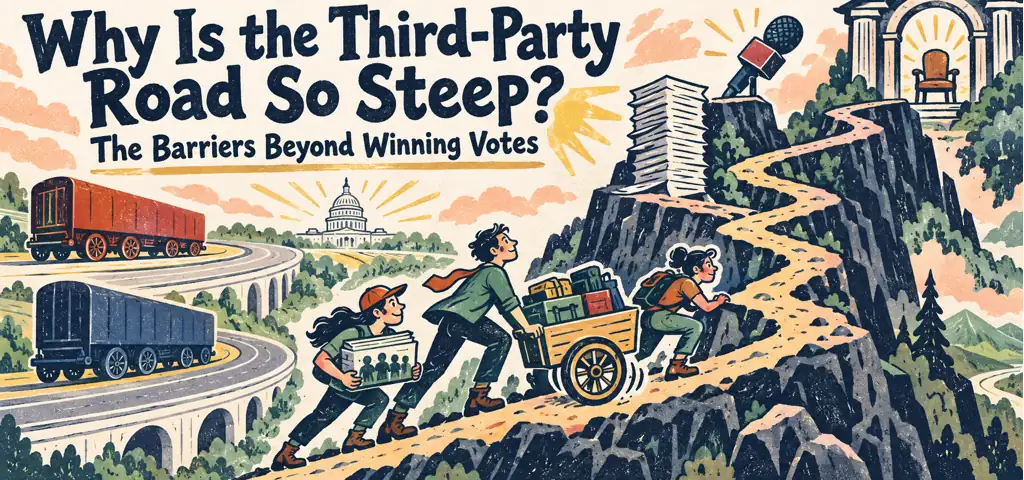
Minor parties face both institutional and strategic barriers. The central institutional barrier is the single-member plurality district: one candidate wins the seat, and finishing second yields no representation. A party can receive a meaningful share of votes spread across many districts while winning none. Presidential competition also awards one office and usually requires geographically broad support, creating a severe challenge for a small national coalition. Additional rules affect entry and visibility. States use different signature, filing, deadline, and ballot-qualification requirements. Debate access, fundraising networks, media attention, and campaign infrastructure favor organizations already treated as viable. These barriers are not identical in every state or election cycle, and legal challenges can limit excessive burdens. The durable lesson is that a new party must spend resources merely to reach voters before it can persuade them.
The mechanism behind why third parties struggle in u.s. elections
Strategic behavior adds a psychological barrier. A voter may prefer a minor candidate but support a major candidate to prevent the least-preferred major candidate from winning. Donors and experienced candidates may make the same calculation about viability. Leaders with related ideas often enter a major-party primary or bargain within a broad coalition rather than split supporters in the general election. This lesson catalogs the barriers a new organization must overcome: ballot qualification, money, visibility, infrastructure, winner-take-all seats, and expectations about viability. Do not conclude that minor-party votes are meaningless. A campaign can influence agendas, reveal dissatisfaction, build local strength, or affect a close result. Nor should every failure be blamed on electoral law. Organization, candidate quality, resources, and public support matter too. Geographic concentration can also matter: a smaller party with concentrated regional support may win seats that a larger but evenly dispersed vote cannot. The next lesson explains why plurality rules themselves generate mechanical and psychological pressures toward two viable coalitions. This lesson keeps that causal pair distinct from the additional legal and organizational costs surrounding entry.
Why Third Parties Struggle in U.S. Elections: key distinctions
Practice with why third parties struggle in u.s. elections
Take one current or historical example of why third parties struggle in u.s. elections, explain the mechanism, and identify the strongest competing principle.
Video lesson: Why Third Parties Struggle in U.S. Elections
Heimler's History gives a focused explanation of this topic in Third Party Politics [AP Gov Review, Unit 5 Topic 5].
If the player does not load, watch this lesson directly on YouTube.
Connect this lesson to the larger course
For a broader map connecting why third parties struggle in u.s. elections to participation, parties, elections, interest groups, and media, use the AP U.S. Government and Politics learning hub.

Related to This Article
More math articles
- Top 10 CLEP College Algebra Practice Questions
- How to Determine Limits Involving Floor and Absolute Value Functions
- Mexican American and Asian American Citizenship and Resistance
- 5 Best Digital Pen Tablets for Online Math Teaching in 2026
- The Best Grade 8 Math Book for Mississippi Students
- How to Help Your 8th Grade Student Prepare for the New Hampshire NH SAS Math Test
- ALEKS Math Placement Test: Day-of-Test Tips and Strategies
- Georgia Grade 2 Math Worksheets — Free Printable PDFs
- CLEP U.S. History I 059: Wage Labor, Class, and Early Unions
- Top 10 Tips to Overcome SHSAT Math Anxiety





















What people say about "Why Third Parties Struggle in US Elections"?
No one replied yet.