Voting Rights in the United States: Expansion and Barriers
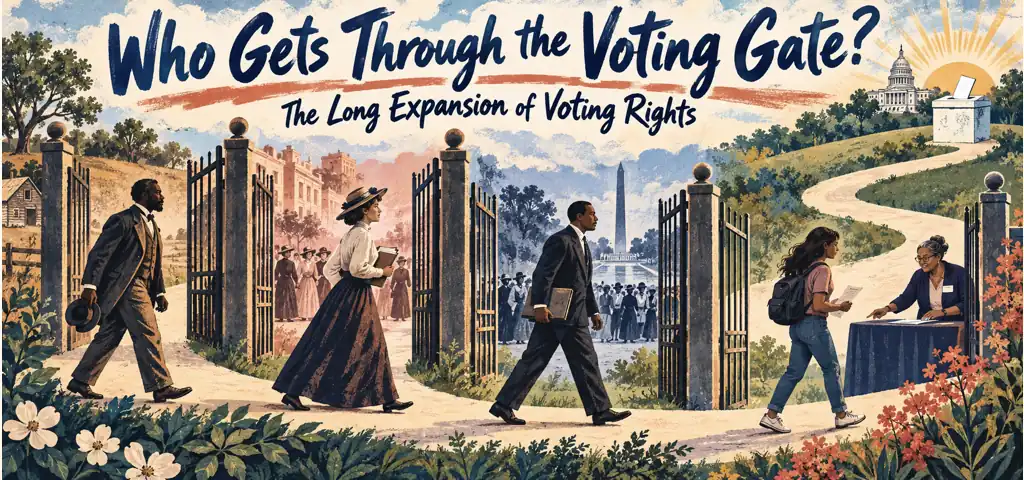
Voting rights in the United States expanded through amendments, legislation, court decisions and sustained political organizing. For AP U.S. Government and Politics, distinguish a legal protection from access to registration and the ballot, then distinguish both from turnout and vote choice.
From State Qualifications to Constitutional Protections
The original Constitution did not announce a single national set of voter qualifications. For elections to the House, it generally connected the federal electorate to the qualifications for the most numerous branch of each state’s legislature. States therefore played the leading role in defining the early electorate, and many used property, taxpaying, race, sex, or citizenship rules that excluded large parts of the population. Expansion came through state change, constitutional amendment, federal legislation, litigation, and organized pressure from people who demanded a political voice.
Three amendments prohibit discrimination based on a specified characteristic. The Fifteenth Amendment bars the United States and the states from denying or abridging a citizen’s vote on account of race, color, or previous condition of servitude. The Nineteenth Amendment does the same for sex. The Twenty-Sixth protects citizens who are eighteen or older from denial or abridgment on account of age. Each amendment also gives Congress enforcement power. The wording is important: these provisions forbid a stated basis of exclusion. They do not create one identical national election system.
Why Legal Protection Did Not End Exclusion
Formal protection was a beginning, not a self-executing finish. After the Fifteenth Amendment, discriminatory officials and private actors used literacy tests, white primaries, intimidation, violence, and selective registration to suppress Black voting. After the Nineteenth, women still faced barriers connected to race, citizenship, language, tax payment, location, and local administration.
The Twenty-Sixth means that a government may not deny or abridge the vote of a citizen who is eighteen or older because of age. It does not require a state to exclude every younger citizen. A state may permit some people under eighteen to participate in specified elections under its own law. Young citizens who possess the right must follow the applicable voting procedures, including registration where required, and use an available voting method. A person can therefore be eligible while confronting a later obstacle in the election process.
Other reforms reached different barriers. The Indian Citizenship Act extended citizenship to Native Americans born in the United States, though state restrictions persisted. The Twenty-Fourth Amendment addressed poll taxes in federal elections. The Voting Rights Act supplied federal tools against racial discrimination. State reforms removed property qualifications and later broadened registration methods. The lesson is not that one amendment gradually solved everything. It is that separate rules attacked separate gates.
Do not use turnout as a test of whether a right mattered. Newly eligible citizens may initially receive little campaign contact, lack registration information, distrust institutions, or live where elections are not competitive. Parties and civic groups can respond over time, and participation can become habitual. Constitutional eligibility changes who may enter the process. Registration, administration, mobilization, and political context help determine who actually does.
Match the Barrier to the Legal Protection
The National Archives’ amendment transcriptions let you compare the protections directly: the Fifteenth addresses race, the Nineteenth sex and the Twenty-Sixth age for citizens eighteen or older. The Twenty-Fourth addresses tax-payment barriers in specified federal elections. Identify the ground of exclusion and the election involved before selecting an amendment.
The Justice Department’s history of voting-rights legislation explains why Congress adopted the Voting Rights Act in 1965 after resistance frustrated case-by-case enforcement. The account also describes the Supreme Court’s 1966 Harper decision against Virginia’s state-election poll tax under the Fourteenth Amendment. These are different legal routes toward removing a barrier. The department’s historical account does not by itself establish which enforcement procedure applies to a present dispute.
Citizenship and election procedures are separate questions too. Indian Affairs’ citizenship explanation notes that many American Indians already held citizenship before Congress extended it in 1924. For present participation, USAGov’s eligibility guide directs voters to state rules and notes North Dakota’s registration exception. Check the applicable process rather than assuming every eligible citizen faces an identical registration system.
Separate Eligibility, Access, Turnout and Choice
A citizen is legally eligible but is denied registration because of race. Separate eligibility, access, turnout, and vote choice before identifying the governing rule.
Check your reasoning
Suffrage expanded through constitutional amendments, federal statutes, court decisions, and political struggle. Formal enfranchisement did not automatically remove registration barriers, intimidation, discriminatory administration, or unequal access. In voting-rights analysis, the Fifteenth Amendment prohibits race-based denial or abridgment of the vote.
Video Lesson: Voting Rights
Khan Academy gives a focused explanation of this topic in Voting rights | Political participation | US government and civics | Khan Academy.
If the player does not load, watch this lesson directly on YouTube.
For the organizational side of participation, see how political parties mobilize voters and organize government.
Continue Studying Participation and Elections

Related to This Article
More math articles
- Abolitionists and Antislavery Politics: Goals, Methods and Petition Rights
- Migration, Urbanization, Borders, and Development
- Top 10 HiSET Math Prep Books (Our 2027 Favorite Picks)
- Conference committees
- Pendleton Civil Service Reform Act
- Simple & Compound Interest Calculator (Free)
- How to Find the Volume and Surface Area of a Triangular Pyramid?
- Math for Travel: Currency, Distance, Time Zones, and Tipping for 2027
- The World of Separable Differential Equations
- 49 Free MTYA Grade 5 Math Worksheets for Maine Students (Aligned, One Skill Per Page)









What people say about "Voting Rights in the United States: Expansion and Barriers"?
No one replied yet.