YOUR AP U.S. GOVERNMENT AND POLITICS PREP STARTS HERE
AP U.S. Government and Politics Online Center
Review Ap Us Government with the independent study resources available on this page. Explore the official assessment, choose a focused topic, and use review or flashcards to strengthen your understanding.
Free study tools · Focused review · Books to compare
AP U.S. Government and Politics Practice Tests
Open the existing practice form and review its explanations. Its results are study feedback, not official scores.
AP U.S. Government and Politics Flashcards
Recall a term, then connect it with an example.
AP U.S. Government and Politics Study Guides
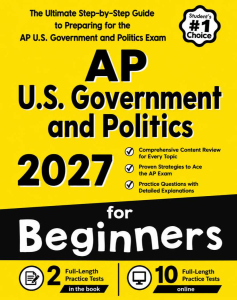
AP U.S. Government and Politics for Beginners
A subject-specific AP U.S. Government and Politics guide. Compare the contents with the current course framework and assessment requirements.
View book & purchase options →AP U.S. Government and Politics Quick Review
Choose a concept or lesson to refresh before another practice activity.
Open this resource →MEET THE ASSESSMENT · CHOOSE YOUR NEXT SKILL
Know AP U.S. Government and Politics before you start.
College Board lists a three-hour fully digital exam: 55 multiple-choice questions in 80 minutes and four free-response questions in 100 minutes. Each section counts for half the score. Independent quizzes here provide study feedback; they do not replace written argument, document analysis, and evidence-based free-response preparation.
Official assessment information ↗Constitutional foundations
Connect a principle with the institution or process it shapes.
Explore this study route →Institutions and powers
Distinguish an institution’s authority from a political preference.
Explore this study route →Rights and participation
Support an interpretation with the relevant evidence and legal context.
Explore this study route →Written political reasoning
Prepare evidence-based arguments using official free-response directions.
Explore this study route →AP U.S. Government and Politics Practice Center
Take a full practice test, review the explanations, then use the flashcards to repair the terms and ideas that slowed you down.
AP U.S. Government Study Blueprint
Open each area to see what to master. The bars show how this Online Center distributes its lessons, so you can plan study time without mistaking the map for an official exam weighting.
01 Foundations of American DemocracyStart with constitutional ideas, compromises, federalism, and democratic models. 9lessons
- Natural rights, republicanism, and constitutional design
- Federalism and competing interpretations of power
02 Interactions Among BranchesCompare the formal and practical powers of Congress, the presidency, courts, and bureaucracy. 15lessons
- Checks, bargaining, oversight, and implementation
- Judicial review and institutional legitimacy
03 Civil Liberties and Civil RightsApply constitutional protections and court reasoning to realistic disputes. 13lessons
- First Amendment freedoms and due process
- Equal protection and civil-rights development
04 Political Ideologies and BeliefsInterpret how values, socialization, and opinion shape policy preferences. 10lessons
- Political culture and public opinion
- Ideology, polling, and policy attitudes
05 Political ParticipationConnect elections, parties, groups, media, and voting behavior. 13lessons
- Campaigns, elections, and participation
- Parties, interest groups, and media strategy
Study-map shares describe the learning resources on this page. They are not presented as official test percentages.
AP U.S. Government and Politics Study Online Center: a single starting point that brings together the lessons, worksheets, practice tests, and review material for this subject, arranged in a sensible order so you can work through it from start to finish.
Learn the institutions, documents, court cases, political behavior, and evidence skills the exam asks you to connect.
AP Practice Test 1
Full AP-style readiness check across all five units.
AP Practice Test 2
A fresh AP-style practice form to confirm you’re ready.
Review Before Test Day
Big Idea, Must Know, Don’t Confuse, and Exam Trap for every unit.
Documents & Required Cases
Tap a card, say the rule, then check yourself against the answer.
The Exam at a Glance
The digital AP exam has two equally weighted sections. Section I contains 55 multiple-choice questions. Section II contains four free-response questions: concept application, quantitative analysis, SCOTUS comparison, and an argument essay.
For scheduling and official exam-day details, check the College Board exam page →
AP U.S. Government Topics: Learn and Review
Open a lesson in a new tab, then check your understanding with its short book-based quiz.
Unit 1
Foundations of American Democracy
- 1.1Ideals of DemocracyQuizPractice
- 1.2Types of DemocracyQuizPractice
- 1.3Government Power and Individual RightsQuizPractice
- 1.4Challenges of the Articles of ConfederationQuizPractice
- 1.5Ratification of the U.S. ConstitutionQuizPractice
- 1.6Principles of American GovernmentQuizPractice
- 1.7Relationship Between the States and National GovernmentQuizPractice
- 1.8Constitutional Interpretations of FederalismQuizPractice
- 1.9Federalism in ActionQuizPractice
Unit 2
Interactions Among Branches of Government
- 2.1Congress: The Senate and the House of RepresentativesQuizPractice
- 2.2Structures, Powers, and Functions of CongressQuizPractice
- 2.3Congressional BehaviorQuizPractice
- 2.4Roles and Powers of the PresidentQuizPractice
- 2.5Checks on the PresidencyQuizPractice
- 2.6Expansion of Presidential PowerQuizPractice
- 2.7Presidential CommunicationQuizPractice
- 2.8The Judicial BranchQuizPractice
- 2.9The Role of the Judicial BranchQuizPractice
- 2.10The Court in ActionQuizPractice
- 2.11Checks on the Judicial BranchQuizPractice
- 2.12The BureaucracyQuizPractice
- 2.13Discretionary and Rule-Making AuthorityQuizPractice
- 2.14Holding the Bureaucracy AccountableQuizPractice
- 2.15Policy and the Branches of GovernmentQuizPractice
Unit 3
Civil Liberties and Civil Rights
- 3.1The Bill of RightsQuizPractice
- 3.2First Amendment: Freedom of ReligionQuizPractice
- 3.3First Amendment: Freedom of SpeechQuizPractice
- 3.4First Amendment: Freedom of the PressQuizPractice
- 3.5Second Amendment: Right to Bear ArmsQuizPractice
- 3.6Amendments: Balancing Individual Freedom with Public Order and SafetyQuizPractice
- 3.7Selective IncorporationQuizPractice
- 3.8Amendments: Due Process and the Rights of the AccusedQuizPractice
- 3.9Amendments: Due Process and the Right to PrivacyQuizPractice
- 3.10Social Movements and Equal ProtectionQuizPractice
- 3.11Government Responses to Social MovementsQuizPractice
- 3.12Balancing Minority and Majority RightsQuizPractice
- 3.13Affirmative ActionQuizPractice
Unit 4
American Political Ideologies and Beliefs
- 4.1American Attitudes About Government and PoliticsQuizPractice
- 4.2Political SocializationQuizPractice
- 4.3Changes in IdeologyQuizPractice
- 4.4Influence of Political Events on IdeologyQuizPractice
- 4.5Measuring Public OpinionQuizPractice
- 4.6Evaluating Public Opinion DataQuizPractice
- 4.7Ideologies of Political PartiesQuizPractice
- 4.8Ideology and PolicymakingQuizPractice
- 4.9Ideology and Economic PolicyQuizPractice
- 4.10Ideology and Social PolicyQuizPractice
Unit 5
Political Participation
- 5.1Voting RightsQuizPractice
- 5.2Voter TurnoutQuizPractice
- 5.3Political PartiesQuizPractice
- 5.4How and Why Political Parties Change and AdaptQuizPractice
- 5.5Third-Party PoliticsQuizPractice
- 5.6Interest Groups Influencing PolicymakingQuizPractice
- 5.7Groups Influencing Policy OutcomesQuizPractice
- 5.8Electing a PresidentQuizPractice
- 5.9Congressional ElectionsQuizPractice
- 5.10Modern CampaignsQuizPractice
- 5.11Campaign FinanceQuizPractice
- 5.12The MediaQuizPractice
- 5.13Changing MediaQuizPractice
Using This Online Center with the Book
AP U.S. Government and Politics for Beginners pairs with every section on this page: work the Online Center for open practice, then use the book for deeper chapter walkthroughs, printed practice tests, and full answer explanations you can study offline.
When a chapter check or practice test exposes a weak spot, use the chapter QR code or the matching topic number above. Book owners can also open the private practice-test links printed in the book. Those test routes are deliberately not listed on this public page.
- ✓ All five AP course units, chapter by chapter
- ✓ Required founding documents and court cases
- ✓ 12 full-length practice tests with explanations
AP and Advanced Placement are registered trademarks of the College Board, which is not affiliated with and does not endorse this resource.
A USEFUL NEXT STEP
AP U.S. Government and Politics: study questions
What is the official AP U.S. Government and Politics exam format?
College Board lists a three-hour fully digital exam: 55 multiple-choice questions in 80 minutes and four free-response questions in 100 minutes. Each section counts for half the score. Independent quizzes here provide study feedback; they do not replace written argument, document analysis, and evidence-based free-response preparation.
Official source ↗How should I use these independent AP U.S. Government and Politics study tools?
Start with a practice activity, review explanations for missed questions, and use quick review or flashcards for one weak topic. The practice results are study feedback, not official exam scores. Compare a book’s contents with your course or test requirements before buying.
Resources from Effortless Math · Editorial standards