AP® Exam Prep · College Board Course
AP Chemistry Practice Test: Free Questions, Flashcards & Unit Review
Prepare for AP Chemistry with free independent practice, flashcards, and quick review. Strengthen atomic structure, chemical reactions, equilibrium, and data reasoning, then compare a general chemistry guide with your course needs.
AP Chemistry Practice Tests
Work through the existing practice form and review the explanations. Its scope and timing are described in the study view.
AP Chemistry Flashcards
Search, shuffle, and flip the existing deck to practice active recall.
AP Chemistry Study Guides
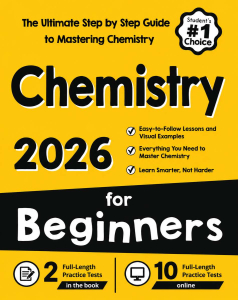
Chemistry for Beginners
General chemistry review. Compare the contents with your AP Chemistry course and free-response requirements.
View book & purchase options →AP Chemistry Quick Review
Open the existing quick review and work on one concept at a time.
MEET THE ASSESSMENT · CHOOSE YOUR NEXT SKILL
Know AP Chemistry before you start.
College Board lists a 3-hour-15-minute hybrid digital exam: 60 multiple-choice questions in 90 minutes and seven free-response questions in 105 minutes. Each section contributes half the score. The independent practice form here supports multiple-choice study; also prepare written explanations, calculations, and experimental reasoning.
Official assessment information ↗Chemical concepts
Connect particle models, equations, and observations. Check that your explanation describes the same reaction.
Explore this study route →Calculation practice
Write units at each step and check whether the answer fits the chemical quantities in the question.
Explore this study route →Free-response work
Practice written calculations and experiment explanations. Follow the official assessment link for released questions.
Explore this study route →Review a weak topic
Use review or flashcards for one missed idea, then explain it without looking at the answer.
Explore this study route →Practice Test 1
Complete the timed practice form, then review every answer explanation.
- 60 independent practice questions
- 90-minute countdown after Begin Test
- Explanations shown after submission
Quick Review
Review one concept before practice, then revisit ideas behind your missed answers.
- 49 concept review boxes
- One popup study view
- Return to the Online Center after review
Flashcards
Use active recall to review the terms and ideas in this subject.
- 217 concept flashcards
- Search, filter, shuffle, and flip
- Mark known cards as you study
Study Topics
Choose a study topic, then use quick review or flashcards to strengthen it.
- 5 domain cards
- 49 topics listed below
- Use review and flashcards for your chosen topic
Your Free Study Tools at a Glance
This study Online Center centers the timed practice form, then gives you the quick-review boxes and flashcards you need to repair missed concepts.
AP Chemistry Topics: Learn and Review
Choose a topic for your next session. Check the official assessment guidance above for current requirements.
- 1. Electron Configuration and the Periodic Table
- 2. Coulomb's Law and Atomic/Ionic Radius Trends
- 3. Ionization Energy and Photoelectron Spectroscopy (PES)
- 4. Mass Spectrometry and Average Atomic Mass
- 5. Types of Chemical Bonding and Lattice Energy
- 6. Lewis Structures, Formal Charge, and Resonance
- 7. VSEPR Geometry and Molecular Polarity
- 8. Hybridization, Sigma/Pi Bonds, and Bond Order
- 9. Intermolecular Forces (IMFs)
- 10. Solids: Types, Structures, and Properties
- 11. Gas Laws and Kinetic Molecular Theory
- 12. Solutions: Concentration and Solubility
- 13. Colligative Properties
- 14. Spectroscopy and the Beer--Lambert Law
- 15. Types of Chemical Reactions and Net Ionic Equations
- 16. Stoichiometry and Percent Yield
- 17. Titration Stoichiometry
- 18. Oxidation--Reduction (Redox) Reactions
- 19. Reaction Rates and Rate Laws
- 20. Integrated Rate Laws and Half-Life
- 21. Reaction Mechanisms and the Rate-Determining Step
- 22. Collision Theory, Activation Energy, and Catalysts
- 23. Calorimetry and Specific Heat
- 24. Hess's Law and Enthalpies of Reaction
- 25. Bond Enthalpy and Energy Diagrams
- 26. Equilibrium Constant Expressions and Q vs. K
- 27. ICE Tables and Solving for Equilibrium Concentrations
- 28. Le Chatelier's Principle
- 29. Solubility Equilibria (\(K_sp\))
- 30. Bronsted--Lowry Acids/Bases, \(K_a\)/\(K_b\), and pH
- 31. Strong vs. Weak Acids/Bases and Percent Ionization
- 32. Acid--Base Titration Curves
- 33. Buffers and the Henderson--Hasselbalch Equation
- 34. Molecular Structure and Acid Strength
- 35. Entropy and the Second Law of Thermodynamics
- 36. Gibbs Free Energy and Spontaneity
- 37. Galvanic (Voltaic) Cells and Cell Potential
- 38. Electrolytic Cells and Faraday's Law
- 39. Standard Reduction Potentials and Predicting Redox Spontaneity
- POWER BOX 1 --- Core Formula Sheet
- POWER BOX 2 --- Pairs Students Always Confuse
- POWER BOX 3 --- Core Taxonomy: Reactions, Solids, and Cells
- POWER BOX 4 --- Required Reference: Constants, Strong Acids/Bases, and Common Ions
- POWER BOX 5 --- Method: Answering a Calculation/Lab-Based FRQ
- POWER BOX 6 --- Exam Format & Question-Type Playbook
- POWER BOX 7 --- Pathway: Setting Up and Solving an Equilibrium (ICE) Problem
- POWER BOX 8 --- Data & Graph Analysis Emergency Guide
- POWER BOX 9 --- AP Trap Statements
- POWER BOX 10 --- Final 15-Minute Review
Use this topic list to plan review. The independent study resources are not an official exam blueprint.
Study Topics
Start with the domains below, then use the practice center to turn recognition into recall.
1. Electron Configuration and the Periodic Table
Use the quick review first, then check this domain with the practice questions and flashcards.
2. Coulomb's Law and Atomic/Ionic Radius Trends
Use the quick review first, then check this domain with the practice questions and flashcards.
3. Ionization Energy and Photoelectron Spectroscopy (PES)
Use the quick review first, then check this domain with the practice questions and flashcards.
4. Mass Spectrometry and Average Atomic Mass
Use the quick review first, then check this domain with the practice questions and flashcards.
5. Types of Chemical Bonding and Lattice Energy
Use the quick review first, then check this domain with the practice questions and flashcards.
AP Chemistry builds from atomic structure to equilibrium and thermodynamics. This Online Center covers 39 topics, including electron configuration, hybridization and bond order, stoichiometry and percent yield, Hess’s law, and reading acid-base titration curves, with 217 flashcards and a 60-question test.
Study path
- Map the main domains in the Study Topics.
- Take the practice test and read every explanation.
- Use Quick Review and Flashcards to repair weak spots, then retest.
The practice tools open in a focused study window so you can keep your place on this Online Center.
60 questions · 90 minutes
No timer is running on this screen. The countdown starts only after you select Begin Test.
Answer every question, then use the explanations to choose what to review next.
A USEFUL NEXT STEP
AP Chemistry: study questions
What is the official AP Chemistry exam format?
College Board lists a 3-hour-15-minute hybrid digital exam: 60 multiple-choice questions in 90 minutes and seven free-response questions in 105 minutes. Each section contributes half the score. The independent practice form here supports multiple-choice study; also prepare written explanations, calculations, and experimental reasoning.
Official source ↗How should I use these independent AP Chemistry study tools?
Start with a practice activity, review explanations for missed questions, and use quick review or flashcards for one weak topic. The practice results are study feedback, not official exam scores. Compare a book’s contents with your course or test requirements before buying.
Resources from Effortless Math · Editorial standards