Modern Political Campaigns: Candidates, Parties and Strategy
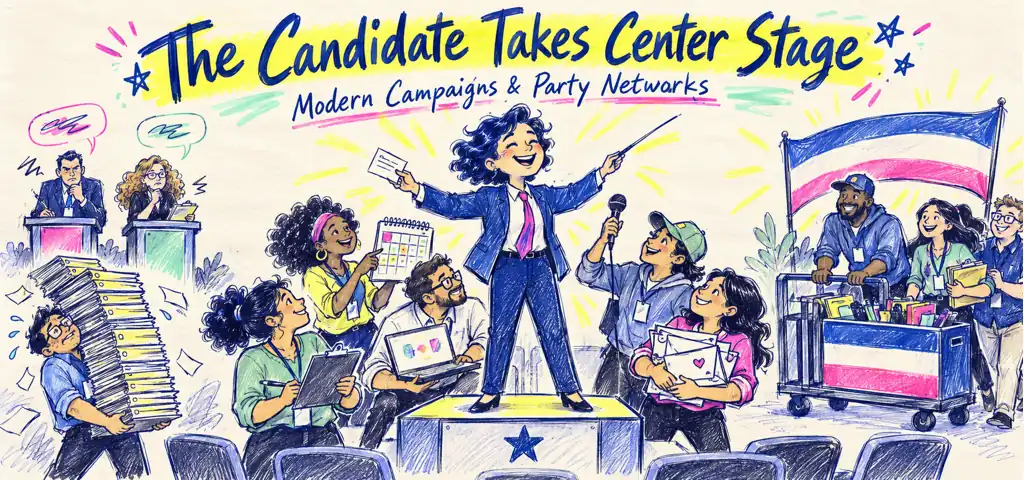
Modern political campaigns are often candidate-centered, but candidates still depend on party labels, organizations and networks. For AP U.S. Government and Politics, distinguish control of a campaign’s staff and message from the support a party supplies. Then explain how that relationship may change between nomination and the general election.
Candidate Organizations and Party Support
American campaigns are candidate-centered because individuals seeking office build personal organizations, raise funds, hire staff, choose messages, schedule appearances, and cultivate public images. Primaries encourage candidates of the same party to compete against one another, while modern fundraising and communication tools let them develop networks that do not depend entirely on a local party organization. Two candidates carrying the same label can emphasize different issues or constituencies and operate separate campaign committees.
Candidate-centered does not mean party-free. Party identification remains a powerful voting cue. National, state, and local committees can provide voter data, training, volunteers, research, shared field assistance, and a recognizable label. Activists, elected officials, and aligned groups also connect candidates to established coalitions. The candidate’s autonomy and the party’s resources coexist. The balance varies by race and stage.
How Campaign Organization Changes Across Stages
The arrangement has advantages and costs. A candidate can adapt a message to local concerns and respond quickly without waiting for a centralized organization. Personal responsibility may help voters identify who is asking for office. At the same time, separate organizations can duplicate spending, produce inconsistent messages, weaken long-term party capacity, and make the coalition appear fragmented. A charismatic candidate may mobilize supporters who feel attached to the person more than the party.
The nomination stage strengthens the personal organization because candidates must distinguish themselves from intraparty rivals. After nomination, party committees and former competitors often cooperate more closely for the general election. This change does not erase the legal and organizational distinctions among candidate committees, party committees, and outside groups.
A Senate nominee may hire a campaign manager directly, maintain a separate staff, and run advertisements centered on a personal record while the state party supplies voter files and turnout volunteers. The campaign is candidate-centered, yet the party remains consequential. The party does not direct every daily choice, and the candidate does not compete in isolation from party labels and networks.
Separate Organization, Rules and Results
The FEC’s guides for candidates and political committees distinguish a candidate’s authorized campaign committee from a local, state or national party committee. Working toward the same election outcome does not make these organizations identical. The guides also flag the June 2026 court decision on party coordinated expenditure limits; use the current ruling rather than treating older caps as unchanged.
Election rules shape the audience at each stage. USAGov explains primary and general-election party rules: participation in a primary or caucus depends on state rules, while voters in a general election need not choose their registered party’s candidate. Do not assume every primary has the same electorate or that party registration determines a general-election vote.
A voter file is a resource, not a record of private ballot choices. The Election Assistance Commission’s voter-list overview explains that availability and permitted uses vary by state. Files may record participation history or party affiliation, but they do not reveal whom a person voted for. Data-based outreach therefore does not establish how every contacted voter will vote.
Apply the Distinction to a Senate Campaign
Imagine a Senate candidate who hires her own staff and emphasizes a local issue during the primary. After nomination, the state party supplies voter data and turnout volunteers. A classmate calls this either a completely independent personal campaign or a campaign entirely controlled by the party. What evidence challenges both descriptions, and what remains unknown?
Check your reasoning
Hiring staff and choosing a message support the candidate-centered description. Party data and volunteers show that the candidate still benefits from a wider organization. Cooperation after nomination does not prove that the party directs every daily decision. The example alone does not establish which tactic changed votes or whether the candidate will win; those claims need additional evidence.
Video Lesson: Political Campaigns
CrashCourse gives a focused explanation of this topic in Political Campaigns: Crash Course Government and Politics #39.
If the player does not load, watch this lesson directly on YouTube.
For the distinction among direct contributions, independent spending and party coordinated expenditures, continue with Campaign Finance Laws and Regulation.
Continue Studying Parties and Elections

Related to This Article
More math articles
- Perimeter for 5th Grade: Find the Distance Around
- How to Identify Graphs of Basic Functions
- SSAT Lower Level Math FREE Sample Practice Questions
- Gini Coefficient: Calculate and Interpret the Area Ratio
- What Skills Do I Need for the ALEKS Math Test?
- 8th Grade IAR Math Practice Test Questions
- How to Support Grade 7 Reading at Home: 12 Smart Strategies That Build Independence
- Area for 5th Grade: Squares, Rectangles, and Composite Figures
- SSAT Upper Level Math Flashcards (Free Online: Formulas, Terms & Concepts)
- What Is on the Florida Algebra 1 EOC? Topics, Timing, Score, and Study Plan












What people say about "Modern Political Campaigns: Candidates, Parties and Strategy"?
No one replied yet.