How the Electoral College Elects a President
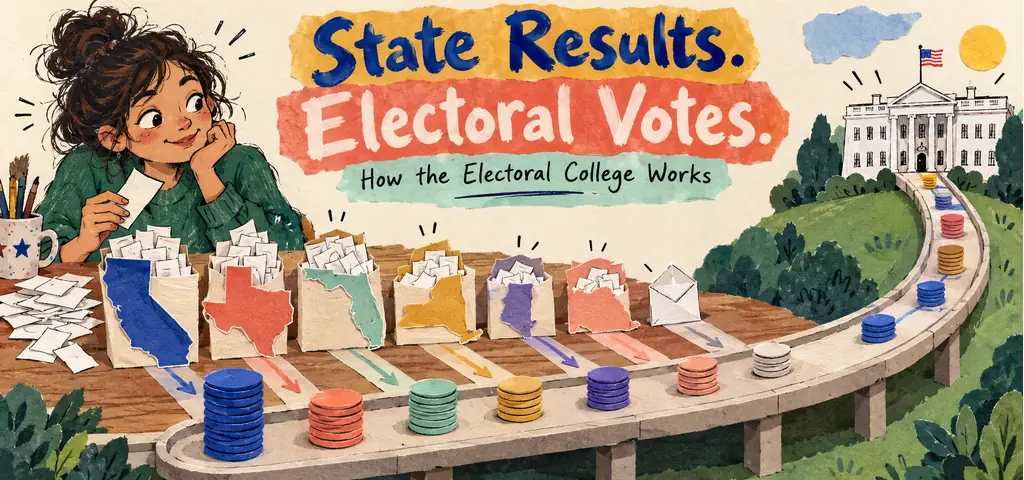
The Electoral College is the constitutional mechanism for selecting the president and vice president. Each state receives electors equal to its House representation plus its two senators. The Twenty-Third Amendment gives the District of Columbia the number it would receive if it were a state, capped at the allocation of the least populous state. Electors meet in their states and cast separate ballots for president and vice president. If no presidential candidate wins an electoral majority, the House chooses from the top three presidential recipients, voting by state delegation. The Senate separately chooses the vice president from the top two. The constitutional formula determines how many electors a jurisdiction receives, while state law generally determines how a popular result appoints them. Most states and the District of Columbia use winner-take-all: the statewide plurality winner receives the whole slate. Maine and Nebraska use a district-based variation, assigning one elector by each congressional district and two by the statewide result. Winner-take-all is therefore widespread state policy, not a constitutional command.
A practical reading of how the electoral college elects a president
State allocation turns geography into strategy. A narrow statewide win can deliver the same bloc as a landslide, so campaigns compare the chance that one more visit, advertisement, or organizer will change the statewide winner. A battleground state is one either leading ticket can realistically win. It is a strategic label, not a permanent legal category. Coalitions, candidates, migration, turnout, and issues can change the map. Safe-state voters still determine their state result and affect other offices, but an additional presidential vote there is less likely to change the electoral allocation. The national popular vote and electoral vote consequently answer different questions. The popular total aggregates ballots across the country. The electoral total applies state appointment and allocation rules. A candidate can build enormous vote surpluses in safe states yet lose enough close states to fall short of an electoral majority. That divergence does not itself establish fraud or a counting error. It follows when the geographic pattern of certified votes interacts with the governing rules. Reform proposals such as a direct national vote, proportional allocation, or district allocation would change incentives, but describing a proposal does not make it current law. Apply the existing rule first, then evaluate its consequences.
How the Electoral College Elects a President: a common mistake
Apply the lesson on how the electoral college elects a president
For Electoral College, connect the electoral rule or constituency to strategic voting, incumbency, turnout, representation, or Electoral College resource allocation. Give one concrete example.
Check your reasoning
Each state receives electors equal to its House and Senate representation, and the District of Columbia receives three. A majority of appointed electors is required. Otherwise the Twelfth Amendment provides contingent election procedures. Most states award all presidential electors to the statewide plurality winner.
Video lesson: How the Electoral College Elects a President
Khan Academy gives a focused explanation of this topic in Electoral college | American civics.
If the player does not load, watch this lesson directly on YouTube.
Connect this lesson to the larger course
For a broader map connecting how the electoral college elects a president to participation, parties, elections, interest groups, and media, use the AP U.S. Government and Politics learning hub.

Related to This Article
More math articles
- How to Measures of Dispersion?
- 6th Grade English Worksheets for Texas (STAAR): 46 Free Printable PDFs
- Preparing For SAT Math? DON’T Make These Big Mistakes!
- Chapter 10: Congressional Powers
- The Best Grade 4 ELA Practice Tests for Wyoming Students
- Multiplying Mixed Numbers for 5th Grade: Convert and Multiply
- Feminist Perspectives
- How to Prepare for the ISEE Lower Level Math Test?
- 8th Grade Common Core Math Worksheets: FREE & Printable
- Top 10 SSAT Upper Level Math Practice Questions






















What people say about "How the Electoral College Elects a President"?
No one replied yet.