How Interest Groups Influence Public Policy
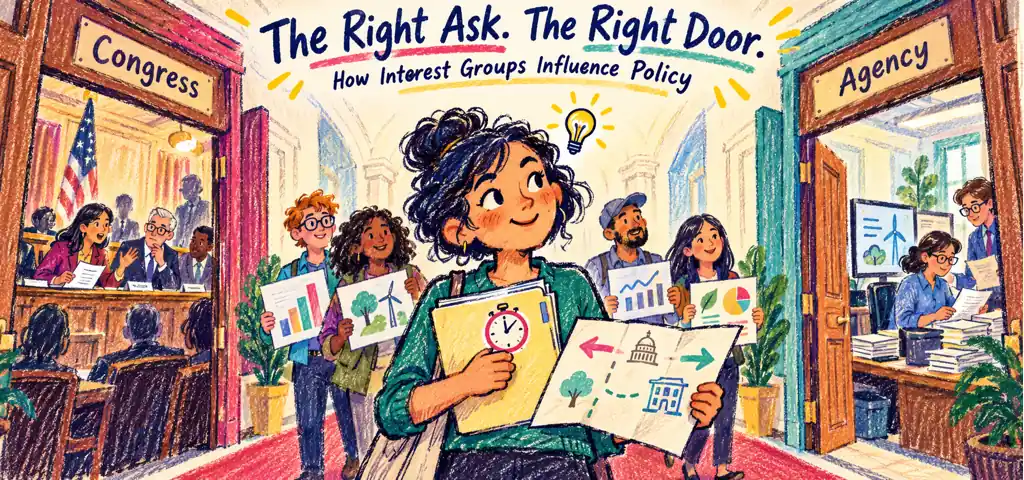
Interest groups influence public policy by matching information, arguments and public pressure to a decision maker’s authority. For AP U.S. Government and Politics, distinguish a request for legislation, a comment on an agency rule and an argument in a court case. Access to an official does not by itself prove influence or corruption.
What Lobbying Can Ask an Official to Do
Lobbying is organized communication intended to influence a public decision. The lobbyist may be a paid professional, an association officer, a company employee, a union representative, or a citizen acting through a group. The common feature is a request directed toward public authority: support this bill, revise this rule, fund this program, or enforce this law differently. Lobbying is a strategy of persuasion and pressure, not a power to make the decision.
Effective lobbying begins with institutional fit. A senator cannot personally issue an agency regulation, and an agency cannot enact a statute beyond the authority Congress delegated. Groups study jurisdiction, procedure, timing, and the people who control each stage. A carefully drafted amendment may be useful before a committee markup but nearly useless after the final vote. A technical comment belongs in an agency record, while district-level effects may matter more to a legislator deciding how constituents will respond.
Match the Message to a Decision Path
Lobbying succeeds only when communication is connected to a decision path. Groups ask what action is still available, who controls it, what deadline governs it, and what evidence or political concern the decision maker is likely to consider. They may communicate through professional representatives or activate constituents, and a single campaign may use both routes. The separate lessons that follow distinguish those audiences. At the overview level, the central point is that sending more messages cannot repair a mismatch between the requested action and the recipient’s authority.
Separate Access, Influence and Corruption
Access is not the same as influence, and influence is not the same as corruption. Officials may meet a group to obtain information, understand implementation, or hear a constituency and still reject its request. Lawful lobbying offers reasons, evidence, or political signals. Bribery or an unlawful quid pro quo exchanges value for official action. Registration and disclosure requirements can reveal covered paid activity without turning every letter from a citizen into a regulated lobbying engagement. A complete analysis therefore identifies the requested action, authorized decision maker, procedural moment, immediate audience, and resource being used.
Use the Institution’s Actual Procedure
The Congress.gov committee-consideration transcript explains how selected witnesses supply testimony and how members consider amendments during markup. Information aimed at a committee can address a bill while it is being developed; a hearing is not a promise that a witness’s preferred text will become law.
The Department of Transportation’s rulemaking overview explains that an agency needs statutory authority to issue a legislative rule. Its comment guidance asks people to identify the relevant docket, examine the proposal’s reasoning and suggest alternatives. For a rule open to comment, a group can connect evidence to the proposed text and follow that docket’s instructions and deadline. This is a different task from asking Congress to amend the underlying statute.
A court case has another channel. The U.S. Courts glossary describes an amicus curiae brief as a formal submission by an interested nonparty. A group considering that route must follow the applicable court’s filing rules; a campaign of private messages to a judge is not a substitute for a proper filing.
Finally, distinguish the broad civics concept of lobbying from a particular disclosure law. The Senate’s lobbying disclosure FAQ describes registration conditions for covered firms and organizations. It does not classify every citizen’s policy request as a registrable professional engagement. Check the applicable definitions and current guidance before making a legal classification.
Choose a Strategy for Each Policy Target
Imagine a group seeking three changes: an amendment to a bill before a committee, a revision to a proposed agency rule open for comment and a legal interpretation in a pending court case. Which decision maker and procedural channel fit each request? Explain why a meeting, a submission or a large volume of messages does not by itself establish that the group caused the final decision.
Check your reasoning
Lobbying communicates information, arguments, or requests to public officials to influence policy. It includes lawful direct contact and grassroots activity and does not itself prove improper control. Direct or inside lobbying targets legislators, staff, administrators, or executive officials through meetings, testimony, research, drafting, and technical information.
For the bill, address the relevant committee and its legislative stage. For the proposed rule, submit relevant evidence through the agency’s specified comment process. For the court case, a properly filed amicus brief may be an appropriate nonparty route, subject to that court’s rules. In each case, compare what was requested with the institution’s actual action and reasons before attributing the outcome to the group.
Video Lesson: Interest Groups and Lobbying
Khan Academy gives a focused explanation of this topic in Interest groups and lobbying | Political participation.
If the player does not load, watch this lesson directly on YouTube.
To separate policy advocacy from transfers of campaign money, compare the transaction categories in Campaign Finance Laws and Regulation.
Continue Studying Political Participation

Related to This Article
More math articles
- Back to School: The Best Laptops for Students
- Weaknesses of the national government
- From Simple to Complex: Calculus of Surfaces
- Descent, Residence, and Authority
- Algebra Puzzle – Challenge 43
- Converting Units of Weight/Mass for 4th Grade
- Affordable Online Accounting Degree Programs
- Chapter 6: Federalism
- New Deal coalition
- The Double V Campaign and the Second Great Migration











What people say about "How Interest Groups Influence Public Policy"?
No one replied yet.