How Congressional Elections Work
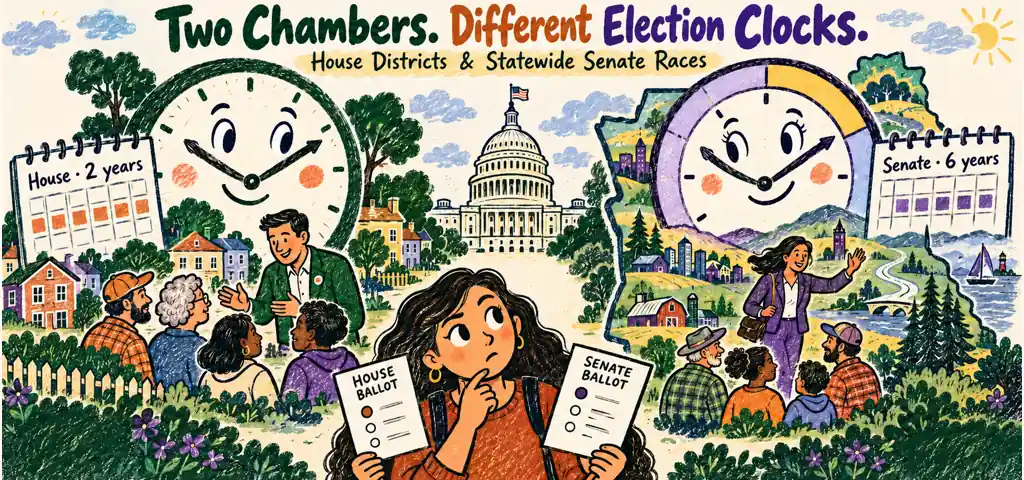
Congressional elections fill two different kinds of representative office. Every House seat is scheduled for election every two years from a single-member district. Senators run statewide for six-year terms arranged in three classes, so roughly one-third of the Senate is ordinarily scheduled in each two-year cycle. The constituency, campaign scale, and timing of accountability therefore differ. A House candidate can build a coalition around one district. A Senate candidate must communicate across an entire state and may face voters under conditions very different from those of the previous election. Most congressional contests use plurality voting: the candidate with more votes than any opponent wins. Because each seat is awarded separately, a party’s national congressional vote is not pooled and converted proportionally into seats. A party receiving 20 percent in each of five districts can win no seat if it never finishes first. House boundaries can also change after reapportionment and redistricting, while Senate constituencies remain whole states. A national Senate vote total does not translate proportionally into seats because states receive equal representation and only one class is normally exposed in a cycle.
How Congressional Elections Work: the working rule
A presidential general election is national in attention but state based in legal operation. The nominees campaign for one national office and present a joint ticket with their vice-presidential running mates. Voters participate through elections administered under state law, and their ballots choose slates of presidential electors. The Constitution supplies the term and electoral framework. States administer registration, ballot access, voting, counting, and certification within federal limits. The presidential process unfolds through distinct stages. Voters cast ballots in November. States canvass and certify results. Electors meet in their states. Certificates are transmitted. And Congress counts the electoral votes. A network projection has no legal power to appoint electors. Presidential and congressional candidates may share a ballot and party label, but their contests remain separate. A strong presidential nominee may help lower-ballot allies by attracting supporters, yet no presidential vote transfers automatically to a House or Senate candidate. Begin every comparison with the office, constituency, term, and vote-conversion rule. Those facts explain why the same political mood can replace the House quickly, affect only the scheduled Senate class, and choose a president through a separate state-based process.
How Congressional Elections Work: limits and hard cases
A new case involving how congressional elections work
For Congressional elections, connect the electoral rule or constituency to strategic voting, incumbency, turnout, representation, or Electoral College resource allocation. Give one concrete example.
Check your reasoning
Congressional elections use state districts for the House and statewide constituencies for the Senate. Incumbency, district composition, national tides, candidate quality, and turnout shape outcomes. Presidential elections combine a national campaign with state-based Electoral College contests.
Video lesson: How Congressional Elections Work
Khan Academy gives a focused explanation of this topic in Congressional elections | Political participation.
If the player does not load, watch this lesson directly on YouTube.
Connect this lesson to the larger course
For a broader map connecting how congressional elections work to participation, parties, elections, interest groups, and media, use the AP U.S. Government and Politics learning hub.

Related to This Article
More math articles
- Full-Length ASVAB Math Practice Test
- Rules of Exponents
- Mitosis and Meiosis
- Malcolm X, Black Power, and Urban Uprisings
- The Best HiSET Math Worksheets: FREE & Printable
- Narrator and Point of View
- Migration, Urbanization, Borders, and Development
- Free Grade 3 English Worksheets for Mississippi Students
- Nominating candidates
- The Best Grade 7 Math Book for New Mexico Students




















What people say about "How Congressional Elections Work"?
No one replied yet.