How to Study Community Nutrition for the RD Exam (2027 Prep)
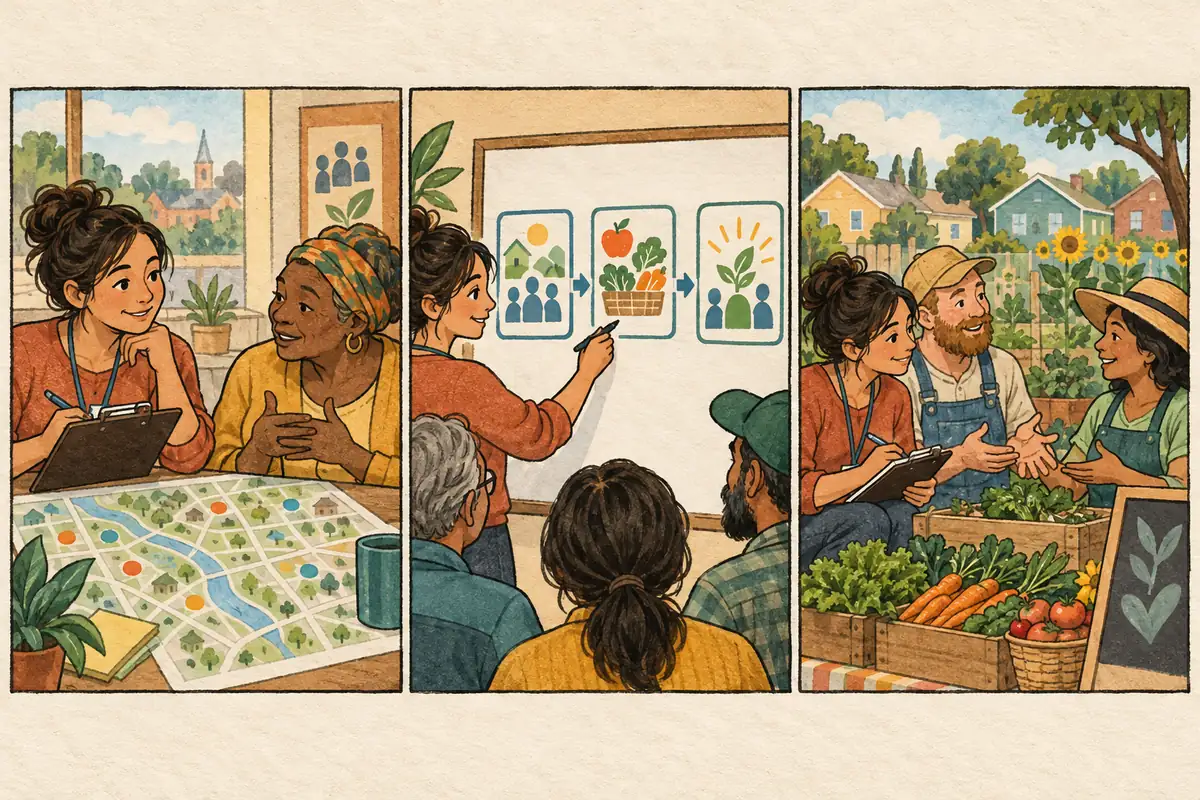
The 2027–2031 RD outline gives Community and Public Health Nutrition 22%. Study it as a connected job: understand the community, design a service, deliver it well, then check what changed after residents have had time to use it.
Community nutrition questions connect local information to practical, measurable services.
If your RD exam date is January 1, 2027 or later, CDR’s 2027–2031 specifications apply. Domain II, Community and Public Health Nutrition, is 22% of the published blueprint. Its three sections move from guidelines and policy, to community needs assessment, to programs and services for individuals and groups.
That sequence gives you a sturdy study map. It also keeps this domain from turning into a pile of disconnected program names. When a case describes a population, first ask what is known, what is missing, and whose perspective has not been heard. Then connect the evidence to a feasible response and an outcome you can measure. CDR’s exam resources link the detailed outline.
What the current outline asks you to study
| Section | What the outline names | A useful study question |
|---|---|---|
| A. Community Nutrition Guidelines and Policies | Social norms and varied dietary patterns; nutrition information and misinformation; regulations and federal programs; national dietary guidance; policy advocacy. | Which guidance, program rule, or policy actually fits this population and setting? |
| B. Community Needs Assessment | Routine screening; community needs, constraints, disease rates and learning needs; social determinants; group indicators; data systems; community resources and partners. | What does the evidence tell you, what can it not tell you, and what should you ask locally? |
| C. Community Nutrition Programs and Services for Individuals and Groups | Service and education planning; funding and budgets; intervention levels; objectives and logic models; health equity; education methods; communication; implementation and outcome evaluation. | Can you link a defined need to a workable program and a fitting measure of success? |
These are study topics, not a prediction of a fixed number of questions for each section. The 22% is the published domain weight. CDR’s detailed outline is the authority for its subtopics and verbs.
Learn a repeatable case sequence
- Name the group and setting. A community is not automatically one uniform audience. Age, language, access, culture, local services, and the question being asked can change what a useful response looks like.
- Assess before you prescribe a program. Review available data, local resources, current services, barriers, and the community’s stated priorities. Separate a population-level pattern from an explanation of why it exists.
- Choose the level of action. CDR’s outline calls out the Social-Ecological Model and primary, secondary, and tertiary prevention. Ask whether the case calls for information, a change in access or setting, an early intervention, or support for people already managing a condition.
- Write a measurable objective. State who will do what, in which setting, by when, and what observable result will count. Keep the objective within the program’s control.
- Match the program to the people and place. Choose the communication method, partners, staff, materials, and resources that fit the audience. A classroom handout, a food demonstration, a referral pathway, and a policy proposal solve different problems.
- Evaluate the right thing. Check whether the service happened, whether people were reached, what changed, and whether the result can reasonably be linked to the program. Use process and outcome measures for different questions.
The order matters. If you start by choosing a class or handout, you may skip the needs assessment that tells you whether education is the barrier at all.
Work one example from evidence to evaluation
Imagine a county team is considering a nutrition service for older adults who report trouble getting food. This is a teaching example, not an official CDR case. The team should check local data and speak with residents and partners before deciding that a class is the answer.
| Step | Illustrative question or measure |
|---|---|
| Need and context | Which older adults report access problems? What transport, cost, language, mobility, or service gaps do residents identify? Which food assistance and health services already operate locally? |
| Inputs and partners | For example, a clinic, aging-services office, food pantry, transit partner, and community members may help shape a referral or delivery pathway. Confirm capacity before setting targets. |
| Activities | Offer a referral process, help residents navigate eligible food resources, or add a community-designed education session if residents identify an information need. |
| Process measure | Count referrals offered and completed, or track how many scheduled sessions were delivered. This checks what the program did. |
| Outcome measure | Ask whether participants can access the service or report improved food access after a defined interval. This checks a result for participants. |
Keep the measures distinct. “We held four sessions” is an activity or process count. It does not establish that food access improved. A stronger plan names both what the team will deliver and what result it hopes to influence, then sets a reasonable time and method for checking each.
Choose data that fits the question
The CDR outline names systems such as NHANES, BRFSS, and YRBSS as examples of nutrition screening and surveillance data. You do not need to use the same source for every case. Match the source and scale to the question, then read its limits.
- NHANES combines interviews, health examinations, laboratory tests, and dietary interviews to assess health and nutritional status in the United States. It supports national estimates. It cannot by itself tell you exactly what is happening on one block or in one county program.
- BRFSS gathers state data from adults about health-related risk behaviors, chronic conditions, and preventive services. Use its geography and questionnaire carefully. A state-level estimate may not describe a small neighborhood.
- YRBSS monitors health-related behaviors and experiences among youth and includes national, state, tribal, territorial, and local survey components. Check which component and age group a result represents before applying it to a program.
For a local assessment, national surveillance can provide context. Local administrative data, service records, listening sessions, and community partners may fill in the details that a national dataset cannot answer. CDR’s outline also points to demographic data, incidence and prevalence, available services, food systems, and stakeholder resources.
Know the evaluation words
| Term in CDR outline | Question it helps answer | Simple example |
|---|---|---|
| Formative evaluation | What should be adjusted while a program is being designed or tested? | Participants find the sign-up form confusing, so the team revises it before broad delivery. |
| Summative evaluation | At the end of a cycle, what overall conclusion can be drawn against the program’s stated aims? | Compare end-of-cycle reach and outcomes with preset targets, then document whether to continue, adapt, or stop. This summary alone does not establish causation. |
| Process evaluation | Was the program delivered as planned, and who did it reach? | Compare completed referrals with referrals offered. |
| Impact evaluation | Did the program produce effects compared with what would have happened without it? | Compare the observed population food-security result with a credible estimate of what likely would have happened without the program, such as a justified comparison group or pre-specified projection. State the assumptions; the estimate alone does not prove causation. |
| Outcome evaluation | Was the intended result achieved, and what else could explain the change? | Track the selected population indicator over time. A change alone does not show that the program caused it. |
| Structure evaluation | Were the staffing, funding, space, materials, and partnerships in place to deliver the program? | Compare planned sessions with staffing, room availability, materials, referral capacity, and budget before implementation. |
| Fiscal/efficiency evaluation | What resources were used relative to the service or result? | Track program cost per completed referral, with the calculation and time window stated. |
For nutrition-education planning, CDR lists four evaluation criteria: formative, summative, process, and impact. In a separate subsection on measuring program goals and objectives, it lists formative, process, impact, outcome, structure, and fiscal/efficiency evaluation. These labels can overlap, but each prompts a different check: formative review helps adjust a program while it is being designed or tested; summative review describes the overall result at a defined endpoint; process asks how delivery and reach matched the plan; outcome asks whether intended results appeared; impact compares observed effects with a credible estimate of what might have happened without the program; structure checks whether capacity and supports were in place; and fiscal/efficiency compares resources with services or results. CDC’s descriptions help keep process, outcome, and impact questions distinct. A sign-in count is a process or reach measure, not a health outcome. A before-and-after change by itself does not establish that the program caused the change. See the CDC program evaluation descriptions and CDR’s detailed outline. The examples here are study prompts, not official CDR definitions.
How to turn the outline into a weekly review plan
Make one page with four columns: outline objective, source or notes, case task, and evidence you can produce from memory, so every review session asks you to retrieve an official objective and apply it to a case. Use the official wording in the first column. In the task column, write an action, such as “choose a local data source and explain its limitation” or “separate process from outcome.” In the final column, solve a short scenario without looking at your notes, then mark the gap.
Rotate the three Domain II sections rather than spending every session memorizing assistance-program acronyms. One session might compare policy and program rules. The next might interpret a simple community indicator. Another can build an objective and evaluation pair. Return to missed tasks a few days later and explain why your choice fits the population and setting.
Download the worksheet below to map an objective to your own source and practice task. It is a blank planning aid, not a CDR form or a list of official questions.
Download the Community Nutrition study-map worksheet
Official references
Study guidance only. CDR publishes the examination blueprint; CDC sources describe data resources and evaluation concepts.

Related to This Article
More math articles
- The Best Algebra 1 Book for Hawaii Students
- Embark on Your SHSAT Math Adventure: Introducing the “SHSAT Math for Beginners” Solution Manual
- Nevada SBAC Grade 8 Math Free Worksheets: 72 Free PDF Worksheets with Step-by-Step Answer Keys
- 5th Grade PARCC Math FREE Sample Practice Questions
- How Students Can Create Memorable Fictional Characters for Narrative Writing
- The Best Grade 4 Math Book for South Dakota Students
- The Best Grade 8 Math Book for Nebraska Students
- The Best Grade 5 ELA Practice Tests for Arkansas Students
- CLEP U.S. History I 067: Whigs, Democrats, and the Second Party System
- FREE 6th Grade ACT Aspire Math Practice Test



















What people say about "How to Study Community Nutrition for the RD Exam (2027 Prep) - Effortless Math"?
No one replied yet.