FREE 7th Grade FSA Math Practice Test
TL;DR: Curious where your seventh grader stands for Florida math? Try this free 7th Grade FSA Math practice test with 20 real-style questions. Florida replaced FSA with FAST (Florida Assessment of Student Thinking) in 2022 to 2023, but the Grade 7 content still largely follows the same B.E.S.T. Standards, so this practice still maps cleanly to what your student will see. Use it as a clean read of where they stand before test day.
Key takeaways:
- This practice set has 20 questions modeled on Florida’s grade 7 math test.
- Florida replaced FSA with FAST (Florida Assessment of Student Thinking) in 2022-23.
- FAST Grade 7 math is given 3 times per year (PM1, PM2, PM3) – PM3 in spring is the summative score.
- An on-screen four-function calculator is allowed on most of the Grade 7 FAST math test.
- 5 achievement levels: Level 1 (lowest) through Level 5 (highest); Level 3 is on-grade-level.
The Absolute Best Book to Ace the 7th Grade FSA Math Test
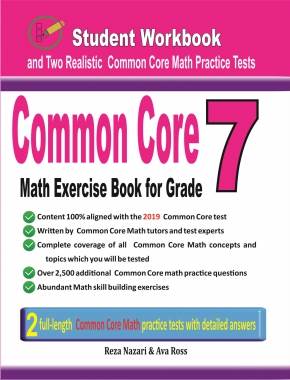
Common Core Math Exercise Book for Grade 7 Student Workbook and Two Realistic Common Core Math Tests
20 practice questions for 7th Grade FSA Math
Answer one question at a time. Press Submit to see right away whether you were correct, along with the worked solution. Your score appears after the last question, with a list of the ones to review.
The equation of a line in slope intercept form is: \(y = mx + b\)
Solve for \(y\).
\(4x-2y=12 ⇒ -2y=12-4x ⇒ y=(12-4x)÷(-2) ⇒ y=2x-6\)
The slope of this line is 2.
The product of the slopes of two perpendicular lines is\( -1\).
Therefore, the slope of a line that is perpendicular to this line is:
\(m_1 × m_2 = -1 ⇒ 2 × (m_2) = -1 ⇒ (m_2) = -\frac{1}{2}\)
Simplify: \(5(x-2y)+(2-x)^2 = (5x-10y)+(4-4x+x^2) = x -10y +4 +x^2\)
When \(x=3\) and \(y=-2\),therefore:
\(x -10y +4 +x^2 =3+20+4+9 =36\)
\(average (mean) = \frac{sum \space of \space terms }{number \space of \space terms}⇒ 88 = \frac{sum \space of \space terms}{50}⇒ sum = 88 × 50 = 4400\)
The difference of 94 and 69 is 25. Therefore, 25 should be subtracted from the sum.
\(4400 – 25 = 4375\)
\(mean =\frac{sum \space of \space terms}{number \space of \space terms}⇒ mean = \frac{4375 }{50}= 87.5\)
If the length of the box is 27, then the width of the box is one third of it, 9, and the height of the box is 3 (one third of the width). The volume of the box is:
\(V = lwh = (27) (9) (3) = 729\)
Add the first 5 numbers. \(40 + 45 + 50 + 35 + 55 = 225\)
To find the distance traveled in the next 5 hours, multiply the average by number of hours.
\(Distance = Average × Rate = 50 × 5 = 250\)
Add both numbers.
\(250 + 225 = 475\)
The ratio of boy to girls is 2:3. Therefore, there are 2 boys out of 5 students. To find the answer, first divide the total number of students by 5, then multiply the result by 2.
\(600 ÷ 5 = 120 ⇒ 120 × 2 = 240\)
The perimeter of the trapezoid is 54 cm.
Therefore, the missing side (high) is \(= 54 – 18 – 12 – 14 = 10\)
Area of a trapezoid:
\( A = \frac{1}{2}h (b_1 + b_2) = \frac{1}{2}(10) (12 + 14) = 130\)
Let \(x\) be the number of years. Therefore, $2,000 per year equals 2000\(x\).
starting from $24,000 annual salary means you should add that amount to 2000\(x\).
Income more than that is:
\(I > 2000x + 24000\)
Solve for \(x\).
\(-2≤2x-4<8 \)⇒ (add 4 all sides)\( -2+4≤2x-4+4<8+4 \)
\(⇒ 2≤2x<12 \)
⇒ (divide all sides by 2)\( 1≤x<6\)
\(x\) is between 1 and 6.
Let \(x\) be the number of new shoes the team can purchase. Therefore, the team can purchase 120 \(x\).
The team had $20,000 and spent $14000. Now the team can spend on new shoes $6000 at most.
Now, write the inequality:
\(120x+14.000 ≤20.000\)
For Sum 6: (1 & 5) and (5 & 1), (2 & 4) and (4 & 2), (3 & 3), so we have 5 options.
For sum 9: (3 & 6) and (6 & 3), (4 & 5) and (5 & 4), we have 4 options.
To get a sum of 6 or 9 for two dice: \(5+4=9\)
Since we have \(6 × 6 = 36\) total options, the probability of getting a sum of 6 and 9 is 9 out of 36 or \(\frac{1}{4}\).
Use formula of rectangle prism volume.
\(V = (length) (width) (height) ⇒ 2000 = (25) (10) (height)\)
\( ⇒ height = 2000 ÷ 250 = 8\)
For each option, choose a point in the solution part and check it on both inequalities.
A. Point \((–4, –4)\) is in the solution section. Let’s check the point in both inequalities.
\(-4 ≤ – 4 + 4, \space It \space works\)
\(2 (–4) + (–4) ≤ –4 ⇒ – 12 ≤ – 4\) it works (this point works in both)
B. Let’s choose this point \((0, 0)\)
\(0 ≤ 0 + 4, \space It \space works\)
\(2 (0) + (0) ≤ –4, \space \space That’s \space not \space true!\)
C. Let’s choose this point \((–5, 0)\)
\(0 ≤ -5 + 4, \space That’s \space not \space true!\)
D. Let’s choose this point \((0, 5)\)
\(5 ≤ 0 + 4, \space That’s \space not \space true!\)
Use simple interest formula:
I=prt
(I = interest, p = principal, r = rate, t = time)
\(I=(8000)(0.045)(5)=1800\)
The probability of choosing a Hearts is \(\frac{13}{52}=\frac{1}{4}\)
Use distance formula:
\(Distance = Rate × time ⇒ 420 = 50 × T\)
divide both sides by 50.
\(\frac{420}{50} = T ⇒ T = 8.4 \space hours\)
Change hours to minutes for the decimal part.
\(0.4 \space hours = 0.4 × 60 = 24 \space minutes\)
\(11 × 36 + 6 × 12 + 4 = 472\)
To find the discount, multiply the number by (\(100\% – \)Rate of discount).
Therefore, for the first discount we get:
\((200) (100\% – 15\%) = (200) (0.85) = 170\)
For the next \(15%\) discount: \((200) (0.85) (0.85)\)
Input \((-1, 3)\) in the \(2x + 4y = 10\) formula instead of \(x\) and y. So we have:
\( 2(-1) + 4(3) = 10\)
\(-2 + 12 = 10\)
Use PEMDAS (order of operation):
\(5 + 8 × (–2) – [4 + 22 ×5] ÷ 6 = 5 + 8 × (–2) – [4 + 110] ÷ 6 = 5 + 8 × (–2) – [114] ÷ 6 = 5 + (–16) – 19 = 5 + (–16) – 19 = –11 – 19 = –30\)
Quiz complete
Best 7th Grade FSA Math Workbook Resource for 2027
Answers and explanations
Every worked solution opens in the quiz box as soon as you submit that question, so you can compare your method with the solution while it is fresh. Press Try again on the last screen to work through the set a second time.
Looking for the best resource to help you succeed on the Grade 7 FSA Math test?
The Best Books to Ace the 7th Grade FSA Math Test
Recommended EffortlessMath Books
For more structured prep alongside this practice test, the Common Core Mathematics Workbook for Grade 7 walks through every Grade 7 math topic (most of which Florida's B.E.S.T. Standards also cover) with step-by-step worked examples. For practice with multi-step word problems, see the Mastering Grade 7 Math Word Problems.
Frequently Asked Questions
Is there a grade 7 FAST math practice test?
Yes. The Florida Department of Education publishes FAST sample test materials for grade 7 mathematics, which show the real question types and testing tools. Use them along with a paper practice set like this one. Review every miss: on the mean question, fixing one score from 94 to 69 lowers the total by 25, so the mean of 50 scores drops from 88 to 87.5.
Is there a grade 7 FAST math reference sheet?
Yes. Florida provides a grade 7 B.E.S.T. mathematics reference sheet with key formulas, such as area, volume and circle formulas, for use on the FAST. You can find it on the Florida Department of Education website. Have your seventh grader practice with it, for example using V = l × w × h to find that a 27 by 9 by 3 cm box holds 729 cm³.
What does a FAST 7 score mean?
A grade 7 FAST math score places your student in one of five achievement levels. Level 3 means on grade level, and Levels 4 and 5 mean above grade level. FAST is given three times a year (PM1, PM2 and PM3), and the spring PM3 counts as the end-of-year result, so the fall and winter scores mainly show growth.
What math should a 7th grader know?
A seventh grader should be comfortable with ratios, rates and percents, operations with negative numbers and fractions, writing and solving two-step equations, area, surface area and volume, and simple probability and statistics. In Florida these skills follow the B.E.S.T. standards tested on FAST. A quick check: can your child evaluate 5(x − 2y) + (2 − x)² for x = 3 and y = −2? The answer is 36.
Is seventh grade math hard?
Seventh grade math feels harder for many students because it adds negative numbers, proportional reasoning and multi-step equations all at once. It gets easier with steady practice and a solid grip on fractions and integers from grade 6. If FAST results show gaps, focus on one weak topic at a time instead of trying to fix everything before the next progress monitoring window.
How do you study for a 7th grade math test?
Start with a practice test to find weak topics, then spend most of your time on those. Redo missed problems without looking at the solution, and say each step out loud. Mix in short timed sets so test pace feels normal. For Florida students, finish by working through the FAST sample test materials so the format holds no surprises.
Related EffortlessMath Lessons
If a topic on this page feels rusty, these short lessons go deeper:
- Proportional ratios
- How to add and subtract integers
- How to solve one-step equations
- Percent of change (resource currently unavailable)
- How to find the volume of a prism

Related to This Article
More math articles
- 4th Grade M-STEP Math Worksheets: FREE & Printable
- How to Solve Theoretical Probability?
- 6th Grade KAP Math Worksheets: FREE & Printable
- How to Find Inverse of a Function? (+FREE Worksheet!)
- Top 10 3rd Grade MEAP Math Practice Questions
- Apportionment and reapportionment
- The Best Grade 5 Math Book for West Virginia Students
- 5th Grade PSSA Math Practice Test Questions
- Everything You Need to Know to Pass Algebra 1
- Necessary and Proper Clause


What people say about "Free 7th Grade FSA Math Practice Test"?
No one replied yet.