YOUR SAT STUDY COMPANION
SAT Math Formulas
TL;DR: The digital SAT Math section gives you a built-in formula reference panel for basic geometry, but everything else is on you. This page collects every formula worth knowing cold, slope, quadratic, exponent rules, percent change, statistics, and the circle equation.
TL;DR: The digital SAT Math section gives you a built-in formula reference panel for basic geometry, but everything else is on you. This page collects every formula worth knowing cold, slope, quadratic, exponent rules, percent change, statistics, and the circle equation.
Key takeaways:
- Digital SAT: two adaptive math modules, 22 questions each (~35 min per module).
- Built-in reference covers basic geometry (area, volume, Pythagorean, special right triangles).
- Slope, quadratic formula, percent change, exponent rules, and statistics are NOT on it.
- Desmos graphing calculator is built into every math question.
- Math score ranges from 200-800; 700+ usually puts you above the 90th percentile.
Comparing Numbers Signs
Equal to (=)
Less than ( <)
Greater than (>)
Greater than or equal (≥)
Less than or equal (≤)
Rounding
Putting a number up or down to the nearest whole number or the nearest hundred, etc.
Example: 64 rounded to the nearest ten is 60 because 64 is closer to 60 than to 70.
Whole Number
The numbers ( {0,1,2,3,…} )
Estimates
Find a number close to the exact answer.
Decimals
Is a fraction written in a special form? For example, instead of writing (frac{1}{2}) you can write (0.5).
Mixed Numbers
A number is composed of a whole number and a fraction. Example: (2 frac{2}{ 3}) Converting between improper fractions and mixed numbers: (a frac{c}{b}=a+frac{c}{b}= frac{ab+ c}{b})
Factoring Numbers
Factor a number means breaking it up into numbers that can be multiplied together to get the original number. Example:(12=2×2×3)
Divisibility Rules
Divisibility means that you are able to divide a number evenly. Example: 24 is divisible by 6, because (24÷6=4)
Greatest Common Factor
Multiply common prime factors
Example:( 200=2×2×2×5×5 60=2×2×3×5)
GCF ((200,60)=2×2×5=20)
Least Common Multiple
Check multiples of the largest number
Example: LCM (200, 60): 200 (no), 400 (no), 600 (yes!)
Integers
( {…,-3,-2,-1,0,1,2,3,…} )
Includes: zero, counting numbers, and the negative of the counting numbers
Real Numbers
All numbers that are on a number line. Integers plus fractions, decimals, and irrationals, etc.) ((sqrt{2},sqrt{3},π), etc.)
Order of Operations
PEMDAS
(parentheses/ exponents/ multiply/ divide/ add/ subtract)
Absolute Value
Refers to the distance of a number from, the distances are positive as the absolute value of a number cannot be negative. (|-22|=22)
or (|x| =begin{cases}x for x≥0 \x for x < 0end{cases} )
(|x|<n⇒-n<x<n)
(|x|>n⇒x<-n or x>n)
Ratios
A ratio is a comparison of two numbers by division.
Example: (3: 5), or (frac{3}{5})
Percentages
Use the following formula to find part, whole, or percent
part (=frac{percent}{100}×whole)
Proportional Ratios
A proportion means that two ratios are equal. It can be written in two ways:
(frac{a}{b}=frac{c}{d}), (a: b = c: d )
Percent of Change
(frac{New Value – Old Value}{Old Value}×100%)
Markup
Markup (=) selling price (-) cost
Markup rate (=) markup divided by the cost
Discount
Multiply the regular price by the rate of discount
Selling price (=) original price (-) discount
Expressions and Variables
A variable is a letter that represents unspecified numbers. One may use a variable in the same manner as all other numbers: Addition: (2+a): (2) plus a
Subtraction: (y-3): (y) minus (3)
Division: (frac{4}{x}): 4 divided by x
Multiplication: (5a): (5) times a
Tax
To find tax, multiply the tax rate by the taxable amount (income, property value, etc.)
Distributive Property
(a(b+c)=ab+ac)
Polynomial
(P(x)=a_{0} x^n+ a_{1} x^{n-1}+)⋯(+a_{n-2} x^2+a_{n-1} x+an)
Systems of Equations
Two or more equations working together.
example: ( begin{cases}-2x+2y=4\-2x+y=3end{cases} )
Equations
The values of the two mathematical expressions are equal.
(ax+b=c)
Functions
A function is a rule to go from one number (x) to another number (y), usually written (y=f(x)). For any given value of x, there can only be one corresponding value y. If (y=kx) for some number k (example: (f(x)= 0.5 x)), then y is said to be directly proportional to x. If y(=frac{k}{x }) (example: f(x (=frac{5}{x})), then y is said to be inversely proportional to x. The graph of (y=f(x )+k) is the translation of the graph of (y=f(x)) by ((h,k)) units in the plane. For example, (y=f(x+3)) shifts the graph of (f(x)) by 3 units to the left.
Inequalities
Says that two values are not equal
(a≠b) a not equal to b
(a<b) a less than b
(a>b) a greater than b
(a≥b) a greater than or equal b
(a≤b) a less than or equal b
Solving Systems of Equations by Elimination
Example: (cfrac{begin{align} x+2y =6 \ + -x+y=3 end{align}}{})
(cfrac{ begin{align} 3y=9 \ y=3 end{align} }{begin{align} x+6=6 \ ⇒ x=0 end{align}} )
Lines (Linear Functions)
Consider the line that goes through points (A(x_{1},y_{1}) ) and (B(x_{2},y_{2})).
Distance from A to B:
(sqrt{(x_{1}-x_{2})^2+(y_{1}-y_{2})^2 })
Parallel and Perpendicular lines:
Have equal slopes. Perpendicular lines (i.e., those that make a (90^° ) angle where they intersect) have negative reciprocal slopes: (m_{1}).(m_{2}=-1).
Parallel Lines (l (parallel) m)
Mid-point of the segment AB:
M ((frac{x_{1}+x_{2}}{2}, frac{y_{1}+y_{2}}{2}))
Slope of the line:
(frac{y_{2}- y_{1}}{x_{2} – x_{1} }=frac{rise}{run})
Point-slope form:
Given the slope m and a point ((x_{1},y_{1})) on the line, the equation of the line is
((y-y_{1})=m (x-x_{1})).
Intersecting lines:
Opposite angles are equal. Also, each pair of angles along the same line add to (180^°). In the figure above, (a+b=180^°).
Slope-intercept form:
given the slope m and the y-intercept b, then the equation of the line is:
(y=mx+b).
Transversal: Parallel lines:
Eight angles are formed when a line crosses two parallel lines. The four big angles (a) are equal, and the four small angles (b) are equal.
Parabolas:
A parabola parallel to the y-axis is given by (y=ax^2+bx+c).
If (a>0), the parabola opens up.
If (a<0), the parabola opens down. The y-intercept is c, and the x-coordinate of the vertex is: (x=-frac{b}{2a}).
Factoring:
“FOIL”
((x+a)(x+b))
(=x^2+(b+a)x +ab) “Difference of Squares”
(a^2-b^2= (a+b)(a-b))
(a^2+2ab+b^2=(a+b)(a+b) )
(a^2-2ab+b^2=(a-b)(a-b)) “Reverse FOIL”
(x^2+(b+a)x+ab=) ((x+a)(x+b))
You can use Reverse FOIL to factor a polynomial by thinking about two numbers a and b which add to the number in front of the x, and which multiply to give the constant. For example, to factor (x^2+5x+6), the numbers add to 5 and multiply to 6, i.e.: (a=2) and (b=3), so that (x^2+5x+6=(x+2)(x+3)). To solve a quadratic such as (x^2+bx+c=0), first factor the left side to get ((x+a)(x+b)=0), then set each part in parentheses equal to zero. For example, (x^2+4x+3= (x+3)(x+1)=0) so that (x=-3) or (x=-1).
To solve two linear equations in x and y: use the first equation to substitute for a variable in the second. E.g., suppose (x+y=3) and (4x-y=2). The first equation gives y=3-x, so the second equation becomes (4x-(3-x)=2 ⇒ 5x-3=2) (⇒ x=1,y=2).
Exponents:
Refers to the number of times a number is multiplied by itself.
(8 = 2 × 2 × 2 = 2^3)
Scientific Notation:
It is a way of expressing numbers that are too big or too small to be conveniently written in decimal form.
In scientific notation all numbers are written in this form: (m times 10^n)
Decimal notation:
5
(-25,000)
0.5
2,122.456
Scientific notation:
(5×10^0)
(-2.5×10^4)
(5×10^{-1})
(2,122456×10^3)
Square:
The number we get after multiplying an integer (not a fraction) by itself. Example: (2×2=4,2^2=4)
Square Roots:
A square root of (x) is a number r whose square is (x: r^2=x)
(r) is a square root of (x)
Pythagorean Theorem:
For any right triangle with legs (a) and (b) and hypotenuse (c): (a^2+b^2=c^2)
Solving for the hypotenuse: (c=sqrt{a^2+b^2})
Solving for a leg: (a=sqrt{c^2-b^2})
Common Pythagorean triples: (3,4,5); (5,12,13); (8,15,17); (7,24,25)
Triangles
Area: (A=frac{1}{2}bh) where (b) is the base and (h) is the height.
Perimeter: (P=a+b+c) (sum of all three sides).
Pythagorean Theorem (right triangles): (a^2+b^2=c^2) where (c) is the hypotenuse.
Sum of interior angles: (180°)
Right triangles:
A right triangle has one (90°) angle. The two sides forming the right angle are the legs; the longest side (opposite the right angle) is the hypotenuse.
Pythagorean Theorem: (a^2+b^2=c^2)
Area: (A=frac{1}{2},a,b) (where (a) and (b) are the two legs)
The two non-right angles are complementary (they add to (90°)).
All triangles:
Area (=frac{1}{2}) b. H
Angles on the inside of any triangle add up to (180^circ).
The length of one side of any triangle is always less than the sum and more than the difference between the lengths of the other two sides.
An exterior angle of any triangle is equal to the sum of the two remote interior angles. Other important triangles:
Equilateral:
These triangles have three equal sides, and all three angles are (60^circ).
Isosceles:
An isosceles triangle has two equal sides. The “base” angles (the ones opposite the two sides) are equal (see the (45^circ) triangle above).

Similar:
Two or more triangles are similar if they have the same shape. The corresponding angles are equal, and the corresponding sides are in proportion. For example, the (3-4-5) triangle and the (6-8-10) triangle from before are similar since their sides are in a ratio of to.
Circles
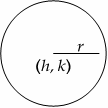
Area (=πr^2)
Circumference (=2πr)
Full circle (=360^circ)
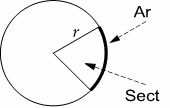
Length Of Arc (=(n^circ/360^circ).2πr)
Area Of Sector (=(n^circ/360^circ).πr^2)
Equation of the circle (above left figure): ((x-h)^2+(y-k)^2=r^2).
Rectangles
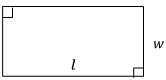
(Square if l=w)
Area=lw
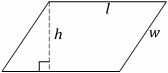
Parallelogram
(Rhombus if l=w)
Area=lh
Regular polygons are n-sided figures with all sides equal and all angles equal.
The sum of the inside angles of an n-sided regular polygon is
((n-2).180^circ).
Area of a parallelogram:
(A = bh)
Area of a trapezoid:
(A =frac{1}{2} h (b_{1}+b_{2}))
Surface Area and Volume of a Rectangular/right prism:
(SA=ph+2B)
(V=Bh)
Surface Area and Volume of a Cylinder:
(SA =2πrh+2πr^2)
(V =πr^2 h )
Surface Area and Volume of a Pyramid
(SA=frac{1}{2} ps+b)
(V=frac{1}{3} bh)
Surface Area and Volume of a Cone
(SA =πrs+πr^2)
(V=frac{1}{3} πr^2 h)
Surface Area and Volume of a Sphere
(SA =4πr^2)
(V =frac{4}{3} πr^3)
(p (=) perimeter of base B; (π ~ 3.14 ))
Solids
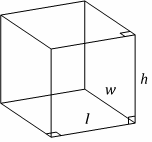
Rectangular Solid
Volume =lwh
Area =2(lw+wh+lh)
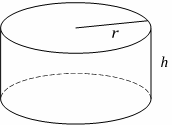
Right Cylinder
Volume (=πr^2 h)
Area (=2πr(r+h))
Quadratic formula:
( x=frac{-b±sqrt{b^2-4ac}}{2a})
Simple interest:
(I=prt)
(I = interest, p = principal, r = rate, t = time)
mean:
mean: (frac{sum of the data}{of data entires})
mode:
value in the list that appears most often
range:
largest value (-) smallest value
Median
The middle value in the list (which must be sorted)
Example: median of
( {3,10,9,27,50} = 10)
Example: median of
( {3,9,10,27}=frac{(9+10)}{2}=9.5 )
Sum
average (×) (number of terms)
Average
( frac{sum of terms}{number of terms})
Average speed
(frac{total distance}{total time})
Probability
(frac{number of desired outcomes}{number of total outcomes})
The probability of two different events A and B both happening are:
P(A and B)=p(A).p(B)
as long as the events are independent (not mutually exclusive).
Powers, Exponents, Roots
(x^a.x^b=x^{a+b})
(frac{x^a}{x^b} = x^{a-b})
(frac{1}{x^b }= x^{-b})
((x^a)^b=x^{a.b})
((xy)^a= x^a.y^a)
(x^0=1)
(sqrt{xy}=sqrt{x}.sqrt{y})
((-1)^n=-1), if n is odd.
((-1)^n=+1), if n is even.
If (0<x<1), then
(0<x^3<x^2<x<sqrt{x}<sqrt{3x}<1).
Interest
Simple Interest: (I=Prt)
where (P) = principal, (r) = annual interest rate (as a decimal), (t) = time in years.
Total amount: (A=P+I=P(1+rt))
Compound Interest: (A=P(1+frac{r}{n})^{nt}) where (n) is the number of times interest is compounded per year.
Simple Interest
The charge for borrowing money or the return for lending it.
Interest = principal (×) rate (×) time
OR
(I=prt)
Compound Interest
Interest computed on the accumulated unpaid interest as well as on the original principal.
A (=P(1+r)^t)
A= amount at end of time
P= principal (starting amount)
r= interest rate (change to a decimal i.e. (50%=0.50))
t= number of years invested
Powers/ Exponents
(x^a×x^b=x^{a+b})
(frac{x^a}{x^b}=x^{a-b})
((x^a)^b=x^{ab})
(x^0=1)
(x^{-a}=frac{1}{x^a})
(x^{frac{1}{n}}=sqrt[n]{x})
Positive Exponents
An exponent is simply shorthand for multiplying that number of identical factors. So (4^3) is the same as (4)(4)(4), three identical factors of 4. And (x^3) is just three factors of x, ((x)(x)(x)).
Negative Exponents
A negative exponent means to divide by that number of factors instead of multiplying.
So (4^{-3}) is the same as ( frac{1}{4^3}) and
(x^{-3}=frac{1}{x^3})
Factorials
Factorial- the product of a number and all counting numbers below it.
8 factorial (=8!=)
(8×7×6×5×4×3×2×1=40,320)
5 factorial (=5!=)
(5×4×3×2×1=120)
2 factorial (=2!=2× 1=2)
Multiplying Two Powers of the SAME Base
When the bases are the same, you find the new power by just adding the exponents
(x^a.x^b=x^{a+b })
Powers of Powers
For power of a power: you multiply the exponents.
((x^a)^b=x^{(ab)})
Dividing Powers
(frac{x^a}{x^b} =x^a x^{-b}= x^{a-b})
The Zero Exponent
Anything to the 0 power is 1.
(x^0= 1)
Permutation:
When different orderings of the same items are counted separately, we have a permutation problem:
(_{n}p_{r}=frac{n!}{(n-1)!})
Combination:
The fundamental counting principle, as demonstrated above, is used any time the order of the outcomes is important. When selecting objects from a group where order is NOT important, we use the formula for COMBINATIONS:
The fundamental counting principle, as demonstrated above, is used any time the order of the outcomes is important. When selecting objects from a group where order is NOT important, we use the formula for COMBINATIONS:
(_{n}C_{r}=frac{n!}{r!(n-1)!})
The Six Trig Ratios
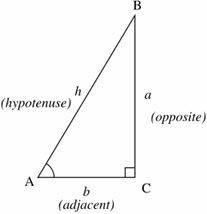
Values for the common angles
sin ((theta)=frac{opp.}{hip.}) csc ((theta)=frac{hip.}{opp})
cos ((theta)=frac{adj}{hip.}) sec((theta)=frac{hip}{adj})
tan ((theta)=frac{opp.}{adj.}) cot((theta)=frac{adj}{opp.})
Trig Functions relationships:
Tan ((x)=frac{sin(x)}{cos(x)})
Csc ((x)=frac{1}{sin(x)})
Sec ((x)=frac{1}{cos(x)})
Cot ((x)=frac{cos(x)}{sin(x)}=frac{1}{Tan(x)})
College Entrance Tests

The Best Books to Ace the SAT Math Test
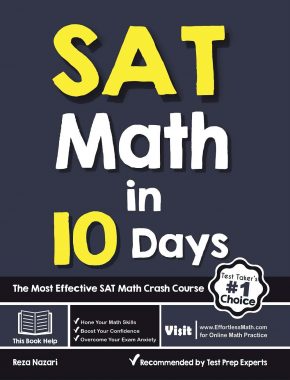
Recommended EffortlessMath Books
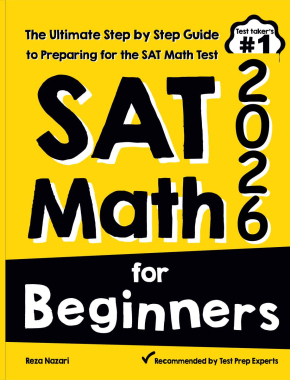
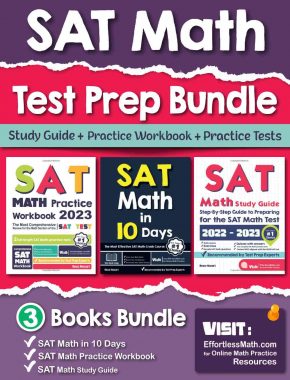
For a workbook that walks through every formula on this page, the SAT Math for Beginners (resource currently unavailable) pairs each topic with worked examples and practice sets. For full digital SAT prep with multiple full-length practice tests, see the SAT Math Test Prep Bundle.
Frequently Asked Questions
Does the SAT give you math formulas?
Yes, partly. The digital SAT has a built-in reference sheet you can open during both math modules. It covers basic geometry, such as circle, rectangle and triangle area, the Pythagorean theorem, special right triangles, and the volume of common solids. It does not include algebra or statistics formulas like slope or the quadratic formula, so you still need those from memory.
What math formulas are given on the SAT?
The SAT reference sheet includes circle area A = πr² and circumference C = 2πr, rectangle and triangle area, the Pythagorean theorem, the 30-60-90 and 45-45-90 triangle ratios, and volume formulas for a rectangular box, cylinder, sphere, cone and pyramid. It also reminds you that a circle has 360° (2π radians) and that a triangle’s angles add up to 180°.
What SAT math formulas are not given and need to be memorized?
Memorize slope, slope-intercept and point-slope form, the quadratic formula and discriminant, vertex form, exponent rules, percent change, mean and median, simple probability, and the circle equation (x − h)² + (y − k)² = r². For example, the circle (x − 2)² + (y + 1)² = 9 has center (2, −1) and radius 3, which the reference sheet will not tell you.
Is there an SAT math formulas cheat sheet PDF?
Yes. Effortless Math’s SAT formula list can be printed or saved as a PDF to study from, and the SAT PSAT Math flashcards are handy for quick review. Build your sheet around what the built-in reference leaves out, like slope, percent change and the circle equation, since those are the ones you have to recall on your own.
What is the best way to remember SAT math formulas?
Practice using each formula rather than rereading it. Cover your list, write the formulas from memory, and fix what you miss. Because the Desmos graphing calculator is built into the digital SAT, also learn when graphing is faster than a formula. Graphing y = x² − 4x − 5, for example, shows the roots x = −1 and x = 5 right away.
Related EffortlessMath Lessons
If a topic on this page feels rusty, these short lessons go deeper:
- Free SAT Math practice test
- How to find the slope of a line
- How to use the quadratic formula
- How to use the Pythagorean theorem
- Rules of exponents
Official source: what the SAT covers, how it is structured and how it is scored are published by the College Board, which writes and administers the test, at satsuite.collegeboard.org.

Related to This Article
More math articles
- Direct Substitution in Limits: Everything you need to know
- The Best Grade 3 ELA Practice Tests for North Dakota Students
- Merit system
- Scarcity, Opportunity Cost, and the Production Possibilities Frontier
- 6th Grade MEAP Math Practice Test Questions
- An In-depth Exploration of How to Find the Codomain
- Campaign contributions
- How to Add and Subtract Radical Expressions? (+FREE Worksheet!)
- The Best Grade 6 ELA Practice Tests for California Students
- Natural Hazards and the Age of Earth








What people say about "SAT Math Formulas Cheat Sheet"?
No one replied yet.