YOUR ASVAB Math STUDY COMPANION
ASVAB Math Cheat Sheet: Every Formula You Need to Know
TL;DR: Walking into the ASVAB Math subtests, Arithmetic Reasoning (AR) and Mathematics Knowledge (MK), means walking in armed. The test gives you no formula sheet and no calculator, so every formula you need has to be in your head before test day. This cheat…
TL;DR: Walking into the ASVAB Math subtests, Arithmetic Reasoning (AR) and Mathematics Knowledge (MK), means walking in armed. The test gives you no formula sheet and no calculator, so every formula you need has to be in your head before test day. This cheat sheet rounds up exactly those formulas in one place so you can drill them, quiz yourself on them, and walk into the testing center confident that nothing on the page will catch you blank.
Key takeaways:
- ASVAB Math = Arithmetic Reasoning (AR) + Mathematics Knowledge (MK) subtests.
- AR and MK are two of the four AFQT subtests that determine enlistment eligibility.
- No calculator allowed on any ASVAB subtest; no formula reference sheet.
- Memorize area, volume, slope, the Pythagorean theorem, percent change, and exponent rules.
- AR focuses on word problems; MK focuses on direct algebra and geometry.
The ASVAB has two math subtests, Arithmetic Reasoning (AR) and Math Knowledge (MK), and your scores on these directly affect which military jobs you qualify for. Here’s the complete cheat sheet plus a smart prep plan.
Arithmetic & number sense
- \(a % text{ of } b = dfrac{a}{100} times b\)
- Percent change = \(dfrac{text{new}-text{old}}{text{old}} times 100%\)
- Simple interest: (I = Prt)
- Distance, rate, time: (d = rt)
- Average: \(dfrac{text{sum}}{text{count}}\)
- Mean × count = sum (useful for “average” word problems)
Algebra
- Slope: \(m = dfrac{y_2 – y_1}{x_2 – x_1}\)
- Slope-intercept: (y = mx + b)
- Quadratic formula: \(x = dfrac{-b pm sqrt{b^2 – 4ac}}{2a}\)
- Distance between two points: \(d = sqrt{(x_2-x_1)^2 + (y_2-y_1)^2}\)
- Midpoint: \(left(dfrac{x_1+x_2}{2}, dfrac{y_1+y_2}{2}right)\)
Geometry
- Pythagorean theorem: (a^2 + b^2 = c^2)
- Area of a rectangle: (A = lw)
- Area of a triangle: \(A = tfrac{1}{2}bh\)
- Area of a circle: \(A = pi r^2\)
- Circumference of a circle: \(C = 2pi r\)
- Volume of a rectangular prism: (V = lwh)
- Volume of a cylinder: \(V = pi r^2 h\)
- Volume of a sphere: \(V = tfrac{4}{3}pi r^3\)
- Volume of a cone: \(V = tfrac{1}{3}pi r^2 h\)
- Sum of angles in a triangle: 180°
- Sum of angles in a quadrilateral: 360°
Probability & statistics
- \(P(text{event}) = dfrac{text{favorable outcomes}}{text{total outcomes}}\)
- Independent events: \(P(A text{ and } B) = P(A) cdot P(B)\)
- Mutually exclusive: \(P(A text{ or } B) = P(A) + P(B)\)
Common Pythagorean triples (memorize)
3-4-5, 5-12-13, 8-15-17, 7-24-25.
Pacing tips
- AR: 16 questions / 39 min on the CAT (computerized), ~2.5 min per question. Slow down on word problems.
- MK: 16 questions / 20 min, ~1.25 min per question. Move quickly; these are formula-driven.
FAQ
Is a calculator allowed on the ASVAB?
No, all math is done by hand or in your head.
What’s a good ASVAB math score?
Each military branch sets its own minimum AFQT score (which depends partly on AR and MK). Most jobs require AFQT 50+; technical jobs often need 65+.
How is the ASVAB scored?
The AFQT composite score combines AR, MK, Paragraph Comprehension, and Word Knowledge into a percentile (1 to 99).
How long should I prep?
4 to 8 weeks of consistent practice is typical for a 10+ point AFQT increase.
Where can I get more practice?
Our ASVAB Math Practice Workbook (resource currently unavailable) has hundreds of practice problems with full solutions.
What’s the difference between AR and MK?
AR (Arithmetic Reasoning) is word problems. You have to set up the math from a story. MK (Math Knowledge) is direct math, plug into formulas, solve equations, manipulate algebraic expressions. Most students find MK faster but AR more brain-intensive.
Can I retake the ASVAB?
Yes. After your first attempt, you can retake after 1 month. After your second attempt, another month. After that, you must wait 6 months before retaking.
What is the AFQT, exactly?
The Armed Forces Qualification Test (AFQT) is a percentile composed from your AR, MK, Paragraph Comprehension, and Word Knowledge scores. It ranges 1 to 99 and is the most important number for enlistment eligibility.
Is the ASVAB computer-adaptive?
Yes, the CAT-ASVAB is the version taken at most MEPS (Military Entrance Processing Stations). The paper version (PiCAT, P&P) is sometimes given at Mobile Examination Test (MET) sites and is not adaptive.
How is the CAT-ASVAB different from a paper test?
On the CAT, you can’t skip a question or go back. Each question gets harder or easier based on your previous answer. This means early questions matter more. They set the difficulty curve.
Smart strategies for AR (the word-problem subtest)
AR is where most students lose points. Three habits that help:
- Read twice. Read once for the story, once for the math.
- Underline the question. Literally underline what you’re being asked to find.
- Write your variable on the page. “Let \(x =\) number of pounds of coffee.” Defining the variable forces you to commit to a structure.
Most AR questions reduce to: distance/rate/time, work rate, percent, mixture, or simple algebra word problems. Drill these 5 templates and you’ll see them everywhere.
Smart strategies for MK (the formula subtest)
MK rewards speed. Three habits:
- Memorize the cheat sheet above. No calculator means every formula has to be in your head.
- Master signed arithmetic. Almost every MK miss traces back to a sign error.
- Practice mental math. Get fast at doubling, halving, percent of, and common squares (up to 20² = 400).
A week of focused mental-math drills can add 5 to 10 AFQT points by itself.
A realistic 6-week ASVAB study plan
- Week 1: Diagnostic + weakness map.
- Week 2 to 3: Drill arithmetic, fractions, decimals, percents, and basic algebra.
- Week 4: Geometry, ratios, and probability formulas.
- Week 5: Two full-length timed practice tests.
- Week 6: Light review, last-minute formulas, sleep.
If you don’t have 6 weeks, prioritize Weeks 2 and 5. They give the highest score-per-hour return.
The geometry shortcuts you must memorize
Without a calculator, every second counts. These mental shortcuts pay off:
- Common right triangles: 3-4-5, 5-12-13, 8-15-17, 7-24-25. If you see two of the sides, you know the third.
- 45-45-90 triangle: legs equal, hypotenuse = leg × \(sqrt{2}\).
- 30-60-90 triangle: sides in ratio 1: \(sqrt{3}\): 2.
- Common Pythagorean triples make many “find the diagonal” problems instant.
Percent shortcuts
- 10% of a number: move the decimal one place left.
- 5% of a number: 10% then halve.
- 15%: 10% + 5%.
- 20%: double 10%.
- 25%: divide by 4.
- Percent change: (new − old) ÷ old × 100%.
Master these and you can do most ASVAB percent questions in under 15 seconds.
Common types of AR word problems
From our data, these 7 patterns cover ~80% of AR questions:
- Cost/quantity, “How much does \(x\) pounds cost at $y per pound?”
- Sale price, “Original $A\(, discounted \)p%$, what’s the sale price?”
- Mixture / averages, “Mix $a\( gallons at \)x%\( with \)b\( at \)y%\(..”
- Rate, distance, time, (d = rt) variations.
- Work, “A can do it in \)a\( hours, B in \)b$ hours, together?”
- Simple interest, (I = Prt).
- Ratio, “Boys to girls is 3:2; 25 total students; how many boys?”
Drill these and AR becomes pattern recognition.
MK, quick-recall topics
For Math Knowledge, you have to recognize the situation in under 5 seconds. Memorize:
- Exponent rules: \(x^a cdot x^b = x^{a+b}\); \((x^a)^b = x^{ab}\); \(x^{-a} = tfrac{1}{x^a}\).
- Simplifying radicals: \(sqrt{ab} = sqrt{a}sqrt{b}\).
- FOIL: ((a+b)(c+d) = ac + ad + bc + bd).
- Factoring difference of squares: (a^2 – b^2 = (a+b)(a-b)).
- Slope formula and slope-intercept form.
- Pythagorean theorem.
If any of these feel slow, drill them 20 minutes a day until they’re automatic.
A final word on test-day mindset
The ASVAB rewards calm pattern recognition more than raw mathematical talent. Students who treat it like a familiar pattern-matching exercise outperform students who treat it as a test of math genius. Take a deep breath, read each question once for the picture and once for the math, and trust your prep.
Extra study tips that move the needle
Most students don’t fail because the math is too hard. They fail because their practice habits are inefficient. Here are the habits that separate the students who improve fast from those who stall.
Practice with a timer. Untimed practice teaches you to eventually get the right answer; timed practice teaches you to get it in test conditions. Set a stopwatch every time you sit down. Aim for 90 seconds per question on most standardized tests.
Keep an error log. A simple spreadsheet with three columns, Problem, My answer, Correct answer, Why I missed it, is the single most powerful study tool ever invented. Review your error log weekly. The same mistakes show up again and again until you name them.
Mix topics every session. Doing 20 problems on the same topic feels productive, but spaced and interleaved practice, mixing topics, builds retrieval skills, which is what the test actually measures. Spend 70% of your time on mixed sets and only 30% on isolated drills.
Sleep on it. Memory consolidation happens during sleep. A 30-minute session the night before a quiz, followed by 7+ hours of sleep, beats a 3-hour cram session that ends at midnight. This is settled cognitive science.
Teach the topic out loud. If you can’t explain it, you don’t fully know it. Either record yourself, write a one-paragraph “how I’d teach this” explanation, or grab a friend to listen. Teaching exposes the gaps your problem sets hid.
When to ask for help
Spinning your wheels for more than 15 minutes on a single problem is a signal, not of failure, but of a missing piece of background. Stop, mark the problem, and either ask a teacher, post in our community, or watch a video on the relevant subtopic. Resuming after gaining the missing piece is much more efficient than guessing your way forward.
A quick self-assessment
Before you close this tab, answer these three questions honestly:
- What’s the one topic in this article you understood best?
- What’s the one topic that still feels fuzzy?
- What concrete next step (a worksheet, a practice test, a video) will you take in the next 48 hours?
Writing those answers down, even just in a notes app, has been shown to roughly double the chance you actually follow through. Treat the next 48 hours as a small, doable experiment, not a marathon. Your future test-day self will thank you.
The military uses a separate score from your sub-tests (called line scores or composite scores) to determine job (MOS, AFSC, Rate) eligibility. The math subtests (AR, MK) feed into many of these composites. A higher score doesn’t just help you qualify. It lets you choose among more jobs. So even after you pass, every additional point matters for picking the career you actually want.
Recommended EffortlessMath Books
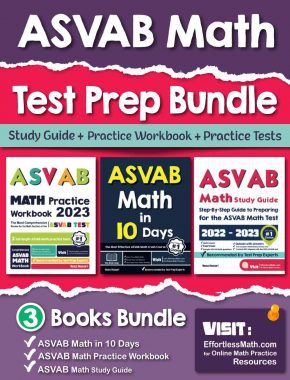
For a workbook that pairs with this cheat sheet, the ASVAB Math for Beginners (resource currently unavailable) walks through every AR and MK topic with worked examples. For complete enlistment-test prep with multiple full-length practice tests, see the ASVAB Math Test Prep Bundle.
Frequently Asked Questions
Does the ASVAB give you a formula sheet?
No. The ASVAB provides no formula reference on any subtest, including Arithmetic Reasoning and Mathematics Knowledge. You also can’t use a calculator. Every formula you need has to be in your head before you sit for the test.
What formulas should I memorize for the ASVAB?
Area of rectangle ((lw)), triangle ((frac{1}{2}bh)), circle ((pi r^2)). Volume of rectangular prism ((lwh)), cylinder ((pi r^2 h)). The Pythagorean theorem ((a^2+b^2=c^2)). Slope ((m=(y_2-y_1)/(x_2-x_1))). Percent change. The quadratic formula. Exponent rules. Distance and rate ((d=rt)).
What’s the difference between AR and MK?
Arithmetic Reasoning (AR) tests math through word problems, distance/rate/time, work rate, mixture, percent, ratio, and basic geometry in context. Mathematics Knowledge (MK) tests direct math, algebra mechanics, exponents, factoring, geometry formulas, and pure number sense. Two angles on the same skill set.
How do I calculate percent change?
Percent change (= frac{text{new}-text{old}}{text{old}}times 100). Positive result = increase; negative = decrease. Example: from 80 to 100 is ((100-80)/80times 100=25%) increase. From 90 to 72 is ((72-90)/90times 100=-20%) (a 20% decrease).
What’s the quadratic formula?
(x=frac{-bpmsqrt{b^2-4ac}}{2a}). Solves any equation of the form (ax^2+bx+c=0). The ASVAB rarely requires the full quadratic formula, most quadratics on the test factor cleanly, but having it memorized is your safety net.
What’s the distance-rate-time formula?
(d=rt), where (d) is distance, (r) is rate (speed), and (t) is time. Rearrangements: (r=d/t) and (t=d/r). The ASVAB Arithmetic Reasoning subtest leans heavily on word problems built around this formula and its work-rate cousin ((text{work}=text{rate}timestext{time})).
What exponent rules show up on the ASVAB?
Product: (x^acdot x^b=x^{a+b}). Quotient: (x^a/x^b=x^{a-b}). Power of a power: ((x^a)^b=x^{ab}). Zero exponent: (x^0=1). Negative exponent: (x^{-a}=1/x^a). The ASVAB keeps exponents at integer levels; fractional exponents are rare.
What’s the Pythagorean theorem?
(a^2+b^2=c^2), where (a) and (b) are the legs of a right triangle and (c) is the hypotenuse (opposite the right angle). Memorize common triples: 3-4-5, 5-12-13, 8-15-17, 7-24-25. Recognizing a triple lets you skip the square-root work entirely.
How does ASVAB Math affect the AFQT?
AR and MK are two of the four subtests that combine into the AFQT (Armed Forces Qualification Test) score. The other two are Word Knowledge and Paragraph Comprehension. AFQT cutoffs for enlistment vary by branch but generally start at 31 for the Army, 35 for the Navy, 31 for the Marines, and 36 for the Air Force.
How should I use this cheat sheet?
Print it as a single-page reference. Drill each formula on 5-10 practice problems until it comes back automatically. Then take a timed ASVAB Math practice test to confirm everything sticks under the no-calculator pressure. The ASVAB pace is tight, formula recall has to be reflex.
Related EffortlessMath Lessons
If a topic on this page feels rusty, these short lessons go deeper:
- Free ASVAB Math practice test
- How to find the slope of a line
- How to use the quadratic formula
- How to use the Pythagorean theorem
- Rules of exponents
Need more ASVAB Math practice?
Use the free ASVAB Math Worksheet Creator to make a fresh one-skill worksheet with answers and step-by-step explanations. It is a good next step after a lesson, a formula review, or a missed practice-test question.
Open the worksheet creatorOpen full page
For a complete study path: pair this printable practice with ASVAB Math for Beginners and ASVAB Math Preparation Bundle.
Official source: the content of each ASVAB subtest is described on the official ASVAB Enlistment Testing Program site at officialasvab.com.

Related to This Article
More math articles
- Free Grade 8 English Worksheets for New Hampshire Students
- 7th Grade NSCAS Math Worksheets: FREE & Printable
- 3rd Grade NYSE Math FREE Sample Practice Questions
- Top 10 Tips You MUST Know to Retake the SAT Math
- Reciprocals
- Sweepstakes Casino Wagering: How Many Spins Until Redemption
- Algebra Puzzle – Challenge 54
- Rhode Island Grade 2 Math Worksheets — Free Printable PDFs
- New Hampshire NH SAS Grade 4 Math Free Worksheets: Printable Standards-Aligned Practice with Answers
- 4th Grade MAP Math Practice Test Questions





What people say about "ASVAB Math Cheat Sheet: Formulas for AR and MK (Free)"?
No one replied yet.