YOUR CLEP STUDY COMPANION
CLEP U.S. History I 108: White Supremacist Violence and Federal Enforcement
Lesson 19.6 of Chapter 19 of the U.S. History to 1877 study guide on Effortless Math covers CLEP U.S. History I 108: White Supremacist Violence and Federal Enforcement: the key terms, the core ideas, and worked examples showing how this topic is tested on the…
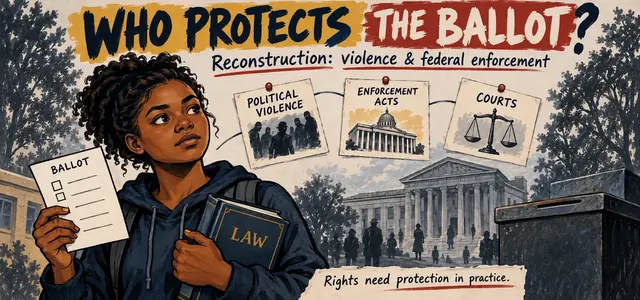
Lesson 19.6 of Chapter 19 of the U.S. History to 1877 study guide on Effortless Math covers CLEP U.S. History I 108: White Supremacist Violence and Federal Enforcement: the key terms, the core ideas, and worked examples showing how this topic is tested on the exam.
U.S. History to 1877 | Chapter 19 | Lesson 19.6
The Ku Klux Klan and other organizations used murder, whipping, sexual violence, arson, and intimidation to destroy Black voting, officeholding, schools, landownership, and Republican organization. Violence was political, not merely private prejudice. Events such as the Colfax massacre showed how armed groups could overturn election outcomes and local government.
Congress passed Enforcement Acts allowing federal prosecution and, under specified conditions, suspension of habeas corpus to suppress conspiracies. Federal action weakened the first Klan in some areas. Yet prosecutions depended on officials, juries, resources, and political will. Supreme Court decisions such as United States v. Cruikshank later narrowed federal reach by limiting how Reconstruction protections applied to private violence.
United States v. Cruikshank (1876) arose from federal prosecutions after the Colfax massacre. The Court treated the First and Second Amendments as restrictions on Congress, not sources of federal power against private attackers, and read the Fourteenth Amendment as prohibiting state action rather than purely private conduct. It also required an indictment under the Enforcement Act to allege a federal right and the legally necessary racial or federal nexus with precision. By voiding the convictions on those grounds, the decision made federal prosecution of private political terror far more difficult when state authorities failed or refused to protect victims. It did not hold that the massacre was lawful, repeal the Enforcement Acts, or erase all congressional power under the Fifteenth Amendment.
Watch the topic in context
Watch this account from The Civil War Nerds with one question in mind: which evidence makes the lesson's strongest claim hold up?
Video: What Were The Enforcement Acts Of The Reconstruction Era?, The Civil War Nerds.
Check your understanding
- Reconstruction-era paramilitary violence aimed most directly to
- expand state funding for interracial public schools.
- protect equal participation in elections and officeholding.
- destroy Black voting and Republican political organization.
- strengthen the Freedmen’s Bureau’s local authority.
- enforce federal civil-rights laws through local courts.
- The Enforcement Acts represented
- presidential restoration through individual pardons.
- congressional repeal of the Fourteenth Amendment.
- federal redistribution of plantations to freed families.
- withdrawal of federal troops from southern statehouses.
- federal intervention against conspiracies using political violence.
- Select all forms of political terror:
- murder,
- whipping,
- arson,
- intimidation,
- election disruption.
- Explain why calling this violence “private” can hide its public purpose.
Write a brief response using a named fact from the lesson.
Open the answers and reasoning
Independent preparation. CLEP is a registered trademark of the College Board, which does not endorse this lesson.

Related to This Article
More math articles
- 5th Grade DCAS Math Worksheets: FREE & Printable
- Divided government
- Cofunction Identities
- Math Courses Required For A Business Degree
- How to Graph Box Plot?
- FREE SIFT Math Practice Test
- How to Use Area Models to Factor Variable Expressions?
- Urinary System and Skin
- Do You Need to Pass the CBEST to be a Substitute Teacher?
- Reconstruction Amendments









What people say about "White Supremacist Violence and Federal Enforcement"?
No one replied yet.