YOUR CLEP STUDY COMPANION
CLEP U.S. History I 103: Presidential and Congressional Reconstruction
Lesson 19.1 of Chapter 19 of the U.S. History to 1877 study guide on Effortless Math covers CLEP U.S. History I 103: Presidential and Congressional Reconstruction: the key terms, the core ideas, and worked examples showing how this topic is tested on the exam.
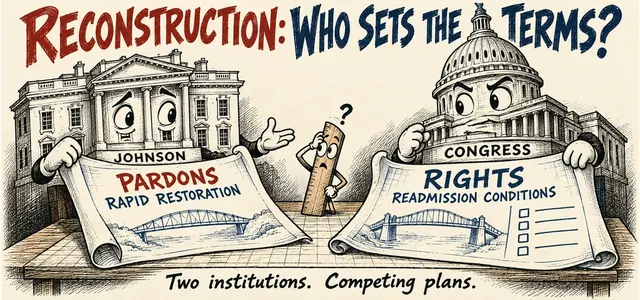
Lesson 19.1 of Chapter 19 of the U.S. History to 1877 study guide on Effortless Math covers CLEP U.S. History I 103: Presidential and Congressional Reconstruction: the key terms, the core ideas, and worked examples showing how this topic is tested on the exam.
U.S. History to 1877 | Chapter 19 | Lesson 19.1
Lincoln’s wartime plans emphasized quick restoration with a loyal minority, though his final position was still developing when he was assassinated. Andrew Johnson offered broad pardons and allowed southern states to reorganize with limited federal demands beyond ending slavery, repudiating Confederate debt, and renouncing secession. Those governments enacted Black Codes and elected prominent former Confederates, convincing many Republicans that restoration without stronger federal protection would preserve the old ruling class.
Congress refused to accept the process on Johnson’s terms. It investigated conditions, renewed the Freedmen’s Bureau, enacted the Civil Rights Act of 1866 over Johnson’s veto, proposed the Fourteenth Amendment, and passed Reconstruction Acts placing ten unreconstructed states under military administration. New conventions had to provide Black male suffrage, and readmission required constitutions and Fourteenth Amendment ratification. Tennessee had already been readmitted and was not placed in the five military districts.
The conflict also defined constitutional institutions. Johnson claimed executive authority over restoration and vetoed congressional civil-rights measures. Congressional Republicans used legislation, constitutional amendment, appropriations, investigation, and ultimately impeachment. Johnson’s impeachment involved the Tenure of Office Act but cannot be understood apart from the struggle over who would control Reconstruction. The Senate fell one vote short of conviction, leaving Johnson in office while congressional policy continued.
Watch, then test the claim
Watch this account from Ms. Sutton's History with one question in mind: which evidence makes the lesson's strongest claim hold up?
Video: U.S. History: Presidential and Congressional Reconstruction (c. 1865-1870), Ms. Sutton's History.
Check your understanding
- Johnson’s approach allowed
- immediate Black suffrage everywhere.
- rapid southern reorganization under broad pardons.
- permanent military rule.
- land redistribution to all freed families.
- Fourteenth Amendment ratification before any government formed.
- Congressional Reconstruction required the ten unreconstructed states to
- retain their Johnson-era governments after accepting only the Thirteenth Amendment.
- seek individual presidential pardons in place of holding new constitutional conventions.
- regain full congressional representation before Congress addressed national citizenship protections.
- create governments based on Black male suffrage and ratify the Fourteenth Amendment.
- repudiate Confederate debt while preserving their existing suffrage rules and officeholders.
- Select all congressional measures:
- Civil Rights Act,
- Fourteenth Amendment,
- Reconstruction Acts,
- Bureau renewal,
- Black Codes.
- Compare what presidential and congressional plans treated as necessary for restoration.
Write a brief response using a named fact from the lesson.
Open the answers and reasoning
Independent preparation. CLEP is a registered trademark of the College Board, which does not endorse this lesson.

Related to This Article
More math articles
- Supply, Demand, and Prices
- Calculations to Help Curb Your Rising Debt
- Top 10 TSI Math Test-taking Tips
- Legislative gridlock
- How to Use Area Models to Find Equivalent Fractions
- The Best Grade 7 Math Book for Pennsylvania Students
- Idaho ISAT Grade 7 Math Worksheets: 95 Free PDFs with Tutor-Style Answer Keys
- The Best Grade 4 ELA Practice Tests for Hawaii Students
- How to Solve Word Problems of Counting Bills and Coins
- Iron triangles and issue networks











What people say about "Presidential and Congressional Reconstruction"?
No one replied yet.