YOUR CLEP STUDY COMPANION
CLEP U.S. History I 105: Black Codes and the Civil Rights Act of 1866
Lesson 19.3 of Chapter 19 of the U.S. History to 1877 study guide on Effortless Math covers CLEP U.S. History I 105: Black Codes and the Civil Rights Act of 1866: the key terms, the core ideas, and worked examples showing how this topic is tested on the exam.
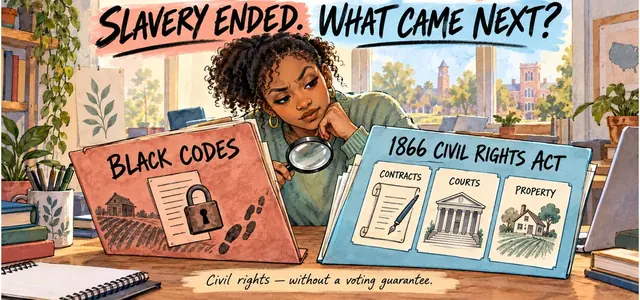
Lesson 19.3 of Chapter 19 of the U.S. History to 1877 study guide on Effortless Math covers CLEP U.S. History I 105: Black Codes and the Civil Rights Act of 1866: the key terms, the core ideas, and worked examples showing how this topic is tested on the exam.
U.S. History to 1877 | Chapter 19 | Lesson 19.3
Southern Black Codes recognized that slavery had ended while attempting to control Black labor, movement, contracts, and legal rights. Vagrancy provisions could punish unemployment and channel people into coerced labor. Apprenticeship laws could remove Black children. Restrictions differed by state, but together they showed why formal abolition did not guarantee civil freedom.
The Civil Rights Act of 1866 used the exact citizenship formula “all persons born in the United States and not subject to any foreign power, excluding Indians not taxed.” It then declared those persons citizens, without regard to race, color, or previous slavery. “Indians not taxed” was the statute’s historical legal phrase, not a statement that Native people generally lacked political identity. Congressional debate connected it to people maintaining tribal political relations and treated some Native individuals outside those relations differently. Native nations possessed their own citizenship and treaty relationships with the United States. General U.S. citizenship for all Native people did not arrive through this act. The Indian Citizenship Act of 1924 later extended U.S. citizenship broadly without terminating tribal citizenship.
The act protected an enumerated set of civil rights on the same basis as white citizens: making and enforcing contracts. Suing, being parties, and giving evidence. And inheriting, purchasing, leasing, selling, holding, and conveying property. It also promised equal benefit of laws for security of person and property and equal punishment. The statute did not itself guarantee voting or officeholding. Congress passed it over Johnson’s veto, then pursued the Fourteenth Amendment because constitutional text would be harder for a future Congress to repeal and could establish a firmer basis for federal protection against state denial.
A focused video lesson
Heimler's History traces the people and chronology behind this lesson. Listen for the evidence that sharpens the written account, then try the questions below.
Video: RECONSTRUCTION [APUSH Review Unit 5 Topic 10] Period 5: 1844-1877, Heimler's History.
Check your understanding
- Black Codes most directly attempted to
- establish equal state citizenship regardless of race.
- distribute confiscated plantation land among freed families.
- require integrated public schools throughout the South.
- preserve white control over Black labor and movement.
- protect Black voting in state and local elections.
- Congress moved toward an amendment partly to
- make citizenship depend on annual congressional reenactment.
- place citizenship and rights on firmer constitutional ground.
- return final civil-rights authority entirely to restored states.
- limit the 1866 act to people formerly enslaved.
- preserve Johnson’s ability to nullify civil-rights statutes by veto.
- Select all civil rights named in the 1866 act:
- contract,
- property,
- access to courts,
- testimony,
- guaranteed officeholding.
- Explain how a vagrancy law could coerce labor without using the word slavery.
Write a brief response using a named fact from the lesson.
Open the answers and reasoning
Independent preparation. CLEP is a registered trademark of the College Board, which does not endorse this lesson.

Related to This Article
More math articles
- Family Change, Cohabitation, Divorce, and the Second Shift
- How Government Institutions Shape Public Policy
- Direct Substitution in Limits: Everything you need to know
- 3rd Grade Mathematics Worksheets: FREE & Printable
- Utah RISE Grade 7 Math Worksheets: 95 Free Printable Single-Skill PDFs with Keys
- 7th Grade FSA Math Practice Test Questions
- How to Use a Protractor to Draw Angles
- Timing, Stamina, and Test Day
- Microorganisms and Disease
- Full-Length 7th Grade GMAS Math Practice Test





What people say about "Black Codes and the Civil Rights Act of 1866"?
No one replied yet.