YOUR CLEP STUDY COMPANION
CLEP U.S. History I 109: Sharecropping, Courts, Northern Retreat, and 1877
Lesson 19.7 of Chapter 19 of the U.S. History to 1877 study guide on Effortless Math covers CLEP U.S. History I 109: Sharecropping, Courts, Northern Retreat, and 1877: the key terms, the core ideas, and worked examples showing how this topic is tested on the…
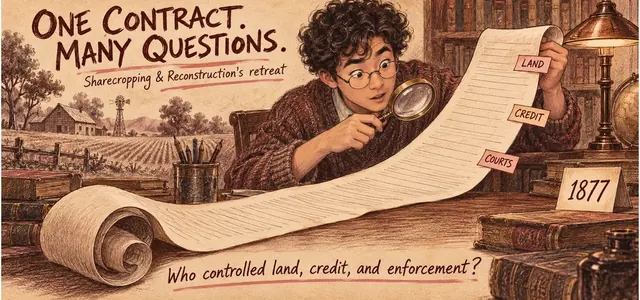
Lesson 19.7 of Chapter 19 of the U.S. History to 1877 study guide on Effortless Math covers CLEP U.S. History I 109: Sharecropping, Courts, Northern Retreat, and 1877: the key terms, the core ideas, and worked examples showing how this topic is tested on the exam.
U.S. History to 1877 | Chapter 19 | Lesson 19.7
Emancipation ended ownership of people but did not redistribute most southern land. Freedpeople sought family-controlled labor, subsistence plots, wages, or landownership. Planters sought a dependable labor force and restoration of commercial agriculture. Early contracts ranged from monthly wages to gang labor, rental, and shares. Over time, sharecropping became widespread: a family worked a plot and paid the owner with a stated portion of the crop. Compared with supervised gangs, the arrangement could give a household more control over pace and family labor. Yet ownership of land, animals, tools, gins, and access to markets left bargaining power unequal. Poor white farmers also entered tenancy, but racial violence and discriminatory law made Black farmers especially vulnerable.
“Sharecropping” did not name one uniform contract. Shares could differ by crop, whether land was already cleared, and which party supplied seed, animals, food, clothing, tools, fertilizer, or housing. A cash tenant who owned equipment and paid fixed rent had different risk and autonomy from a cropper supplied and supervised by a landlord. Written contracts show legal freedom to bargain but not necessarily equal ability to refuse terms. Local labor demand, kin networks, land quality, and Bureau presence changed the balance. Oral agreements and missing records limit generalization.
Credit connected labor to the cotton market. Because planting expenses came months before harvest, merchants advanced supplies and took a crop lien as security. Interest, inflated store prices, a poor harvest, low cotton prices, or disputed accounting could consume a family’s share. Debt carried into the next season reduced practical mobility even without legal ownership of the worker. Landlords also risked crop failure and uncertain labor, but they usually controlled the account and market connection. The mechanism was therefore a sequence: advance, lien, harvest, accounting, residual debt: not an automatic condition identical on every farm.
A focused video lesson
This ColumbiaLearn lesson supplies a second explanation of the same period. Note where chronology, cause, and perspective connect.
Video: MOOC | Retreat from Reconstruction | The Civil War and Reconstruction, 1865-1890 | 3.7.5, ColumbiaLearn.
Check your understanding
- Which inference is best supported by the Robinson-Couch contract table?
- The agreement assigned Couch the same fraction for every crop and field.
- Couch received a fixed monthly wage unrelated to the harvest.
- One season of clearing land transferred legal title to Couch.
- Crop shares varied with the field and labor described in the agreement.
- Federal law imposed these same terms on every farm in Georgia.
- Which development most directly followed resolution of the 1876 presidential dispute?
- Congress renewed a general program of plantation redistribution to freedpeople.
- Federal troops left statehouse support in the last Republican-led southern governments.
- The Supreme Court broadened federal prosecution of private political terror.
- Military supervision became a permanent feature of southern elections.
- Congress imposed another round of readmission requirements on former Confederate states.
- Select all forces in Reconstruction’s retreat:
- violence,
- depression,
- northern fatigue,
- court narrowing,
- Democratic recovery.
- Explain why 1877 was both an ending and not the erasure of Reconstruction.
Write a brief response using a named fact from the lesson.
Open the answers and reasoning
Independent preparation. CLEP is a registered trademark of the College Board, which does not endorse this lesson.

Related to This Article
More math articles
- Addition of 3-Digit Numbers
- Principal-agent problems and bureaucratic models
- Taft-Hartley, the Fair Deal, and the Election of 1948
- Protest rights
- Free Grade 3 English Worksheets for North Dakota Students
- Winner-take-all allocation
- Top 10 Tips to ACE the SSAT Math Test
- High-Volatility Slots: A Math Profile of Big-Swing Games
- Momentum, Work, and Power
- How Probability And Math Help Gamblers Win: The Science Behind Strategic Gaming

















What people say about "Sharecropping, the Courts and 1877"?
No one replied yet.