YOUR CLEP STUDY COMPANION
CLEP U.S. History I 104: Freedmen’s Bureau, Labor, Land, and Family
Lesson 19.2 of Chapter 19 of the U.S. History to 1877 study guide on Effortless Math covers CLEP U.S. History I 104: Freedmen's Bureau, Labor, Land, and Family: the key terms, the core ideas, and worked examples showing how this topic is tested on the exam.
Lesson 19.2 of Chapter 19 of the U.S. History to 1877 study guide on Effortless Math covers CLEP U.S. History I 104: Freedmen’s Bureau, Labor, Land, and Family: the key terms, the core ideas, and worked examples showing how this topic is tested on the exam.
U.S. History to 1877 | Chapter 19 | Lesson 19.2
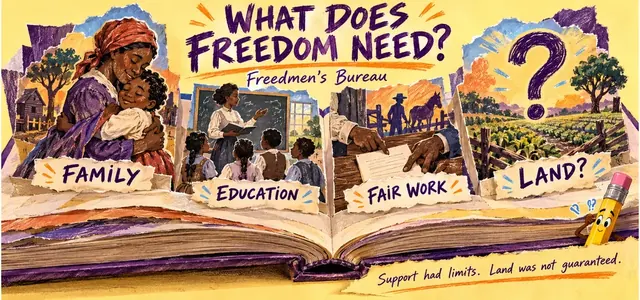
The Freedmen’s Bureau provided emergency relief, supported hospitals and schools, supervised some labor contracts, offered legal assistance, and helped families locate relatives. Its resources and lifespan were limited, and local agents differed. Freedpeople placed enormous value on family reunification, independent churches, education, movement, fair contracts, and control over work time. Many also sought land, understanding economic independence as protection against coerced labor.
The wartime promise associated with “forty acres and a mule” arose from Special Field Order No. 15 and related settlement in parts of the coastal South, not a national guarantee to every freed family. Johnson restored much abandoned and confiscated land to pardoned owners. Without broad land redistribution, many families negotiated wage contracts, rented land, or entered sharecropping under unequal conditions.
Family autonomy connected civil and economic freedom. Formerly enslaved people legalized marriages, searched for children and spouses separated by sale, withdrew women and children from coerced field labor when possible, and built schools and churches. Employers often treated mobility or family labor choices as breach of contract. Bureau records therefore document relief administration but competing definitions of labor discipline, household authority, and the meaning of freedom.
[.78 ] images/bank-selected/freedmens-bureau-richmond.jpg Education as a freedpeople’s institution James E. Taylor, “The Misses Cooke’s School Room, Freedman’s Bureau, Richmond, Virginia,” published in Frank Leslie’s Illustrated Newspaper, November 17, 1866. The engraving documents how a northern illustrated newspaper represented a Bureau-supported school. It does not by itself measure enrollment, classroom conditions, or educational access across the South.
Watch the topic in context
This The Daily Bellringer lesson supplies a second explanation of the same period. Note where chronology, cause, and perspective connect.
Video: Freedmen's Bureau, Sharecropping and Black Codes | Reconstruction | DAILY BELLRINGER, The Daily Bellringer.
Check your understanding
- Which activity fell within the Freedmen’s Bureau’s mission?
- Granting plantation land permanently to each freed family.
- Administering pensions for former Confederate officers and soldiers.
- Supporting schools and supervising some labor contracts.
- Replacing elected southern legislatures with Bureau commissioners.
- Directing crop production on privately owned southern farms.
- Why did freedpeople place such importance on access to land?
- Land ownership supplied national citizenship without federal legislation.
- A farm guaranteed equal access to voting and public office.
- Property restored the labor obligations imposed under slavery.
- Independent farming reduced the need for schools and churches.
- Land could reduce dependence on former enslavers for work and subsistence.
- Select all freedpeople’s priorities:
- family reunification,
- education,
- churches,
- mobility,
- fair labor.
- Explain why a signed labor contract does not alone prove equal freedom.
Write a brief response using a named fact from the lesson.
Open the answers and reasoning
Independent preparation. CLEP is a registered trademark of the College Board, which does not endorse this lesson.

Related to This Article
More math articles
- Classifying a Conic Section (in Standard Form)
- How to Identify the Change, Price, or Amount Paid
- How to Use Area Models to Add Fractions with Like Denominators
- 4th Grade MCAP Math Worksheets: FREE & Printable
- Maintenance, Alarms, Feed Lines, Drains, and Outlets
- Full-Length SAT Math Practice Test
- How to Use Properties of Numbers to Write Equivalent Expressions?
- The Best Algebra 1 Book for Self-Study and Homeschoolers
- Quotient Quest: How to Master Division with Decimal Results
- Triangle Inequality









What people say about "The Freedmen's Bureau, Labor and Land"?
No one replied yet.